Pressure rarely arrives as a feeling about the task. It arrives as a feeling about who you are while doing the task. A presentation is just slides. An exam is just questions. A difficult conversation is just words. But the moment it matters, your brain starts running a story about what the outcome says about you. That story is the pressure. And it is the thing you need to get out of the way before you perform.
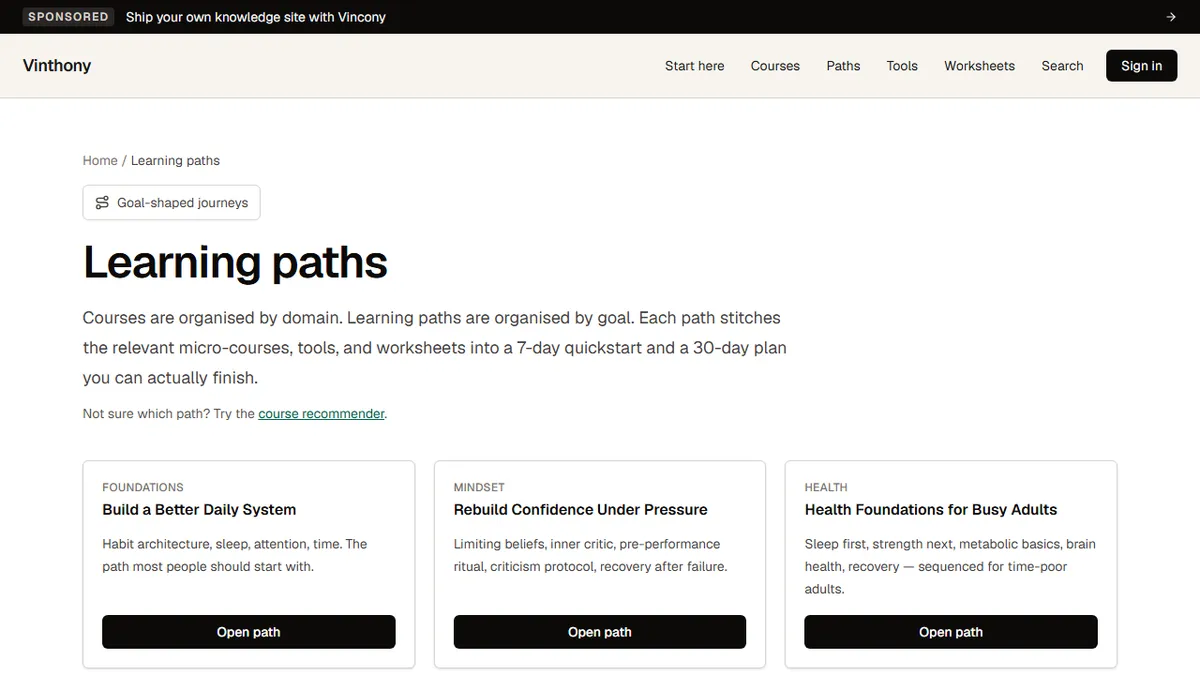
Veteran performers across comedy, elite sport, and high-stakes business describe the same trap: the bigger the room, the louder the inner story about who you have to be to deserve it. The free lesson on designing a pre-performance state shift inside the learning paths at Vinthony makes the same point: pressure lives in identity-mode, and the way out is process-mode. The ritual below takes twelve minutes, uses only inputs you control, and is built to compress your attention until the only thing in the room is the next breath, the next note, the next rep.
The Problem Is Identity, Not the Task
You are not nervous about the slides. You are nervous about what the slides say about you. You are afraid of being revealed as someone who does not belong there, not of the interview itself. The ritual is designed to move you from identity-mode into process-mode, not to pump you up. Identity-mode asks, "Will this prove I am enough?" Process-mode asks, "What is the next clean action?" The first question produces anxiety. The second produces movement. You cannot think your way out of the first question, but you can build a ritual that drops you into the second one.
Why Twelve Minutes
Twelve minutes is enough to run three to five repeatable steps and short enough to run in any venue. A forty-five-minute routine is fragile. It breaks the moment you are backstage, in a car, or standing outside a meeting room. A twelve-minute ritual can be executed anywhere because it is built from inputs you control: breath, posture, attention, and music. The steps below are designed to total twelve minutes. You do not need to feel confident to run them. You do not need to believe they will work. You run them whether you feel like it or not. After enough reps, the ritual itself becomes the cue. Your brain learns that when these steps fire, identity goes in the box and the practitioner shows up.
Step One: Name the Sentence Under the Pressure
Take two minutes and write down the sentence that pressure is running. Ask yourself: what would I have to be true about me for this moment to be dangerous? Listen for the claim underneath the excuse. The shortlist is almost always the same: I am not enough, I do not matter, I am different, nothing will ever work for me. You are not trying to argue with the sentence. You are trying to catch it in the act. Saying it in one plain sentence cuts its power because it stops being weather and starts being something you can examine. Naming is not curing, but nothing changes until you can point at the thing. If you want a structured place to do this, the inner-critic worksheet walks through the same interrogation in writing.
Step Two: Move from Identity to Process
Take three minutes and define the next clean action. Not "give a great talk." Not "ace the interview." Something you can actually do in the next sixty seconds: place both feet flat, breathe out, read the first line, pick up the pen. Process-mode has no then, no before, no after. When you are fully in the now, there are no consequences to attach to, and therefore no pressure to feel. The moment you can articulate consequences mid-performance, you are not in the now yet. Shorten your attention to the next action and write that action down in one line.
Step Three: Anchor with a Sensory Cue
Take three minutes and run a sensory anchor. A fixed walk to the start line. A specific song. A physical gesture. A private superstition. Sensory anchors work because they bypass thinking. They do not require you to reason your way into calm. They signal to your nervous system that it is safe to release the grip. Choose one anchor you can repeat in any venue. Two slow exhales longer than your inhales. Roll your shoulders back. Press your feet into the floor. The content matters less than the repetition. The anchor is not a mood. It is a piece of engineering. Run it the same way every time, and it becomes the trigger that tells your brain the performance is about to start.
Step Four: Use a Physical Interrupt
Take two minutes and change your physical state. A shake-out. A cold splash of water. A change of posture. When thinking your way out of a spiral fails, a short physical interrupt resets the nervous system first. This is not about burning off adrenaline. It is about telling your body that the fight is not happening yet. Your body leads and your mind follows. If you are stuck in a loop of rehearsing worst-case outcomes, stop trying to think more clearly. Stand up, change your breathing, move your body for two minutes. The loop cannot survive the interrupt.
Step Five: Close with a Single Instruction
Take two minutes and close with one instruction to yourself. Second person, present tense: "You are going to breathe, then speak the first line." Or: "You are going to place your hands, then begin." One instruction, not three. The brain cannot hold a checklist under pressure. It can hold a single next action. This is the difference between a ritual and a to-do list. A to-do list keeps you in your head. A single instruction drops you into the moment where the work actually happens.
Why the Ritual Becomes the Cue
Run the ritual on low-stakes days so it becomes a trained cue, not an emergency tool. Run it before a practice session, before a small meeting, before a workout. The more often you fire the sequence, the more reliably it works when the stakes are real. Treat the ritual like engineering, not mood. You are not waiting to feel ready. You are running a repeatable sequence that compresses your attention until the only thing left is the next action. If you miss a step, do not restart. Land on the single instruction and move forward. The twelve minutes are about making sure nervousness does not get to write the story, not about eliminating it. The story is already written. You named it, you moved past it, and you anchored your body to the present. Now you can perform. If you want the exact sequence spelled out with a timer and a worksheet, start with the free lesson and run it once before something that does not matter. That is how you build the cue before you need it.