What BPC-157 Is and Where It Comes From
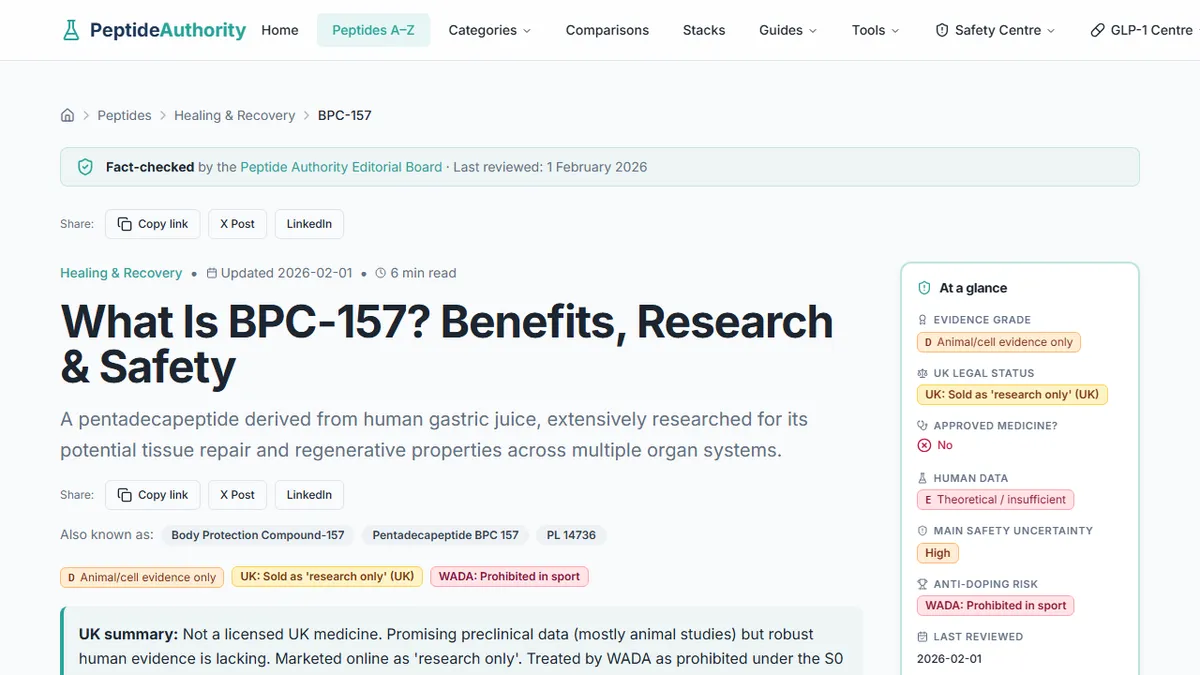
BPC-157 is a synthetic pentadecapeptide (a chain of fifteen amino acids) that was derived from a protein fraction isolated from human gastric juice. The letters stand for Body Protective Compound, a name that reflects its origins in gastrointestinal research rather than the tissue repair and recovery applications it has since become associated with online. It is not a naturally occurring compound in the form typically sold by research suppliers, but the protein it was derived from does exist in the human gut.
The peptide was characterised and studied primarily by Croatian researcher Predrag Sikiric and colleagues, and the research base that generated the most discussed findings comes largely from that team's work. This concentration of research origin is relevant context for evaluating the literature, not because it invalidates the findings, but because a breadth of independent replication is a key criterion for evidence quality.
How to Read a Peptide Study: Species, Model, and Route of Administration
Before evaluating what BPC-157 research shows, it is worth establishing a basic framework for reading any preclinical research. Three variables matter most: the species studied, the injury model used, and the route of administration.
Species matters because rodent physiology differs from human physiology in ways that are not always predictable. Compounds that produce dramatic effects in rats frequently behave differently in humans, not because the research was wrong, but because translation across species is genuinely uncertain. This is not unique to BPC-157; it is a structural feature of all preclinical research.
The injury model matters because a controlled, surgically induced injury in a laboratory animal is not the same as the complex, multifactorial tissue damage that occurs in real clinical conditions. Models are designed to isolate variables, but that isolation may not reflect the environment in which the compound would actually be used.
Route of administration matters because how a peptide is delivered (intraperitoneal injection, subcutaneous injection, oral administration) affects what the compound does, how much of it is absorbed, and which tissues it reaches. Findings from intraperitoneal injection in a rat do not straightforwardly apply to subcutaneous injection in a human.
What the Animal Research Shows and Why It Is Not the Same as Human Evidence
The rodent literature on BPC-157 is genuinely substantial. Studies have investigated its effects on tendon and ligament healing, muscle repair, gut mucosal damage, bone healing, and neurological protection. Results in many of these models have been positive, showing accelerated healing markers, reduced inflammatory indices, and improved functional outcomes in treated animals compared to controls.
These findings are scientifically interesting and provide meaningful grounds for hypothesis generation. The BPC-157 evidence profile and regulatory status reflects this: preclinical signals exist, but they occupy a specific and limited position in the evidence hierarchy.
What they do not do is establish that BPC-157 produces the same effects in humans. The metabolic pathways involved — particularly nitric oxide signalling, which appears to be central to BPC-157's proposed mechanisms — exist in both rodents and humans, but the downstream consequences of modulating those pathways differ. Extrapolating from animal injury models to clinical human applications requires evidence that currently does not exist for this compound.
The Absence of Robust Human Clinical Trials
As of 2026, BPC-157 has not progressed through Phase 2 or Phase 3 randomised controlled trials in human subjects for any of its proposed applications. There are no peer-reviewed published RCTs establishing safety, dosing, efficacy, or acceptable risk profiles for human use. This is the most important single fact about the compound that online discussions routinely understate or omit.
The absence of human trial data means that fundamental questions remain open: what dose is therapeutic in humans, what dose is excessive, what the pharmacokinetics of the compound are in human tissue, how it interacts with existing medications, and what the adverse event profile looks like across a diverse population. These are not trivial gaps. They are the questions that regulatory approval processes exist to answer, and they have not been answered.
This does not mean that BPC-157 is necessarily unsafe or ineffective in humans. It means that neither claim can currently be supported by the type of evidence that medicine requires before treatment recommendations are made.
Claims Commonly Made Online Versus What the Published Literature Supports
The online discourse around BPC-157 has developed a set of standard claims that deserve examination against the actual evidence base. Tendon repair, gut healing, systemic anti-inflammatory effects, and neurological protection all appear in the preclinical literature. The forums and social media discussions that circulate these claims often present them as established rather than as hypotheses derived from animal research.
The anecdotal accounts that accumulate online are not without value: they provide signals worth investigating formally. But they are subject to the full range of confounders that make anecdote insufficient as evidence: regression to the mean, concurrent interventions, placebo effects, publication bias toward positive experiences, and selection effects in who shares their outcomes. None of this makes the accounts false; it makes them insufficient as the basis for clinical conclusions.
Understanding how evidence grading works for peptide research clarifies why the distinction between preclinical and clinical evidence is not pedantry but a practical safeguard. Evidence grades exist because the history of medicine contains many compounds that were promising in animal models and harmful or ineffective in humans.
The UK Regulatory Picture: Legal Status and What It Tells You
In the UK, BPC-157 is not licensed as a medicine. It is not approved by the MHRA for any therapeutic application, and it is not available through NHS prescription. Research suppliers in the UK and abroad typically sell it under research-reagent labelling, using the "not for human consumption" designation that is common in this sector. That designation has specific legal and liability implications that are discussed elsewhere on this site.
The absence of MHRA licensing does not mean that BPC-157 is explicitly prohibited as a substance, but it does mean that anyone selling it as a therapeutic product is operating outside the licensed medicine framework and that any quality claims made about the product have not been independently verified to pharmaceutical standards.
How to Critically Evaluate Any Peptide Research Paper Yourself
Developing basic research literacy is the most durable skill a person interested in peptides can acquire. When evaluating any study, start with species and model: what was studied, in what species, under what conditions? Then look at sample size: underpowered studies can show dramatic effects that do not replicate. Check who conducted and funded the research, and whether the findings have been independently replicated.
Look for the primary endpoint: what was actually measured, and is it a surrogate marker or a functional outcome? Surrogate markers (inflammatory cytokine levels, healing scores in tissue samples) may not translate to the outcomes that matter to patients. Finally, check whether the study has been peer-reviewed and published in an indexed journal, or whether it exists only as a preprint or conference abstract.
None of these criteria disqualifies a study on their own. But they determine how much weight to place on a finding, and how far it is reasonable to extrapolate from the results to conclusions about human benefit.