On this page
A useful watchlist lets you answer two questions later: what changed, and which document supports that observation? Start with a small list of identified companies and keep every update tied to its source.
The Company Register Intel research pages can help surface filings and derived signals. For ongoing alerts, Companies House offers its own free Follow service, described in the official register guide.
Set up the list deliberately
Confirm each company's registered number before adding it. Write a reason for monitoring it and a specific question, such as “Has a newer set of accounts been filed?” Avoid an undefined objective such as “find trouble”.
To use Companies House Follow, sign in, find and select the company, then choose the follow control. The official guide says its email alert links to the filing history, where the document can be downloaded. Treat the alert as a prompt to inspect a filing, not an interpretation of its contents.
Give each observation its own row
Here is an original watchlist structure. Keep the alert date separate from the document's own dates.
| Field | Why you keep it |
|---|---|
| Company number | Connects the observation to the selected entity |
| Alert received | Shows when you learned about the filing |
| Filing date and document reference | Locates the registered item |
| Reporting period | Identifies the period the document covers |
| Page, note and short evidence extract | Lets another reader check the observation |
| Your interpretation | Keeps analysis separate from copied evidence |
| Unresolved question and next check | Makes the follow-up explicit |
Use access appropriate to your work. Do not copy personal addresses or other details into a shared sheet merely because they appear somewhere in a filing; retain only what the research task requires.
Label the verification state precisely
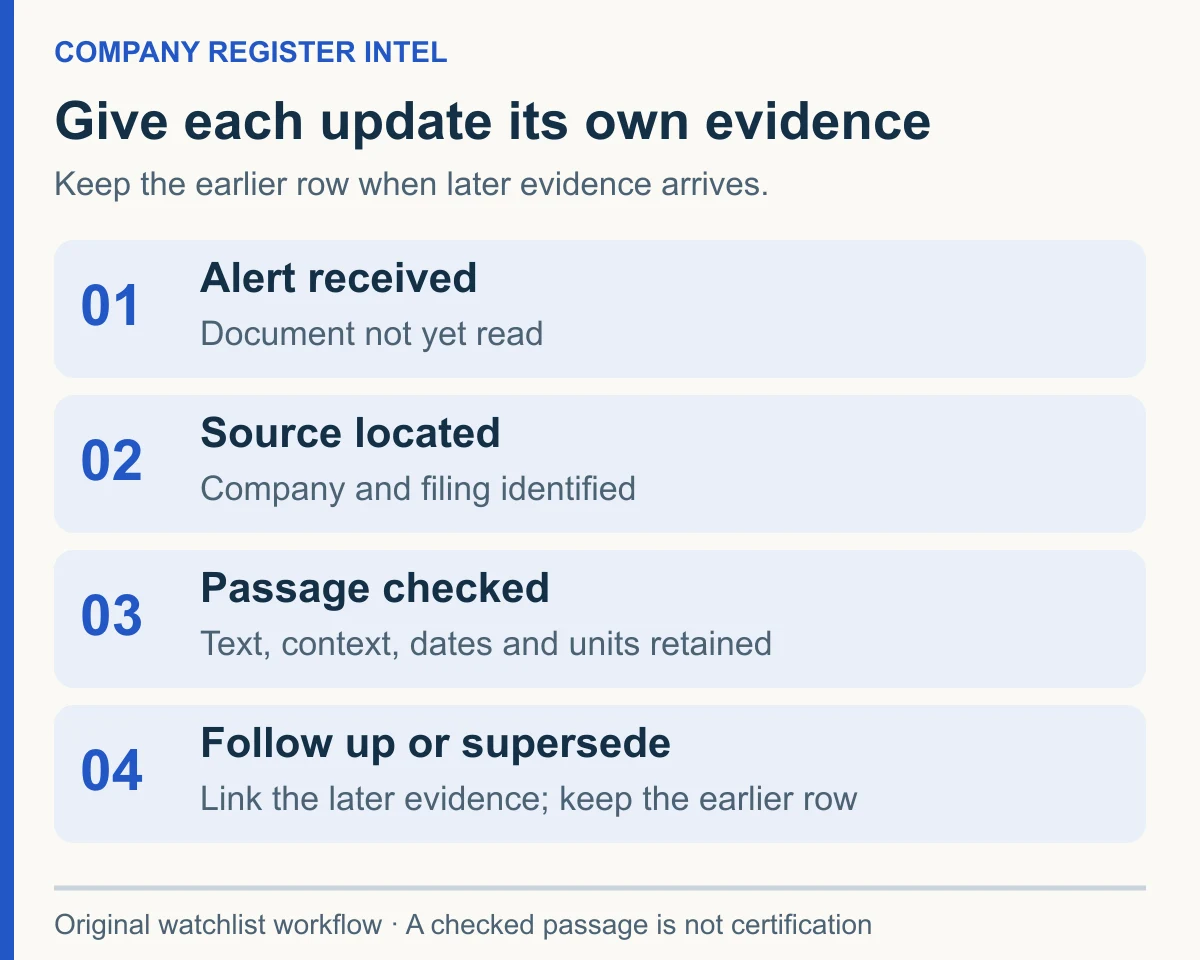
A single “verified” checkbox is ambiguous. This suggested set of states makes the work clearer:
| State | Meaning in this worksheet |
|---|---|
| Alert received | Document not yet read |
| Source located | Correct company and filing identified |
| Passage checked | Text or figure checked in its context |
| Follow-up open | Interpretation depends on missing or later evidence |
| Superseded | A later observation replaces an earlier conclusion, with both retained |
These are editorial workflow labels, not legal or accounting classifications. “Passage checked” means you verified the passage; it does not certify that every underlying statement is correct.
Preserve changes instead of overwriting them
In a fictional example, your first row records that a filing mentioned an unresolved financing condition. A later document states that the facility was renewed. Add a second row with its own reference and link the first row to it. Do not erase the earlier observation or keep presenting it as current.
If the later document covers a different company, period or facility, record that mismatch. It does not automatically close the original question.
The limits of automated company-filing analysis include the historical position described by filings. Your watchlist should retain those dates and uncertainties. At each review, identify which open question the new document actually answers and leave the others open.