Why a CoA Is Necessary But Not Sufficient
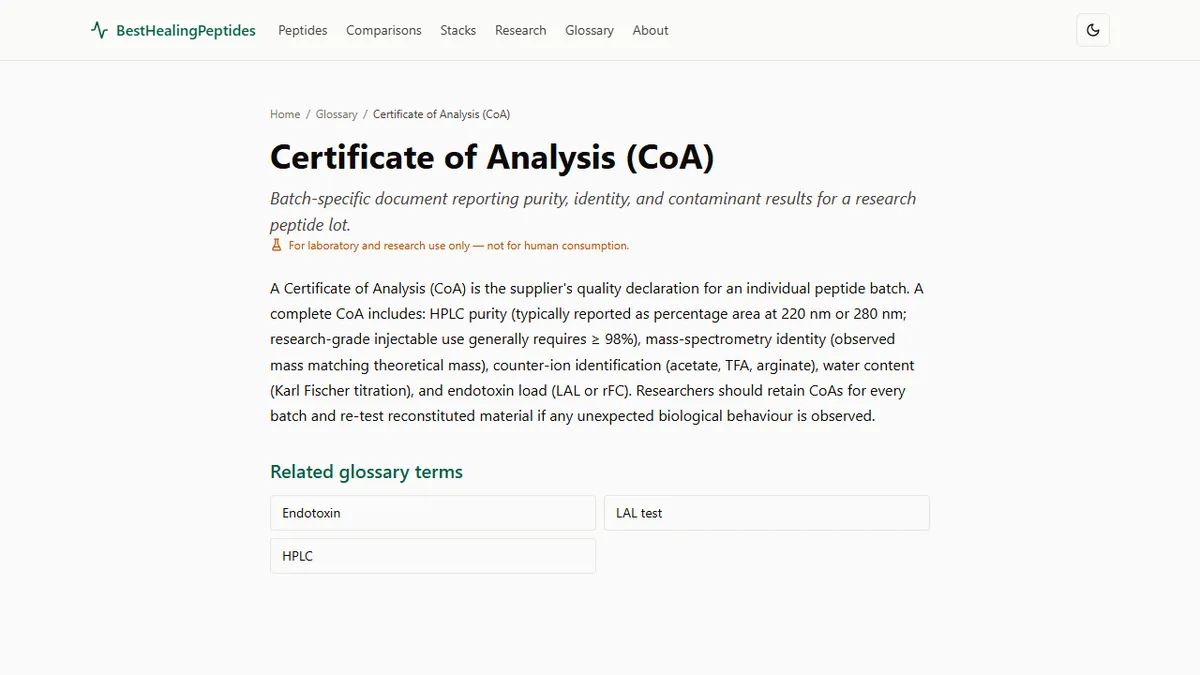
Every reputable peptide supplier issues a certificate of analysis with each batch. The document is supposed to be independent assurance that what is printed on the vial label matches what is actually inside. In practice, a CoA functions as evidence of quality only when the researcher receiving it can evaluate its contents critically, which requires knowing what each parameter measures, what acceptable values look like, and what manipulations are possible.
A CoA is necessary because without one you have no documented basis for believing the peptide is what it claims to be. It is insufficient because supplier-generated documentation can be incomplete, cherry-picked, or in some cases fabricated. Understanding the glossary definition of certificate of analysis in peptide research sets the baseline, but the practical skill is in working through each section of the document with an informed eye.
HPLC Purity: What 98% Actually Means and How to Spot Cherry-Picked Chromatograms
High-performance liquid chromatography (HPLC) purity is reported as a percentage of the total peak area attributable to the main compound. A figure of 98% or above is the accepted minimum for research-grade peptides, meaning no more than 2% of the total UV-absorbing material eluting from the column should be attributable to anything other than the target sequence.
What this number does not tell you is what the impurities are. The 2% non-target material could be inert buffer components, truncation fragments that retain partial biological activity, or racemised amino acid residues that can generate spurious biological responses. High purity reduces the probability of confounders but does not eliminate them.
Red flags in HPLC documentation include chromatograms that show only a single peak without visible baseline noise (genuine chromatograms always contain some noise and often show trace shoulder peaks), and reports that state a purity figure without providing the raw chromatogram at all. Suppliers who offer only a percentage without a downloadable trace file are providing unverifiable data. When a supplier will not provide the raw chromatogram on request, this alone is a reason to source elsewhere.
Mass Spectrometry: Confirming Sequence and Spotting Truncation Fragments
HPLC tells you how much of something is present. Mass spectrometry tells you what that something is. The two measurements are complementary, not interchangeable, and a CoA that includes only one of them is incomplete.
Electrospray ionisation (ESI-MS) or matrix-assisted laser desorption/ionisation time-of-flight (MALDI-TOF) mass spectrometry confirms the molecular weight of the main peak. For BPC-157, the expected molecular weight is approximately 1,419.5 Da. For TB-500 as the LKKTETQ heptapeptide, the expected value is approximately 888 Da. A measured molecular weight that deviates from theoretical by more than 1 Da (accounting for instrument tolerance) indicates a problem with synthesis, sequence, or identity.
Mass spectrometry can also reveal truncation fragments. These are shorter peptides produced when coupling steps during solid-phase synthesis are incomplete. These fragments may have the same molecular weight as the full sequence minus one or two residues, which means their peaks can partially overlap with the target compound in HPLC. An MS spectrum showing multiple peaks rather than a single dominant ion cluster warrants investigation, and the supplier should be able to explain each peak.
Endotoxin Testing: LAL Assay, the 1 EU/mg Threshold, and Why It Matters for Injectables
Endotoxins are lipopolysaccharide fragments derived from the outer membrane of Gram-negative bacteria. They are pyrogens (fever-inducing agents) that trigger a systemic inflammatory response at very low concentrations. In cell-culture experiments, nanogram quantities of endotoxin can activate NF-kB, upregulate TNF-alpha and interleukin-6, and generate biological effects that could easily be misattributed to the peptide under study.
The Limulus Amebocyte Lysate (LAL) assay is the standard method for quantifying endotoxin in pharmaceutical and research preparations. The what the LAL endotoxin test measures and its research significance covers the assay mechanism in detail. For injectable research peptides, the accepted threshold is below 1 Endotoxin Unit per milligram (1 EU/mg). Some researchers working with cell-based assays adopt even tighter limits, particularly when studying inflammatory pathways where endotoxin would directly confound the signal.
A CoA that omits endotoxin data entirely is incomplete for any injectable application. A figure simply listed as "pass" without a quantitative value is uninformative. Ask for the actual numerical result.
Sterility Testing: Membrane Filtration vs. Direct Inoculation
Sterility testing confirms the absence of viable microorganisms in the final preparation. Two methods are standard: membrane filtration and direct inoculation. Membrane filtration passes the dissolved peptide solution through a 0.22 micrometer membrane, which is then incubated in culture media to detect growth; this method is preferred for low-volume or low-bioburden preparations. Direct inoculation dissolves the test article into culture media and monitors for turbidity over an incubation period.
For researchers conducting animal injection studies, positive sterility testing on the batch being used is the baseline requirement. Sterility testing on a separate batch or conducted months earlier does not necessarily apply to the vial in hand. Some suppliers test a statistical sample of production batches rather than every individual vial; this is acceptable in pharmaceutical manufacturing but less reassuring in the research-chemical space where batch-to-batch consistency is less tightly controlled.
Moisture Content and Lyophilisation Quality Indicators
Lyophilised peptides are freeze-dried to remove water and extend storage stability. The moisture content of the final product (typically measured by Karl Fischer titration) directly influences peptide stability during storage and the accuracy of reconstituted concentration calculations. Higher residual moisture accelerates degradation and can introduce error into dose calculations because the researcher may be working from a nominal milligram weight that partly comprises water.
A well-lyophilised peptide appears as a uniform white or off-white powder or cake that does not clump or show signs of partial liquefaction. If the material in the vial appears yellowed, collapsed, or has a waxy texture rather than a dry friable structure, these are signs of poor lyophilisation or cold-chain failure during shipping. Some suppliers include residual moisture data on CoAs; where this is absent, the physical appearance of the lyophilised material provides indirect quality information.
Third-Party Testing: When to Request Independent Verification
The fundamental limitation of all supplier-provided documentation is that it is produced by the entity with the greatest financial interest in favourable results. Third-party testing (sending a sample to an independent analytical laboratory for HPLC, MS, and endotoxin analysis before committing to a batch for critical research) eliminates this conflict.
Third-party testing adds cost and time to the procurement process, but these are modest compared to the cost of a failed experiment caused by substandard peptide. For studies that will form the basis of publication, grant applications, or downstream regulatory submissions, independent verification of at least the HPLC purity and MS identity is a reasonable requirement. For routine exploratory work, supplier CoA review remains the practical minimum standard — but it is still a minimum, not a guarantee.