
On this page
A change in a displayed member count tells you about two observations. It does not, by itself, tell you how many people joined, why the count changed or whether the community improved.
The GuildRegister movers page presents measured member changes over a seven-day window. Its measurement description says the underlying public-invite counts are approximate. Keep that qualification with any calculation you reproduce.
Fix the comparison before calculating
Record the same server identifier, the count definition and the timestamp for each observation. Do not compare a total-member count at the start with an online count at the end. Discord's API documentation defines those as different fields.
Here is an original log structure:
| Field | Start observation | End observation |
|---|---|---|
| Server identity | Same identified record | Confirm the same record |
| Count type | Approximate total members | Same definition |
| Measurement time | Date, time and timezone | Date, time and timezone |
| Source | Record URL | Record URL |
| Value | Recorded count, or missing | Recorded count, or missing |
A missing observation is not zero. If you cannot establish a comparable pair, record the gap instead of displaying a growth percentage.
Recalculate a fictional seven-day change
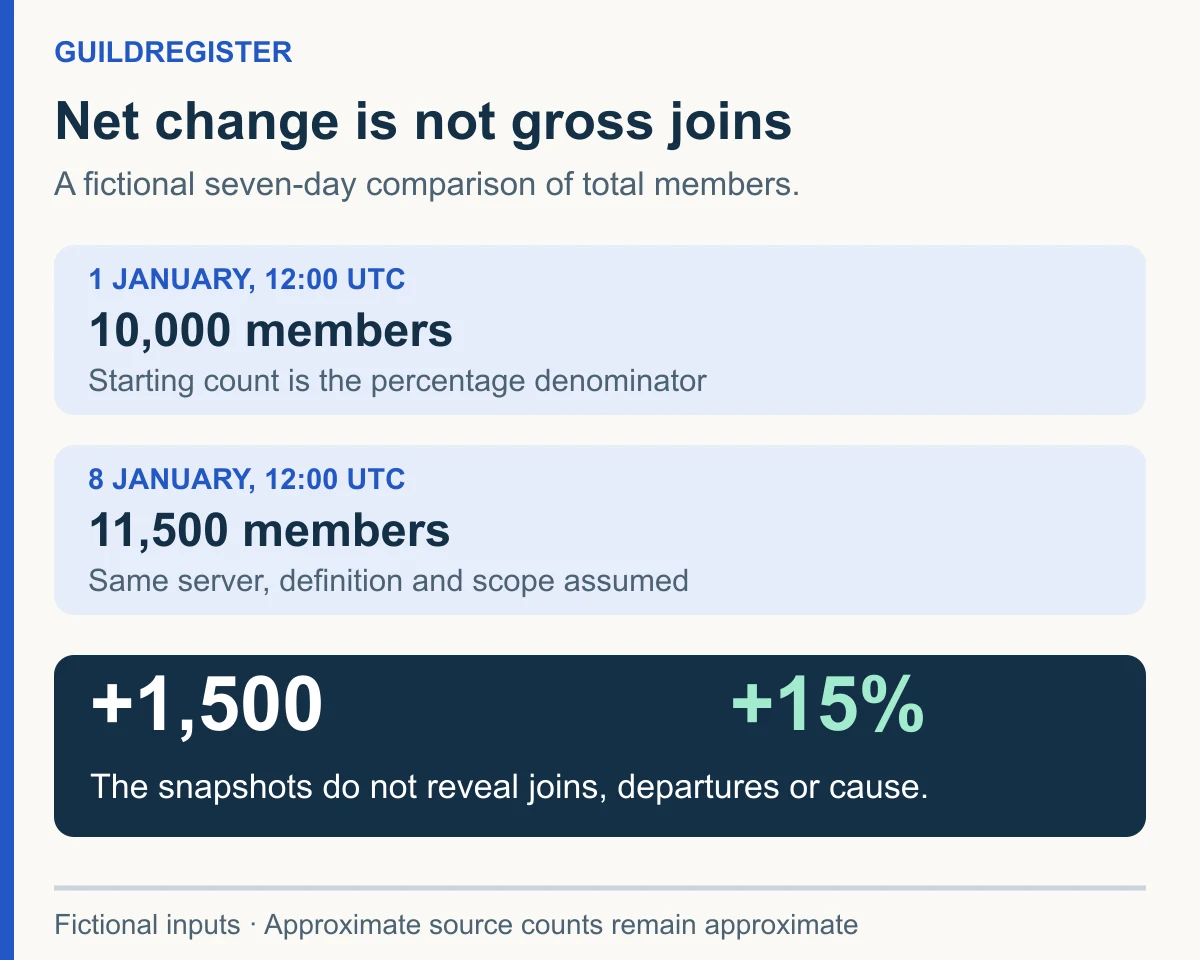
Assume a fictional server has 10,000 members at 12:00 UTC on 1 January and 11,500 at 12:00 UTC on 8 January. Assume both counts use the same definition and scope.
The displayed change is 11,500 − 10,000 = 1,500. Relative to the starting count, that is 1,500 ÷ 10,000 × 100 = 15%.
The denominator is the starting count, not the ending count. If the starting value were zero, that percentage calculation would be undefined; report the absolute values instead of inventing a percentage.
These fictional inputs make the arithmetic exact, but applying the formula to approximate source counts does not make the underlying measurement exact.
Separate net change from joining activity
The two fictional observations do not show the number of joins and departures between them. Many combinations could produce the same net difference. For example, an invented sequence of 2,000 joins and 500 departures also gives +1,500, but the snapshots do not establish that this sequence occurred.
Do not infer a promotion, coordinated activity or a particular event merely from a large increase. Those explanations need separate evidence. Likewise, being independent of Discord does not make a directory free of measurement error or bias.
Write the result with its limits
A complete note would say: “The fictional total-member count rose from 10,000 to 11,500 over the stated seven days, a 1,500 increase or 15% of the starting count. The observations do not identify gross joins, departures or the cause.”
For a real comparison, replace the invented values with the dated source observations and retain the approximate-count qualification. Keep the calculation reproducible and leave causal questions open until you have evidence to answer them.