Starting Point: MMA and Prison Fights in Thailand
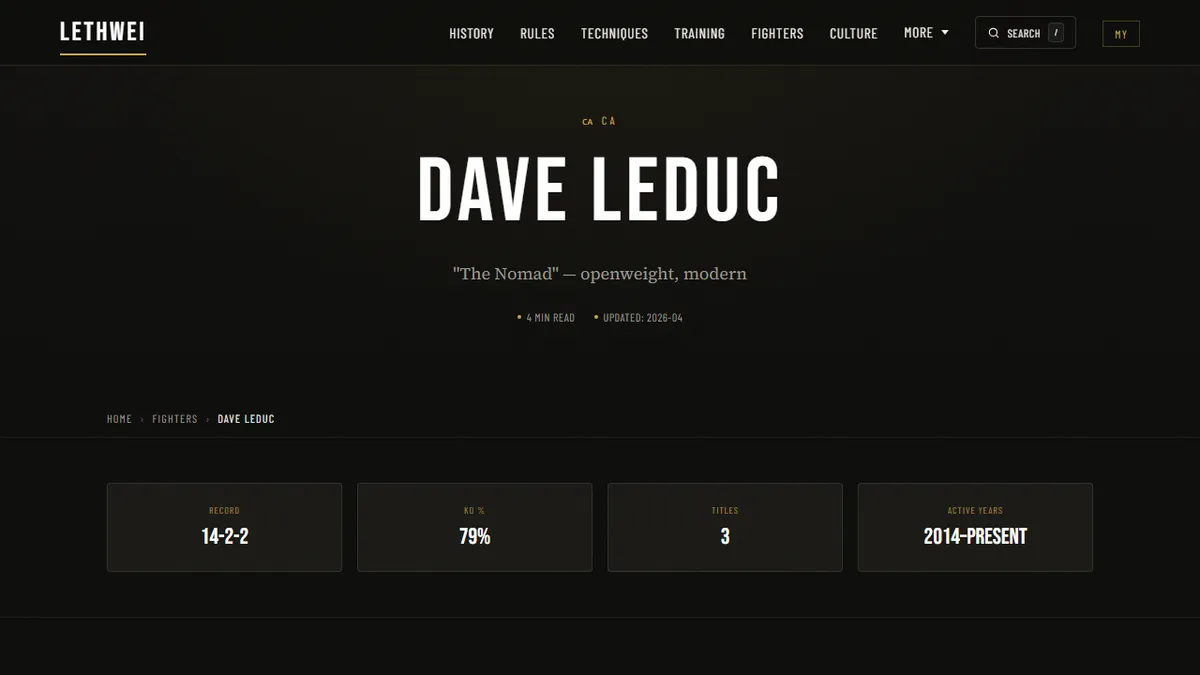
Dave Leduc was born in December 1991 in Canada and arrived in Southeast Asia as a young fighter searching for the kind of competitive environment that North American gyms could not easily provide. By the early 2010s he had found his way into Thailand's fight circuit, competing in MMA and eventually participating in the unconventional "Prison Fights" events held inside actual correctional facilities, bouts characterised by their rawness and the minimal structural support surrounding them.
The prison fight circuit was not a career destination. It was a proving ground for fighters with nothing to lose and everything to demonstrate. What it gave Leduc was something more valuable than a record: a tolerance for physical adversity and a competitive willingness to engage on difficult terms. These qualities would prove essential for what came next.
He was a competent but not extraordinary MMA fighter at this stage. What distinguished him, according to those who encountered him during the Thailand years, was an unusual seriousness about technical absorption, a willingness to study and adapt rather than simply rely on athleticism. He was already looking for something more complete than what the existing fight scene was offering him.
The Decision to Move to Myanmar
The move to Myanmar was not the obvious career choice. Lethwei in the early 2010s was barely known outside Myanmar's borders. It had no international broadcast deal, no established infrastructure for foreign fighters, and no precedent for a Westerner integrating successfully enough to compete at the top level.
What it offered Leduc was a complete stand-up fighting system under bareknuckle conditions with the legal headbutt, a unique combination that no other training environment in the world could provide. He had encountered footage of traditional Lethwei bouts and understood immediately that the tactical demands were unlike anything he had faced. Headbutts in the clinch changed the entire defensive calculus. The all-or-nothing knockout requirement removed the points-game that he found strategically limiting.
He moved to Yangon. He found a gym. He started from something approaching zero in terms of cultural fluency, linguistic ability, and standing within the local fighting community, all of which had to be earned rather than assumed.
Learning the Hard Way: Camp Life and Cultural Integration
Camp life in a Myanmar Lethwei gym is not designed around the comfort of visiting foreigners. The training sessions are long, the conditioning work is demanding, the hierarchy within the gym is observed, and the respect afforded to a newcomer is commensurate with what they demonstrate on the floor rather than who they were elsewhere.
Leduc approached the cultural integration with a seriousness that locals noted. He learned Burmese: not tourist Burmese but functional conversational Burmese, sufficient to interact with coaches and training partners without a constant interpreter. He observed the traditional protocols around the lethwei yay, the pre-fight dance, and the hsaing waing orchestra. When the opportunity arose, he married a Burmese woman in a traditional ceremony that was broadcast to an estimated 30 million viewers inside Myanmar, a moment that transformed him from a skilled foreign fighter into something closer to a genuine cultural figure.
The training itself was the essential work. The gap between his Muay Thai and MMA background and full Lethwei competence was not primarily technical; much of the clinch and striking foundation transferred. The gap was in the bareknuckle conditioning, the headbutt mechanics, and the mental adjustment to fighting under rules where drawing is an accepted outcome and finishing the opponent is the only path to a win.
The Golden Belt Fight: December 2016
In December 2016, Leduc entered the Golden Belt Championship in Yangon (the most prestigious Lethwei competition in existence, administered by the Myanmar Traditional Lethwei Federation). He won. He became the first foreigner in the history of the sport to hold a Lethwei world title.
The significance of this moment extended beyond the obvious landmark. Myanmar's relationship with Lethwei is deeply tied to national identity. The sport is culturally central in a way that has no direct parallel in Western martial arts. It is a rite of passage, a source of national pride, and a living connection to a pre-colonial past. For a Canadian fighter to win the Golden Belt was not simply an athletic achievement. It was a statement about what the sport had become and where it was capable of going.
Within Myanmar, reaction was mixed: genuine respect for what Leduc had accomplished, accompanied by a fierce desire among the country's own fighters to reclaim what they considered theirs.
The Tun Tun Min Trilogy — Three Fights That Defined a Career
The contest between Leduc and Tun Tun Min (the young Burmese champion who had defended the openweight Golden Belt eighteen times and was considered by many to be the pound-for-pound best active Lethwei fighter) produced three bouts that defined both careers and attracted the widest international attention Lethwei had yet received.
Their first meeting ended in a draw, which under traditional Lethwei rules is the equivalent of neither fighter winning. It was a fight of exceptional quality that established Leduc as a genuine peer rather than a novelty opponent.
The second fight produced the moment that defined the rivalry: Leduc knocked out Tun Tun Min in the first round with a jumping elbow strike, a technique of considerable difficulty and spectacular impact. The finish was decisive and the record unmistakable. A foreigner had beaten Myanmar's greatest active fighter, in Myanmar, under Lethwei's own rules.
The third fight, completing the trilogy, reinforced the verdict. The full career record and profile of the six-time world champion documents each fight in detail, including the tactical evolution across all three bouts and the context that made their competition so consequential for the sport's international profile.
What Leduc's Success Changed for International Lethwei
The impact of Leduc's championship career on Lethwei's international development is difficult to overstate. He provided the WLC (founded in August 2017) with a ready-made English-language narrative: the foreigner who went deep into Myanmar's traditional fighting culture and earned acceptance on merit. That story was legible to international audiences in a way that a purely Myanmar-domestic product could not have been.
His presence on the card gave the WLC a recognisable personality around whom broadcast deals could be structured. When WLC 7 landed on UFC Fight Pass in 2019, Leduc was central to the promotional case made to international distributors. The subsequent reach to over 100 countries via Fight Network, Fox Sports, and Star Sports was built partly on the foundation of his story.
Beyond marketing, Leduc's success demonstrated that genuine technical competence in Lethwei was accessible to outsiders willing to commit seriously to the cultural and physical requirements. His online academy and ongoing coaching work have since provided an entry point for international practitioners who cannot travel to Myanmar but want authentic instruction. The outsider who became an insider, and then built a bridge for others to follow.