What the AED 2M Threshold Actually Means
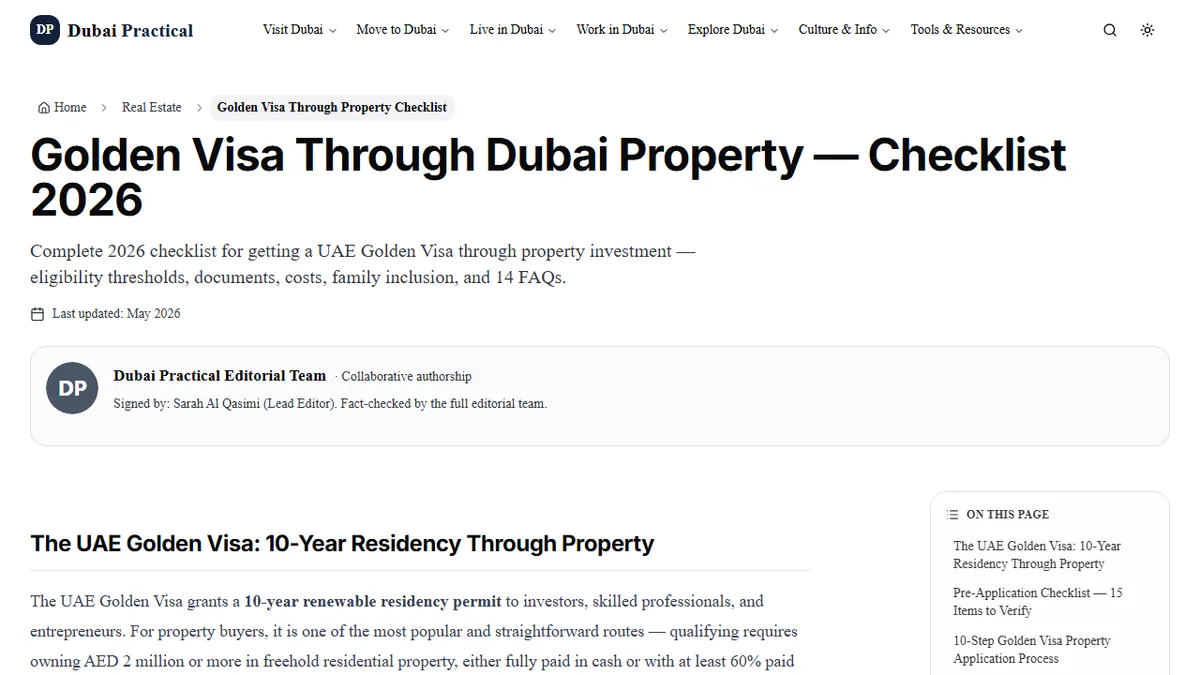
The headline is deceptively clean: own property worth AED 2 million or more in Dubai and you qualify for a 10-year Golden Visa. Brochures from developers and real estate agents repeat this figure as if it settles the matter. It doesn't. The threshold is a starting point, not a finish line, and the conditions attached to it eliminate a significant percentage of otherwise eligible buyers before they even reach the application stage.
The AED 2 million is a minimum purchase price: not market valuation, not assessed value, and not the price you paid minus any discount the developer threw in on paper. Authorities look at the actual registered transaction value recorded with the Dubai Land Department. If that number comes in below the threshold after fees or adjustments are factored in differently from how you calculated them, the visa pathway closes.
Freehold vs Leasehold — Only One Qualifies
This is where the first trap springs. Dubai's residential property market is divided between freehold areas, where foreign nationals can hold full title indefinitely, and leasehold areas, where foreigners receive long-term usage rights (typically 99 years) without true ownership. Golden Visa eligibility extends exclusively to freehold properties in the 30-plus designated freehold zones: Downtown Dubai, Dubai Marina, Palm Jumeirah, Jumeirah Village Circle, Business Bay, and others.
A leasehold purchase in a non-designated area, regardless of its price, contributes nothing toward the Golden Visa threshold. Buyers who have purchased in certain older residential clusters or non-freehold mixed-use developments sometimes discover this only when they attempt to apply. Verifying the tenure classification of any property before purchase is essential, not optional.
Can You Stack Multiple Properties? The Portfolio Rule
Yes, under current rules you can combine the registered value of multiple freehold properties to reach the AED 2 million floor. A buyer holding two freehold apartments (one registered at AED 1.1 million and another at AED 1 million) crosses the threshold on paper. However, the properties must all be fully paid up, free of mortgage, and registered in your name as the applicant. Mortgaged properties only count for their paid-down equity portion, which is a crucial distinction many buyers misunderstand.
The complete property checklist for Golden Visa applicants maps out exactly which documents are required for single-property and portfolio applications.
Off-Plan Purchases and the Mortgage Trap
Buying off-plan (purchasing a unit that is still under construction) is popular in Dubai for good reason. Launch prices are typically lower than completed-unit prices, payment plans spread cost over construction milestones, and post-handover payment structures are sometimes available. But for Golden Visa purposes, off-plan purchases create a timing problem.
The Golden Visa through property requires that the purchase be completed and the title deed registered with the Dubai Land Department. An off-plan purchase during construction does not generate a title deed. It generates a Sales Purchase Agreement and an Oqood pre-registration. These documents do not satisfy the Golden Visa requirement. The visa pathway opens only once the unit is handed over and the title deed is issued.
Mortgage financing introduces a second layer of complexity. Properties purchased with a bank mortgage are not excluded from the pathway, but only the equity portion (the amount actually paid) counts toward the AED 2 million figure. A buyer who purchased a AED 3 million apartment with a 25% deposit has paid AED 750,000 against the threshold. They are nowhere near qualifying, even though they technically own a property worth well above the requirement.
The Application Process Through ICP Step by Step
Once the property qualifications are confirmed, the application moves through the Federal Authority for Identity, Citizenship, Customs and Port Security (known as ICP). The process runs as follows.
The applicant submits an initial application through the ICP portal, attaching the title deed, passport copies, a current visa or entry permit, and proof of health insurance. ICP reviews the submission and issues a six-month Buffer Visa (sometimes called an entry permit) that gives the applicant time to complete the remaining requirements without their legal status expiring mid-process.
Within that six-month window, the applicant must complete a medical fitness test at an approved DHA facility, obtain Emirates ID biometrics, and pay the associated government fees. The total government fee for a Golden Visa is approximately AED 2,800 to AED 3,800 depending on the application category and processing speed chosen. Once all steps are cleared, the 10-year residence visa is stamped.
Processing typically takes two to four weeks once the complete file is submitted, though delays can occur if any document fails verification. Following the step-by-step Golden Visa walkthrough for 2026 helps applicants sequence each step correctly and avoid the most common submission errors.
Benefits Checklist — Family Sponsorship and the 6-Month Buffer Visa
The practical value of the Golden Visa extends well beyond the residence stamp itself. Key benefits include:
The 10-year validity, renewable indefinitely, removes the dependency on an employer's continued sponsorship. The visa holder is self-sponsored, meaning a job loss or career change does not automatically trigger visa cancellation.
Family sponsorship is included. A Golden Visa holder can sponsor a spouse, children, and, under certain conditions, parents, without the minimum salary requirements that apply to standard residence visa sponsorship. This makes it particularly valuable for business owners and retirees who may not draw a regular salary.
The six-month re-entry grace period means a Golden Visa holder does not invalidate their visa by spending extended time abroad, unlike standard residence visas that lapse after 180 days outside the UAE. For frequent travellers and those splitting time between countries, this flexibility is significant.
Household staff can be sponsored under a Golden Visa. Domestic workers, drivers, and personal assistants can be included in the visa holder's sponsorship family without requiring a separate employment agency relationship.
Common Mistakes That Delay or Void the Application
Several errors recur in Golden Visa applications and are entirely avoidable with advance preparation.
Submitting an application with a mortgaged property whose paid equity falls below AED 2 million is the single most common disqualifying mistake. The mortgage balance must be settled, or the calculation must accurately reflect only the paid portion.
Applying with leasehold properties, even very valuable ones, is immediately rejected. Title deed documentation distinguishes freehold from leasehold, but some applicants rely on agent assurances rather than checking the deed itself.
Allowing health insurance to lapse mid-process causes ICP applications to stall. Valid UAE health insurance must remain in place throughout the application window.
Attempting to include off-plan properties before the title deed is issued delays applications by months and sometimes longer, particularly if the handover date slips, a regular occurrence in Dubai's construction market.
Finally, using personal funds deposited into a property held under a corporate structure rather than in the individual applicant's personal name creates a mismatch that ICP flags. The title deed must be in the same name as the applicant's passport.