Hour 0–2: The Scene of Arrest
Thai law requires police officers to identify themselves as law enforcement before making an arrest, except in circumstances where the suspect is caught in the act of committing an offence. In practice, roadside stops, bar raids, and tourist-area sweeps routinely occur without formal identification being offered first.
At the moment of arrest, the officer is obligated under the Criminal Procedure Code to inform you of the charge or the grounds for detention. This obligation exists on paper, but it frequently occurs only at the police station rather than at the scene. If you are not told why you are being arrested, you have the right to ask, and you should.
Physical resistance is inadvisable regardless of whether you believe the arrest is lawful. Thai courts take a dim view of resisting officers, and it creates an additional charge. If the arrest is unlawful, that is an argument to make through a lawyer, not in the street.
Hour 2–8: At the Police Station
Once at the station, you will be booked. This involves recording your identity, the alleged offence, and the circumstances of arrest. Evidence will be documented, and any items seized from you should be listed and signed for. Request a copy of this list.
Your right to legal counsel attaches at this stage. Thai law permits you to contact a lawyer before answering any questions. You are not required to provide a statement, and anything you say can and will be used in subsequent proceedings. The conventional advice (say nothing substantive until your lawyer is present) applies as firmly in Thailand as anywhere else, and arguably more so given language barriers.
The police will take your passport. You will not get it back until either released or bail is granted. This is standard procedure, not an escalation.
Hour 8–24: The Charge Decision and the Public Prosecutor's Role
Thai criminal procedure involves a division between the investigating police and the public prosecutor. The police investigate and collect evidence; the prosecutor decides whether to indict. For minor offences, the charge decision can be made relatively quickly. For serious offences, the police may hold you in custody while they continue investigation.
The initial detention period without charge is 48 hours, extendable by court order for serious cases. Within the first day, your lawyer's primary task is to establish what charge is under consideration and whether the evidential position supports it. Many cases at this stage are amenable to negotiation: not in the sense of guilt, but in terms of charge categorisation, which has downstream effects on bail eligibility and penalty ranges.
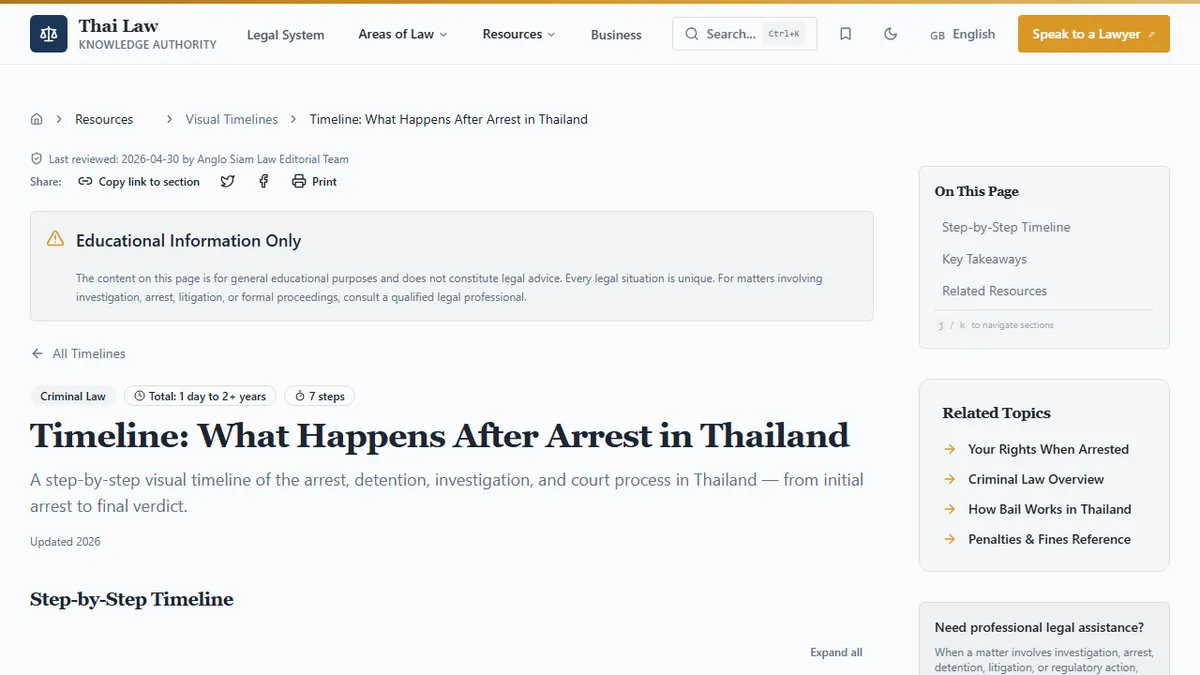
The step-by-step Thai arrest process timeline maps each procedural stage against the typical timeframes involved, which vary by offence category.
Hour 24–48: The Bail Application
Bail in Thailand is not a constitutional right, but it is routinely granted for non-capital offences. The application is made to the court, not to the police, and the amount is set by the judge based on the severity of the offence, the likelihood of flight, and the strength of evidence.
Typical bail amounts for common offences range from 20,000 to 200,000 THB, though serious drug charges or financial crimes can produce bail amounts of several million baht. Bail can be posted in cash or via a letter from a Thai bank. Surety from a Thai national (essentially a guarantor) is sometimes accepted in lieu of the full cash amount, but this requires someone willing to take on that liability.
For foreigners without Thai contacts or immediate access to funds, embassies may sometimes provide a list of local legal contacts but will not post bail themselves. Some expat insurance policies have a legal assistance component that covers bail bond — reviewing your policy terms before a crisis is advisable.
The Consulate Notification Right
You have the right to have your embassy or consulate notified of your arrest. This is enshrined in the Vienna Convention on Consular Relations, to which Thailand is a signatory. The police are obligated to facilitate this contact if you invoke it.
Timing matters considerably. Consular officers can visit detainees, provide a list of local lawyers, liaise with family members, and (in extreme cases) raise concerns about detention conditions through diplomatic channels. They cannot secure your release or waive charges. Requesting consular access at the earliest opportunity preserves these options.
Some embassies are more responsive than others. The UK, US, and Australian embassies all maintain duty officer lines for citizen arrests abroad. Knowing this number before you travel is elementary preparation that most people skip.
Five Things That Worsen Your Position in the First 48 Hours
First, making a statement without a lawyer present. Even an innocent explanation can be misconstrued, mistranslated, or selectively recorded. Second, offering money to an officer to secure release. What begins as an attempt to resolve a minor matter can immediately become a bribery charge. Third, contacting people outside the formal consular channel to try to "fix" the situation. Fixers who promise results in exchange for payment are rarely what they claim, and the payment itself creates a record. Fourth, allowing your anger or distress to manifest as confrontational behaviour toward officers. Fifth, signing documents you do not understand. Do not sign anything (including paperwork characterised as a formality) without a translation and legal advice.
What a Credible Lawyer Does in This Window vs What a Fixer Promises
A properly qualified Thai criminal lawyer in the first 48 hours will: attend the station or detention facility, review the charge documentation, advise you on whether to cooperate with police questioning, begin preparing a bail application, and establish communication with your family or embassy. They will not promise you a particular outcome. If someone representing themselves as a lawyer or agent promises you the case will disappear in exchange for a cash payment, that person is not acting as a lawyer.
Thailand has documented cases of foreigners paying large sums to individuals who claim connections with prosecutors or police commanders. The only reliable path through an arrest is through a registered lawyer operating within the formal legal system.
Anglo Siam Law is an information platform. For legal representation, contact a qualified Thai criminal lawyer immediately.