On this page
Why the Elbow Defines the Sport's Identity
Every combat sport has a signature weapon: the one that shapes its tactical logic and gives it a recognizable visual identity. In Western boxing it is the straight punch. In wrestling it is the double-leg. In Kun Khmer, it is the elbow. Not because other weapons are absent, but because no other striking art organizes its tactical framework so consistently around delivering the elbow as the decisive blow rather than as a supplement to other attacks.
The reason is anatomical. The elbow is the hardest point on the human body that can be reliably directed in combat. When it connects cleanly against the orbital bone, the eyebrow ridge, or the temple, it cuts. Those cuts bleed immediately and heavily, impairing vision and creating grounds for a stoppage. Unlike a punch, which can be absorbed by a well-prepared fighter across several rounds, an elbow cut requires neither power nor accumulation. One clean contact is sufficient to produce a fight-changing injury.
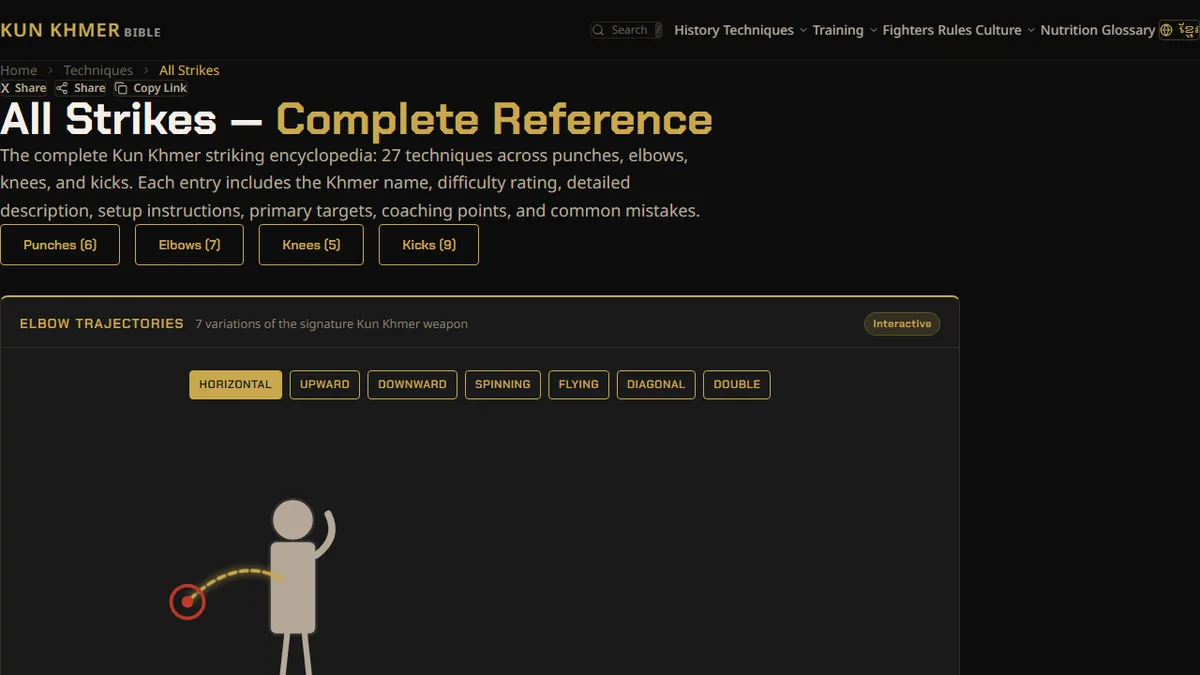
Cambodian trainers do not treat this as secondary or situational. They build entire combination structures around creating the angle and distance for a specific elbow variation, and they teach seven distinct variations with individual names, mechanics, and tactical applications.
The Seven Variations: Names, Angles, and Mechanics
The horizontal slashing elbow (Bat Koun Phloet) is the most commonly seen variation and the one that produces the majority of orbital cuts in professional bouts. The arm travels horizontally across the centerline at face height, with the fighter rotating into the strike from the hip. It is executed at close to mid-range and requires the opponent's guard to be temporarily displaced by a preceding punch.
The upward elbow drives from below to above, useful against an opponent who has dropped their head or bent forward into a clinch break. It targets the chin and nose and generates knockout potential through an upward trajectory that transfers force efficiently into the skull.
The downward elbow (Sok Tee) travels from above to below against a bent or dropped opponent and is particularly effective after a sweep or when an opponent attempts a body level change. Its angle is unusual enough that it surprises fighters who have not trained specifically against it.
The spinning back elbow requires full rotation, generating substantial force from momentum. It targets the side of the head and jaw. The risk is the rotation phase, during which the fighter is briefly turned away from the opponent.
The diagonal elbow travels at roughly a 45-degree angle, splitting the difference between horizontal and upward. Its value is unpredictability. Fighters who have become accustomed to the horizontal and upward variations are vulnerable to the diagonal because their defensive reads are calibrated to the more common angles.
The flying elbow combines a forward jump with a downward or horizontal elbow, used typically as a finishing attempt against a stunned or retreating opponent. It is the most spectacular variation and the highest-risk.
The double elbow links two variations in rapid succession, usually horizontal-upward or upward-downward, designed to defeat the defensive adjustment the opponent makes after the first strike.
The Horizontal Slash vs the Downward Sok Tee — Which Scores More?
Between the two most studied variations, the horizontal slash produces more stoppages but the downward Sok Tee scores more consistently when judges evaluate clean execution without visible damage. The horizontal slash's scoring advantage derives from consequence: a cut above the eye is visible, undeniable, and prompts referee attention. The Sok Tee's scoring advantage derives from precision; judges recognize and reward a correctly executed downward elbow against a ducking opponent as technically difficult and tactically intelligent.
For a fighter developing their elbow game, this means the horizontal slash is the primary tool during the first years of training. It appears most frequently, is most accessible from standard punch combinations, and produces the most immediate feedback. The Sok Tee and the diagonal variations come later, once the fighter has the combination structure to create the specific openings those angles require.
When to Use the Spinning Back Elbow (and When Not To)
The spinning back elbow is the variation most often misused by developing fighters, typically because they have seen it finish fights in highlight reels and attempt to deploy it as a first-choice weapon rather than as a specific tactical response to a specific situation.
The correct setup involves first establishing the opponent's habit of countering a standard combination by moving laterally to one side. Once that pattern is confirmed, the spinning back elbow is thrown in the direction of that anticipated lateral movement, meeting the opponent as they step into the path of the elbow's arc. Without the setup, the rotation phase creates a window of vulnerability that experienced opponents will exploit with a counter knee or stepping elbow.
Elbows to the Head: The Rule That Changes Everything
Elbows to the head are legal in Kun Khmer. This single rule fundamentally changes the tactical logic of the close-range game. In sports where head elbows are prohibited, a fighter who has been backed against the ropes or caught in a disadvantageous clinch break can rely on the referee to prevent the most dangerous close-range attacks. In Kun Khmer, the break distance is itself an attack opportunity, and fighters must maintain defensive awareness through the entire clinch exit.
The complete guide to striking weapons in Kun Khmer covers all four weapon categories, but the elbow section reflects the sport's deepest technical development precisely because of this rule. Every aspect of defensive positioning in Kun Khmer is conditioned by the constant awareness that an elbow to the head is legal and immediately available.
How Judges Score Elbow Damage vs Clean Strikes
Cambodian judges weight outcome and damage heavily, which means an elbow that opens a cut scores more decisively than a cleaner but consequence-free punch combination. This is not arbitrary: it reflects the sport's origins as a system for assessing genuine fighting effectiveness rather than point accumulation. A fighter who is bleeding and visually impaired has demonstrably lost something; the judge's scoring reflects that reality.
The implication for fighters is that a conservative strategy of avoiding elbows in favor of safer scoring through kicks and punches may accumulate points over early rounds but can be rapidly negated by a single elbow exchange that produces visible damage in a late round. Game planning in Kun Khmer must account for elbow risk throughout the full five rounds rather than treating it as a finishing-phase weapon only.
Training the Elbow: Pad Drills Used in Cambodian Gyms
Standard Cambodian gym pad work for elbows uses a focus mitt held at various angles rather than Thai pads, because Thai pads are designed for kicks and knees and do not replicate the correct surface resistance for elbow technique development. The trainer presents the mitt at horizontal, upward, downward, and diagonal angles in varying combinations, developing the student's ability to read the opening and deliver the correct variation without conscious deliberation.
A common early drill links a jab-cross combination to a horizontal elbow, establishing the punch-to-elbow transition as a reflex rather than a decision. More advanced drills introduce the spinning variation from a predetermined combination that creates the rotation setup. Competent elbow technique in Kun Khmer typically requires two to three years of consistent pad work before a fighter can reliably access all seven variations under competitive pressure.