The October start that breaks January instincts
Open a Thai government spreadsheet and the first thing that looks wrong is the year. The budget for "2568" appears where you expected "2025". If you get past that, the months are stranger: the fiscal year begins in October, not January. Then the column labelled "budget" turns out to be money that was approved but never spent. None of these are errors. They are conventions, and they are consistent. The problem is that most readers bring January-to-December, Common Era instincts to data that was recorded on a different calendar.
Budget comparisons are usually done in a hurry. Someone pulls the "2025 budget" number and compares it against 2025 GDP, or 2025 tax receipts — and the comparison is off by three months, because the fiscal year started the previous October. The three traps below cause most of that confusion.
Trap one: the Buddhist Era calendar
The first trap is the calendar era. Buddhist Era is the Common Era plus 543 years. The year 2025 is BE 2568. Thai-language pages almost always use BE. English-language pages sometimes convert, sometimes do not, and the underlying files occasionally mix both in a single column.
The practical rule: if a year is above 2400, it is Buddhist Era, and you subtract 543 to get the Common Era year. If it is below 2400, it is almost certainly already Common Era. The ambiguity is real, and it is not always resolved by the publisher. A column that mixes 2568 and 2025 is a sign of a bad conversion somewhere in the chain, not a deliberate choice.
The conversion itself is simple. The trap is assuming the table you are reading has already been converted. A figure labelled "2568" is not a typo for "2025"; it is the same year on a different calendar. Once you know that, the number stops looking wrong.
Trap two: the fiscal year starts in October
The second trap is the fiscal calendar. Thailand's fiscal year begins on 1 October and ends on 30 September of the following Common Era year. Fiscal year 2568 runs from 1 October 2024 to 30 September 2025.
The consequences are easy to underestimate. The first quarter of FY2568 is the fourth quarter of calendar 2024. A monthly series labelled "October 2024" belongs to fiscal 2568, not to fiscal 2567. If you are comparing budget execution to a calendar-year economic series, you need to align the quarters before you align the numbers.
The naming convention adds another layer. The fiscal year takes the number of the year in which it ends. So the budget that starts in October 2024 is called FY2568, not FY2567, even though three of its first six months fall in calendar 2024. This is the same convention used by the US federal government, but it surprises people who expect a budget to be labelled with the year it begins.
Trap three: appropriation is not disbursement
The third trap is the difference between two words that look interchangeable in a budget table: appropriation and disbursement.
Appropriation is the amount parliament authorised. It is a legal ceiling on spending. Disbursement is what the treasury actually paid out. Both numbers are published, and they differ — often by a lot. A ministry might be appropriated 100 million baht and disburse 70 million because a procurement was delayed, a construction contract stalled, or a project simply did not spend as fast as planned.
Reading appropriation as spending overstates what actually happened. It also produces phantom gaps: the difference between this year's appropriation and last year's disbursement is not a cut, it is a comparison of two different things. The useful comparison is disbursement against disbursement, or appropriation against appropriation, over the same fiscal period.
The gap itself is information. A persistent shortfall between appropriation and disbursement tells you about execution capacity, not about the budget law. Both series are available: the data now includes appropriation and the actual payments recorded by GFMIS, the treasury's accounting system, back to fiscal year 2016. You can look at actual cash disbursement records and compare them against the appropriation for the same period.
How to tell which convention a table uses
Before doing any arithmetic, check three things.
Start with the year values. If they are above 2400, they are Buddhist Era; subtract 543. If a column contains some values above 2400 and some below, treat it as unreliable until you have checked the source.
Next, the date range. If a "2025" table starts in October 2024, it is fiscal-year data. If it starts in January 2025, it is calendar-year data. Neither is wrong, but they cannot be mixed in the same comparison.
Finally, the column labels. "Appropriation", "budget", and "allocation" mean money that was approved. "Disbursement", "paid", and "cash" mean money that left the treasury. If the label is ambiguous, the source agency usually resolves it: the Bureau of the Budget publishes appropriation, while the payment side comes from GFMIS, run by the Comptroller General's Department.
What the traps mean for comparing years
Once you have normalised the calendar and the era, the comparisons become meaningful. Year-on-year changes in disbursement, measured October to September, tell you whether execution is accelerating or slowing. Quarterly patterns within a fiscal year show the familiar end-of-year spending surge, because agencies that underspend risk losing the unused portion.
The same traps apply to revenue. Tax receipts are published on the same fiscal calendar and face the same BE/CE ambiguity. A tax revenue time series needs the same October-to-September alignment before you can compare it against a calendar-year economic indicator.
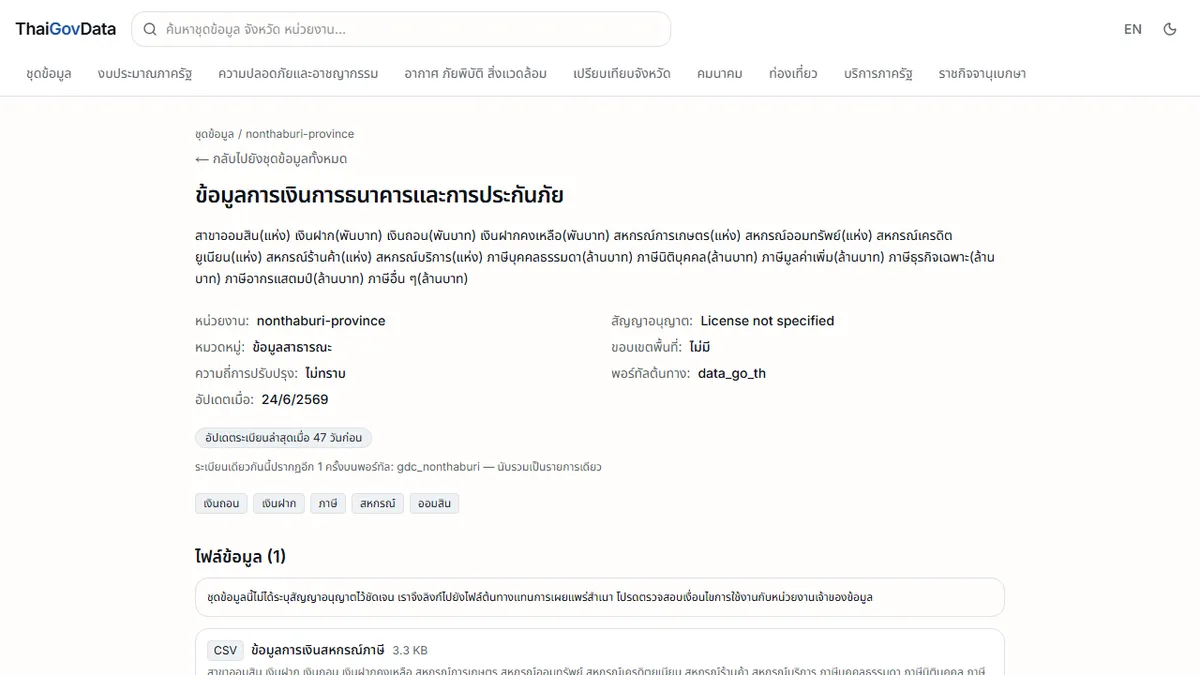
There is a fourth source of confusion that is not a calendar: duplicate records. The same dataset is often republished across portals that harvest each other, so the same budget table appears on data.go.th and on provincial GD Catalog portals. Summing the two double-counts. The site merges records that share a harvest lineage, so its counts are deliberately lower than the sum of the upstream portals' own totals. That is not a flaw; it is a correction.
Where to find the data with the conventions already applied
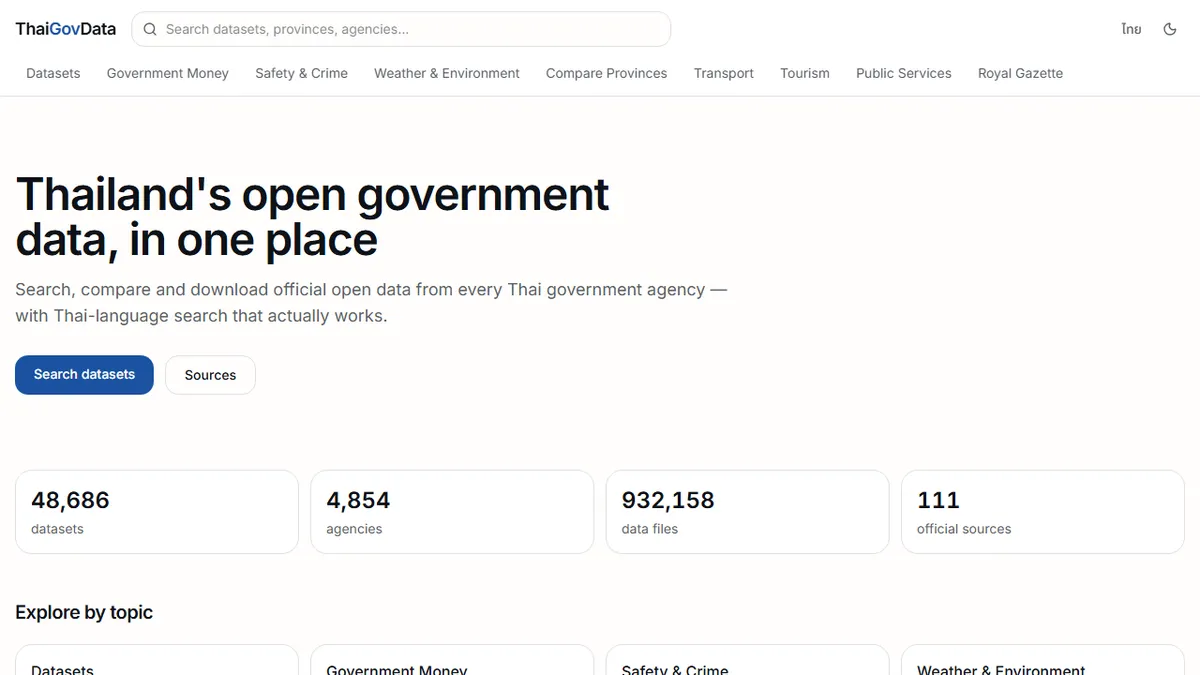
The practical way to avoid all of this is to start from a source that has already normalised the conventions. You can browse an English-language index of Thai government data where every date is stored in Common Era, Buddhist Era is re-derived for display, appropriation is kept separate from disbursement, and cross-portal duplicates are merged. Every figure on the site is read from the database rather than written into the code, and an automated check fails the build if anyone hardcodes a number.
That does not make it an official source. It is an independent index that links back to the original publisher. If a number matters to a decision, check it against the source it names. But for the first pass — understanding whether a figure is BE or CE, fiscal or calendar, approved or spent — the conventions are the story. Once you know which calendar the table is on, the numbers stop looking wrong and start looking like information.