What Runway Actually Means (and What It Doesn't)
Runway is the number of months your startup can continue operating before running out of cash. That is the entire definition. But the simplicity is deceptive. The number is only as accurate as the inputs feeding it, and most founders contaminate those inputs with optimism before the calculation even begins.
Runway does not tell you whether the business is healthy. A company with eighteen months of runway could be on a trajectory toward profitability or toward a death spiral. The runway number alone cannot distinguish between those outcomes. What it does tell you is how much time you have to make decisions and how much urgency should attach to each one. It is a countdown, not an assessment.
The most dangerous position is not knowing your runway with precision. Founders who have a vague sense that they have "about a year" left often discover (when they finally model it properly) that they have seven months. That shift in perception changes which conversations you need to have and how quickly you need to have them.
Gross Burn vs Net Burn: Which Number to Use
These two figures answer different questions. Gross burn is your total monthly outflow: every salary, every SaaS subscription, every piece of infrastructure and office cost. It is what you spend before any revenue arrives.
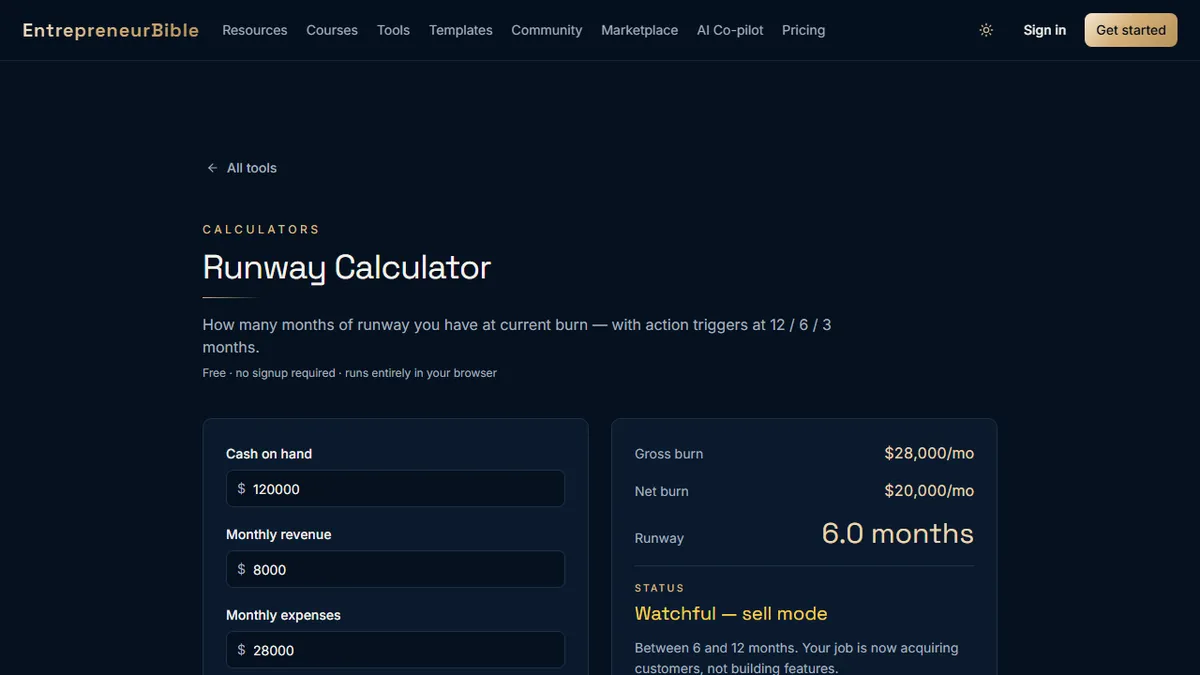
Net burn subtracts revenue from gross burn to give you the actual monthly cash reduction. If your gross burn is forty thousand per month and you are collecting twenty thousand in recurring revenue, your net burn is twenty thousand. That is the number that actually determines runway.
Both figures matter. Use gross burn to understand your cost structure and identify where cuts would have the most impact. Use net burn (paired with current cash balance) to calculate actual runway. The plain-English burn rate definition with worked examples explains how both figures evolve as a startup matures and why they diverge in ways that confuse early-stage founders.
The Correct Runway Formula — and Three Ways Founders Get It Wrong
The formula is: current cash balance divided by average monthly net burn. The result is your runway in months.
The first common error is using last month's burn as though it represents the future. Burn tends to grow as teams hire and products scale. If you modelled runway using a three-month average from a period before your last two hires, you are significantly overestimating how long the money lasts.
The second error is excluding committed but unpaid expenses. If you have signed an office lease or a vendor contract with a twelve-month term, those future obligations reduce your effective cash, even if the invoices have not landed yet.
The third error is treating expected revenue as guaranteed. Counting a deal that is "ninety percent likely to close" as cash in the bank is how runway numbers become wildly optimistic. Until the contract is signed and the payment has cleared, that revenue does not belong in the formula.
How to Model Runway Scenarios
Rather than maintaining a single runway estimate, build three versions. The conservative scenario holds revenue flat and allows burn to increase by ten to fifteen percent to account for unexpected costs. The base scenario uses current revenue growth and current burn. The optimistic scenario shows what happens if a key deal closes or a planned cost reduction executes on schedule.
The conservative scenario is the one that drives decisions. If that figure falls below six months, you have reached a critical threshold that demands action regardless of how the base or optimistic scenarios look. Use the interactive startup runway calculator to model all three scenarios against your actual numbers and update the projections monthly.
Five Levers to Extend Runway Without Raising
When runway shrinks to an uncomfortable number, raising more capital is not always the first or best option. There are five operational levers available before you open an investment conversation.
Deferred compensation for founders is often the most immediate option: converting founder salaries to deferred obligations or equity reduces cash outflow without layoffs. Annual billing incentives convert monthly subscribers into upfront payments, injecting cash immediately. Cutting non-essential SaaS tools (almost every startup has several that nobody uses) tends to recover more cash than expected once properly audited. Pausing or slowing the next planned hire delays a recurring expense while the business validates its growth rate. Finally, renegotiating vendor contracts for longer payment terms improves cash flow without reducing services.
None of these options are painless. But each is reversible, and reversible actions preserve optionality in a way that mismanaged runway does not.
When to Raise vs When to Get to Default Alive
The decision between raising capital and engineering a path to profitability depends on the shape of the business at the moment the question arises. A company with genuine product-market fit signals, strong retention, and clear unit economics can make a credible case to investors. A company with flat retention, unclear positioning, and uncertain revenue is raising to buy time, not to accelerate something proven.
The concept of default alive (coined in the startup community) asks a specific question: if growth continues at its current rate and spending remains constant, does the company reach profitability before the cash runs out? If the answer is yes, raising is optional and you can be selective. If the answer is no, the business is in a race between fundraising and failure, which is a much worse position to negotiate from.
Knowing your runway number precisely, updated monthly, is what makes this question answerable before it becomes urgent.