Who Qualifies for the Thai Non-Immigrant O-A Visa
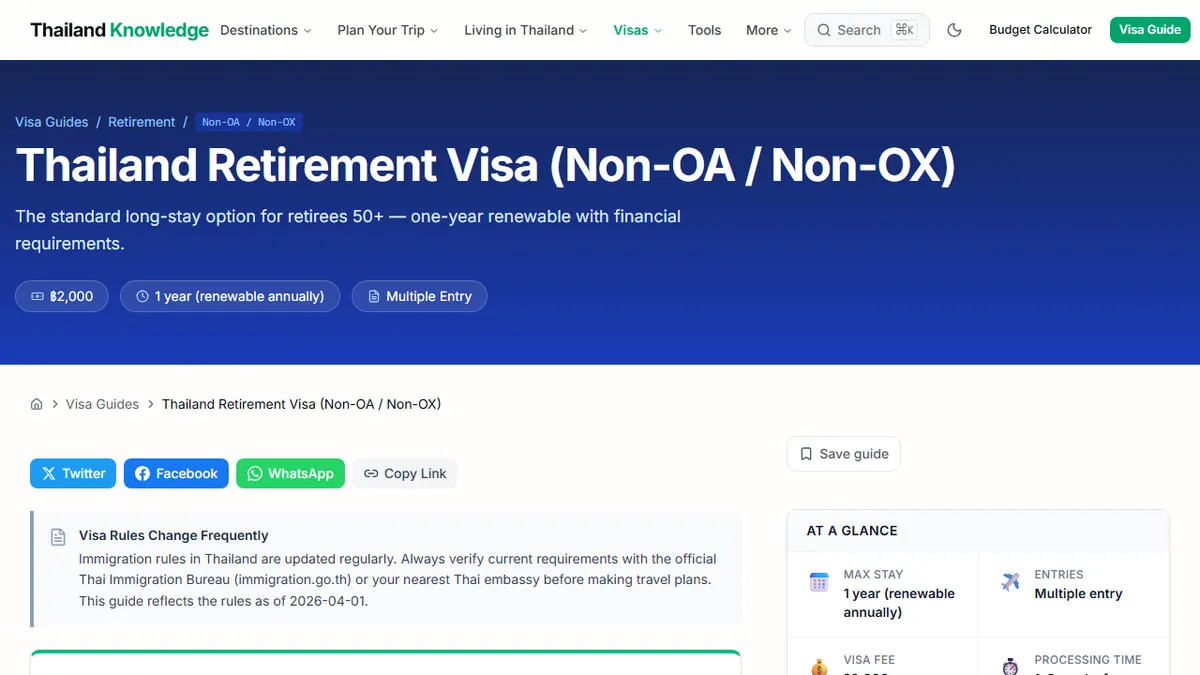
Thailand's retirement visa (formally the Non-Immigrant O-A) is available to foreign nationals aged 50 years or older. There is no requirement to have actually retired; you simply need to be the right age and meet the financial thresholds. You cannot be employed in Thailand on this visa, which means any work arrangement must be conducted through other legal frameworks if income generation within Thailand is part of your plan.
The nationality requirements are broad. Citizens of most Western countries, including the United Kingdom, the United States, Australia, Canada, and the majority of EU member states, are eligible. A small number of nationalities face additional scrutiny or are ineligible, so checking the current policy at your nearest Thai embassy before beginning an application is essential. The official retirement visa requirements and process provides an up-to-date eligibility matrix by nationality.
The Income vs Bank-Deposit Proof Options Explained
Meeting the financial requirements is where most applicants invest the most planning time. Thailand offers two routes to satisfying the financial condition, and choosing the right one for your circumstances matters.
The first route is demonstrating a monthly income or pension of at least 65,000 baht. This figure must be verifiable through official documentation: a pension statement, a letter from a government benefits agency, or certified proof of regular income deposits. Bank transfers from abroad that show consistent monthly amounts are accepted if accompanied by a letter from your home country's bank or relevant institution.
The second route is maintaining a deposit of at least 800,000 baht in a Thai bank account. This must be a Thai bank account (not an overseas account), and the funds must have been present for at least three months before the application date and remain present throughout the visa period. Seasonal deposits that spike for application purposes and then disappear are a known red flag for immigration officers and have led to rejections and bans.
A combined method is also accepted: demonstrating that your income plus your Thai bank balance together meet a threshold defined by the immigration authorities. This option suits retirees with modest but regular pensions who can maintain a partial deposit as a supplement.
Documents You Need Before You Apply
Building your document file before approaching the embassy saves considerable frustration. The core requirements are consistent across embassies, though some add supplementary requests based on your nationality.
You will need a valid passport with at least 18 months of remaining validity, passport photographs meeting the embassy's specifications, the completed visa application form, proof of financial means as described above, a police clearance certificate from your home country issued within the past three months, and a medical certificate confirming that you are free from prohibited diseases. The medical certificate must typically come from a licensed physician and be on official letterhead.
If applying from within Thailand rather than abroad, the immigration officer may request additional supporting documents, so it is worth confirming the current in-country extension requirements with the specific immigration office handling your case.
Applying from Abroad vs In-Country Extension
The O-A visa can be obtained either at a Thai embassy in your home country before departure, or as a one-year extension of stay inside Thailand if you entered on a different visa category. These two paths are slightly different in practice.
Applying at a Thai embassy abroad typically results in a one-year visa that permits multiple entries. Each entry is valid for 90 days, and you can extend your stay for the full year at a Thai immigration office after arrival. This route suits people who want certainty before relocating.
Applying for an annual extension from inside Thailand is common among retirees who entered on a tourist visa or visa exemption and then decided to stay longer. The process requires visiting an immigration office, submitting your financial documentation, and completing the medical and criminal history forms. Extensions are granted for one year at a time and must be renewed before expiry, not on the expiry date, but in the weeks before it. Missing the renewal window requires leaving the country and restarting the process.
Annual Renewal Checklist and Deadlines
Annual renewal is the rhythm of retirement visa life in Thailand. The renewal must be completed before your current permission to stay expires, and immigration offices strongly encourage applications at least 30 days in advance to allow processing time.
Your checklist for renewal: current passport and entry stamp, the TM.7 extension form completed in advance, proof of financial means updated to the current year, a passport photograph, and proof of your Thai address. Many immigration offices also require a proof-of-address form (TM.30) to have been filed by your landlord or property manager, confirming your registered place of residence. If your landlord has not filed this document, you may be required to file it yourself before your extension can be processed.
Health Insurance Requirements for O-A Holders
A health insurance requirement was formally introduced for new O-A visa applicants. Applicants must hold a policy providing at least 40,000 baht of outpatient coverage and 400,000 baht of inpatient coverage per policy year. The insurance must be from a Thai-approved insurer or from a foreign insurer whose policy meets the specified criteria and is certifiable in a format acceptable to Thai immigration.
For those renewing existing O-A visas, the enforcement of this requirement has been applied progressively, and it is prudent to assume it applies to all renewals as of 2026. Failing to carry qualifying health insurance is now a documented rejection reason, not merely an administrative oversight.
Common Rejection Reasons and How to Avoid Them
The most frequent rejection causes follow a consistent pattern. Insufficient documentation (particularly financial proof that does not meet the three-month seasoning requirement for bank deposits, or income certificates that are informal rather than officially certified) accounts for a large share of failed applications.
Criminal record disclosures are another area that can create complications. The police clearance certificate requirement is taken seriously, and a history of serious criminal convictions in any jurisdiction will be reviewed with scrutiny.
Overstay history in Thailand creates lasting problems. Overstaying a previous Thai visa by even one day generates a record that immigration officers can access, and a pattern of overstays or previous visa violations substantially reduces the likelihood of approval for any long-stay category.
The full expat retirement guide for Thailand covers the lifestyle context in full, from finding housing to navigating healthcare once you are settled. But the bureaucratic foundation is what makes the rest possible, and getting the application right the first time saves significant time, cost, and stress.