The 2023 Policy Change: What Actually Changed
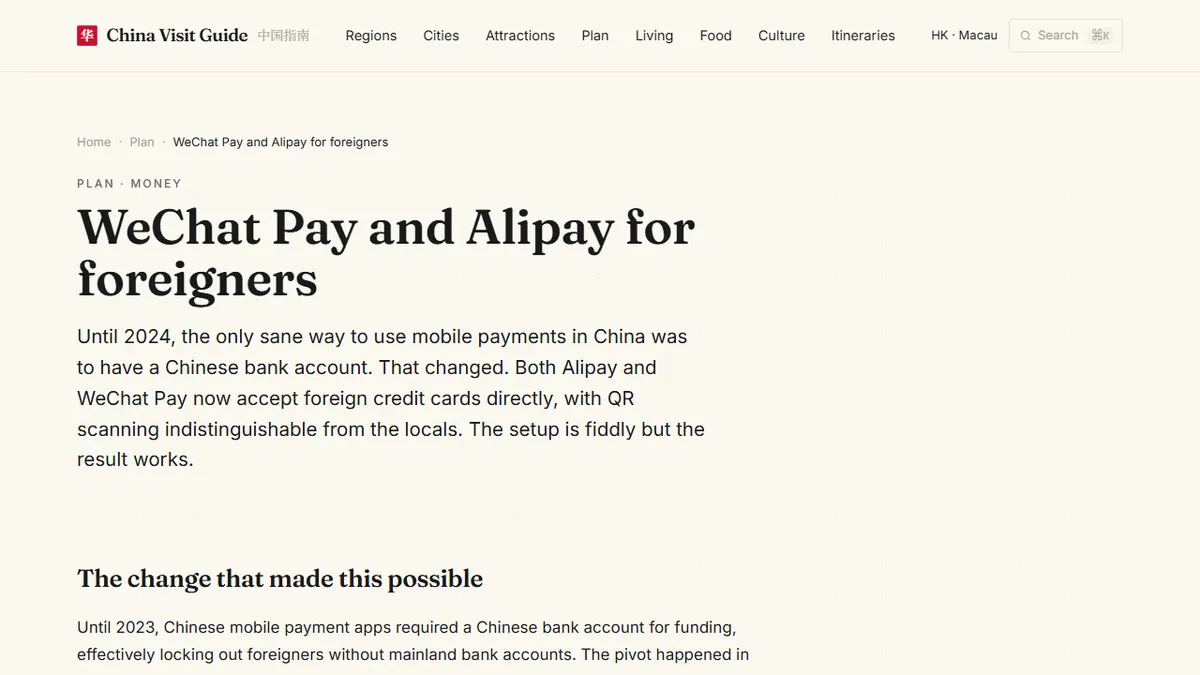
Before 2023, foreign visitors to China faced a near-total exclusion from the mobile payment ecosystem. WeChat Pay and Alipay (which between them handle the vast majority of in-person transactions in Chinese cities) both required a Chinese bank card, and Chinese bank cards required proof of Chinese residency to open. The result was a two-tier experience: residents and long-stay expats transacted seamlessly by phone, while tourists fumbled with physical cash in a society that had largely moved past it.
The 2023 policy change, introduced as part of a broader push to improve inbound tourism infrastructure, allowed both platforms to link international Visa and Mastercard debit and credit cards. This was described by some travel writers as solving the problem. That framing was too optimistic, and by 2026 the situation is more accurately described as: the barrier has been significantly lowered for most situations, but the system is not yet seamless, and there are specific contexts where foreign card linking still fails in ways that matter.
Linking a Foreign Visa or Mastercard to Alipay: Step by Step
The setup process for Alipay is the more straightforward of the two platforms. Download the app before you arrive in China. The app stores change their regional availability occasionally, and downloading from outside China removes the risk of not finding it. Open the app, create an account using your phone number, and navigate to the payment settings to add a card.
At this stage, the app will ask for your passport details, card number, expiry, and CVV. International cards from Visa and Mastercard are accepted; American Express has patchy acceptance and should not be relied upon. The card needs to have international transactions enabled, and some issuing banks add a friction step (an OTP to your registered bank phone number), which works normally if that number is your current travel SIM.
Once linked, the Alipay foreign card balance works at the vast majority of QR-code payment points in cities and at most major transport hubs. Spending limits apply (typically up to USD 10,000 in equivalent RMB per year), which is more than sufficient for a typical trip.
The full setup walkthrough, including screenshots and error message explanations, is on the WeChat Pay and Alipay setup guide for foreign visitors page.
WeChat Pay's Foreign Card Mode: Where It Works and Where It Doesn't
WeChat Pay added foreign card support slightly later than Alipay and the implementation has been narrower. The setup process is similar (link an international card through the WeChat app's payment section), but the acceptance has historically been less consistent at smaller merchants, particularly outside the major tier-1 cities.
In Shanghai, Beijing, Chengdu, and Guangzhou, WeChat Pay with a foreign card now works reliably at supermarkets, restaurant chains, transport card top-up machines, and most mid-size retailers. Where it still sometimes fails: smaller independent restaurants in tier-2 and tier-3 cities, market vendors, temple admission desks in rural areas, and anywhere that has an older QR payment terminal that processes transactions differently.
The functional difference between the two platforms in 2026 for most visitors is smaller than it was in 2024. For setting up one platform first, Alipay remains slightly more reliable for foreign card holders.
Situations Where Digital Payment Still Fails Foreign Visitors
A number of specific contexts continue to be problematic regardless of which platform you use or how well it is set up.
Hospital and clinic payments often still require a Chinese bank card or cash, particularly in public hospitals. Private and international clinics are more likely to accept card or mobile payment.
Overnight train ticket collection machines at some smaller stations still require Chinese identification for the payment step even if the ticket was booked online.
Some tourist attraction admission payments in rural or heritage areas operate on WeChat Pay or Alipay channels that are set up for Chinese ID holders only, not the international-card mode of the apps.
Transfers to other individuals via WeChat Pay are generally restricted for foreign-card accounts, meaning splitting bills or paying back a Chinese contact is not straightforward.
Government-operated facilities and museums with national ticketing systems occasionally do not recognise foreign-card transactions on the app.
Physical Cash as the Non-Negotiable Backup
Every piece of advice about mobile payments for China visitors should include this statement: bring cash. Not as your primary payment method, but as a backup for the situations where digital payment fails.
Chinese renminbi is widely accepted, and carrying 1,000-2,000 RMB in mixed denominations covers most emergencies. The places where cash is specifically useful — small temples, rural transport, older market vendors, some hospital payments — are exactly the places where a failed payment creates the most inconvenience.
ATMs at major banks (Bank of China, ICBC, China Construction Bank) reliably accept international Visa and Mastercard for cash withdrawals. Airport bank branches are the most reliably staffed for currency exchange. Be aware that foreign transaction fees from your home bank apply on top of any ATM charge, and withdrawal limits per transaction are often set at 2,500-3,000 RMB.
UnionPay Prepaid Cards: The Underrated Option
A genuinely useful option that most travel writers underemphasise: loading a prepaid UnionPay card before you travel. Several services allow non-Chinese residents to purchase a loaded UnionPay card online or at international airports in major hub cities. Because UnionPay is China's domestic card network — the underlying infrastructure that most Chinese payment terminals actually process — prepaid UnionPay cards work in virtually all situations where foreign Visa and Mastercard still fail.
The limitation is that you are loading money in advance and cannot top it up easily once in China without a Chinese bank account. For a 10-day trip with a predictable budget, this is fine. For longer or more flexible stays, the constraint becomes irritating.
For more context on this and other alternatives to the main two apps, the payment alternatives for foreign visitors who cannot set up Alipay guide covers the full range of options.
Recommended Setup Before You Land
The optimal payment setup for most foreign visitors in 2026 involves three elements working together: Alipay linked to an international card as the primary digital payment tool, WeChat Pay linked to the same or a different international card as the backup digital option, and 1,000 to 2,000 RMB in physical cash for the situations where both fail.
Download and set up both apps before you leave your home country. You will need a phone number that can receive SMS, and the verification steps are easier on a domestic connection with a familiar SIM. Enable international transactions on every card you plan to link. Keep a note of your bank's emergency number for international transaction queries, because some card issuers treat the first WeChat Pay or Alipay transaction as a fraud flag and decline it silently.