What is a peptide, and why does size matter for brain access?
A peptide is a short chain of amino acids (the same building blocks that make up proteins, but assembled into far smaller structures). Where a typical protein might contain several hundred amino acid units folded into complex three-dimensional shapes, a peptide used in cognitive research might contain anywhere from three to fifteen. That small size turns out to matter enormously when the target organ is the brain.
The blood-brain barrier is a selective filter built from tightly joined endothelial cells lining the brain's capillaries. Most large molecules cannot pass through it unaided, which is partly why drug development for brain conditions is so difficult. Small peptides, by contrast, have several potential routes into the central nervous system: some cross the barrier directly by passive diffusion or active transport, and others exploit the anatomical shortcut provided by the olfactory nerves when delivered intranasally. The brain's accessibility to a compound is not simply a matter of molecule size, but size is a significant factor, and it is one reason the peptide approach to cognitive pharmacology has attracted sustained research interest.
The Russian discovery tradition — Semax, Selank, and the ACTH lineage
The nootropic peptide field is not, for the most part, a Western invention. The foundational compounds (Semax, Selank, Noopept) emerged from Soviet and post-Soviet research institutions, particularly from groups studying the neurological effects of adrenocorticotropic hormone (ACTH) and its fragments during the 1970s and 1980s.
ACTH is a stress hormone released from the pituitary gland. Researchers noticed that certain short fragments of ACTH (particularly the segment spanning positions four to ten in the amino acid sequence) appeared to influence memory and learning in animal studies without triggering the hormonal cascade that the full molecule produces. This was a significant discovery: it suggested that the cognitive activity of a stress hormone could be isolated from its endocrine effects by working with the right fragment.
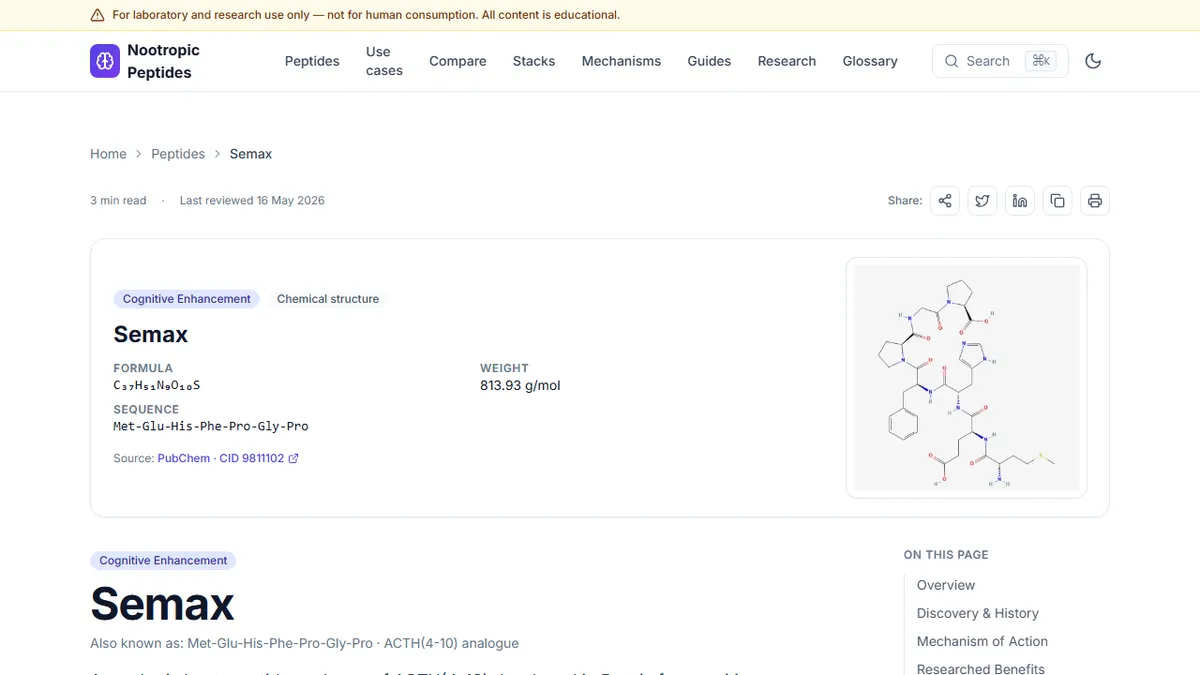
Semax was engineered directly from that ACTH(4-10) fragment, with modifications to improve metabolic stability. Selank was built around tuftsin, an endogenous immunomodulator, and extended with stabilising amino acids to produce an anxiolytic peptide. This tradition of taking an endogenous molecule, identifying its cognitively relevant component, and engineering stability into a research tool is the core methodology of the Russian cognitive-peptide school.
How nootropic peptides differ from conventional racetam nootropics
Many people first encounter the concept of cognitive enhancement through racetams (piracetam, aniracetam, oxiracetam), a compound class that originated with Corneliu Giurgea's work in the 1960s. The racetam family acts primarily through modulation of cholinergic neurotransmission and AMPA receptor sensitivity, and its members are small, orally stable synthetic molecules with well-documented tolerability profiles.
Nootropic peptides represent a pharmacologically distinct approach. Rather than modulating receptor sensitivity at the synapse, many of them act upstream at the level of gene expression, inducing the production of neurotrophic growth factors such as BDNF and NGF that regulate synaptic plasticity on a longer timescale. This means the cognitive effects, where demonstrated, often develop over days to weeks rather than hours, and the mechanism is tied to structural changes at synapses rather than acute neurotransmitter modulation.
The practical implication for researchers is that these two compound classes are measuring different things and are best suited to different research questions. Asking whether a racetam or a nootropic peptide produces a better cognitive effect is somewhat like asking whether a speedometer or an odometer is a better instrument — the answer depends entirely on what you need to measure.
The four main research categories: cognitive, anxiolytic, neuroprotective, sleep
The nootropic peptide family is not pharmacologically uniform. Compounds within it have been developed for four broadly distinct primary purposes, and understanding this taxonomy helps avoid the mistake of treating them as interchangeable.
Cognitive-enhancement peptides (principally Semax and Noopept) are the compounds most often associated with the field. Their primary research endpoints involve memory, attention, and learning, with BDNF induction as the key mechanistic anchor. Anxiolytic peptides, with Selank as the central example, target the enkephalinase system to raise endogenous enkephalin tone and reduce anxiety without sedation. Neuroprotective peptides, including Cerebrolysin and compounds from the Khavinson bioregulator school, are studied primarily in the context of age-related decline, stroke recovery, and neurotoxic injury. Sleep-modulating peptides, of which DSIP (delta sleep-inducing peptide) is the primary example, affect sleep architecture rather than waking cognition directly, and their cognitive relevance comes through the well-established relationship between slow-wave sleep and memory consolidation.
Most compounds blur these categories somewhat (Semax has both cognitive and neuroprotective evidence, and Selank has both anxiolytic and cognitive effects), but understanding the primary research identity of each helps calibrate expectations appropriately.
What 'research use only' actually means under UK law
Every legitimate supplier of nootropic peptides in the United Kingdom labels their products with some variation of "for research use only" or "not for human consumption." These phrases have a specific meaning under UK medicines law that is worth understanding precisely.
The Human Medicines Regulations 2012 define when a compound becomes a regulated medicinal product: primarily when it is presented as having effects on physiological function or as being suitable for administration to humans for medical purposes. A compound that is sold without any such claims (as a laboratory research chemical with no accompanying medical framing) does not automatically fall within that regulatory definition, and can be lawfully supplied in that context.
The critical point is that "research use only" is not a blanket exemption from regulation. It describes a specific lawful use case, and the boundary between that use case and unlicensed medicine supply is defined by how the compound is presented, labelled, and sold. Researchers working with nootropic peptides in the UK need to understand that framing matters legally, and that compounds purchased for legitimate in vitro or preclinical research should be used within that scope.
Five things to understand before reading any peptide study
Research quality in this field varies widely, and a few interpretive frameworks go a long way toward reading the literature accurately. First, animal studies (which constitute the majority of the published corpus) measure rodent cognition, not human memory. Rat hippocampus BDNF mRNA is a molecular endpoint, not a clinical outcome, and the translation gap between the two is real and often understated.
Second, most clinical studies in the field originated in Russia and Eastern Europe. This does not automatically invalidate them, but it does mean that trial methodology, blinding standards, and control conditions should be examined critically rather than taken on trust. Third, effect sizes in published trials are often reported without the context needed to assess clinical significance: a statistically significant improvement on a cognitive battery score may or may not represent a meaningful difference in daily function.
Fourth, publication bias is a real concern in a field where most research comes from groups with institutional investment in the compounds under study. Fifth, and perhaps most importantly, consult the introductory guide to research peptides before drawing strong conclusions from any single study — the field rewards readers who approach it with calibrated scepticism rather than either uncritical enthusiasm or reflexive dismissal.