What the CCRC Is and Is Not
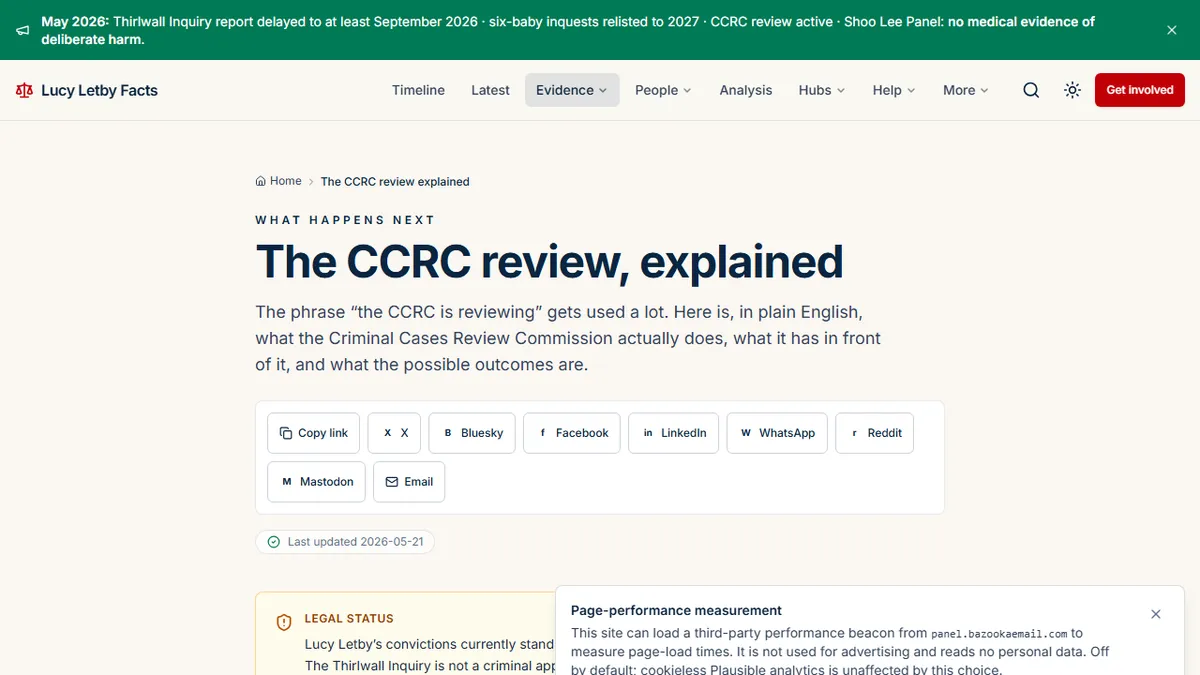
The Criminal Cases Review Commission is an independent public body established by the Criminal Appeal Act 1995. Its function is to review potential miscarriages of justice in England, Wales, and Northern Ireland. When it finds that a real possibility exists that a conviction, verdict, or sentence would not be upheld on appeal, it refers the case to the relevant appeal court.
The CCRC is not an appellate court. It cannot quash a conviction. It cannot declare anyone innocent. It cannot substitute its own verdict for the jury's. What it can do is place a case back before the Court of Appeal (the body with the legal power to quash a conviction) on the basis of evidence or arguments that were not adequately considered the first time.
It also has considerable investigative powers that direct appellants do not. It can require disclosure of documents from public bodies, commission its own expert reports, and access materials that the defence may not have been able to obtain at trial or during a first appeal. This investigative capacity is one of the reasons the CCRC route is often more productive than a direct second appeal attempt, particularly in cases where the evidential picture has changed substantially since the original trial.
For anyone following the Lucy Letby case, the plain-English guide to the CCRC review process maps the institutional mechanics in more detail.
The Referral Threshold: What 'Real Possibility' Means in Law
Section 13 of the Criminal Appeal Act 1995 sets the threshold for referral: the Commission must not make a referral unless it considers that there is a real possibility that the conviction, verdict, finding or sentence would not be upheld were the reference to be made.
The phrase "real possibility" is a legal term of art. It does not mean certainty. It does not mean the Commission believes the defendant is innocent. It means that, on the basis of the material now before the CCRC, a reasonable Court of Appeal could conclude that the conviction is unsafe. Unsafe is itself a term of art in English appeal law: a conviction is unsafe when it cannot be relied upon, whether or not the court is satisfied that the defendant is guilty.
The threshold requires either new evidence not considered at trial or a new argument of law not raised before. In practice, most CCRC referrals rest on new expert evidence that post-dates the original proceedings, new scientific understanding, or newly disclosed documentary material. A referral does not require the CCRC to conclude that the conviction was wrong. It requires only that there is a real, as opposed to speculative, possibility that the appellate court would find it unsafe.
How a CCRC Application Is Built and Filed
An application to the CCRC can be made by the convicted person, their legal representative, or in some circumstances by a third party. There is no formal time limit, though a final domestic appeal must ordinarily have been exhausted before the CCRC will accept the application. The application sets out the grounds on which it is argued that the conviction may be unsafe, supported by any evidence the applicant has assembled.
The CCRC then undertakes its own review. A case review manager is assigned and examines the existing case materials. Where the grounds raise scientific or technical questions, the CCRC may commission independent expert reports. Where disclosure questions arise, it may formally require relevant bodies to provide documents. The review can last months or years, depending on the complexity of the case and the volume of material.
In the Letby case, the application was received on 3 February 2025. Since then, the published chronology of filings in the Letby CCRC application records nine further filings between February 2025 and January 2026, including supplementary expert submissions and paediatric-pathology re-readings. This is consistent with a live, actively developed application rather than a static filing.
What Happens After a Referral: the Court of Appeal Stage
If the CCRC makes a referral, the case proceeds to the Court of Appeal as if it were a renewed leave-to-appeal application by the defendant. The Court of Appeal then considers the conviction in light of the new grounds. It applies the statutory test from section 2 of the Criminal Appeal Act 1968: it must allow an appeal against conviction if it thinks the conviction is unsafe, and must dismiss it in any other case.
The Court of Appeal is not a retrial. It does not hear witnesses afresh, assess credibility, or apply the criminal standard of proof. It reviews the trial record alongside the new material and asks whether, in light of what is now known, the conviction is one that should stand.
Why a First Appeal Refusal Does Not Close the Door
A direct appeal that fails (including a refusal of leave to appeal) does not prevent a subsequent CCRC application. The CCRC route exists precisely because the direct-appeal route can fail while the evidential picture is still incomplete. The statutory structure separates the two paths intentionally: a first appeal is decided on the evidence then available, and the CCRC reviews cases where subsequent evidence or argument changes the picture.
This is not a theoretical distinction. In the Letby case, a direct appeal was refused in May 2024. The Shoo Lee International Expert Panel report, the Joint Expert Witness insulin report, and several independent paediatric-pathology re-readings were all produced after that refusal. The CCRC's task is to assess whether those subsequent developments meet the referral threshold. That is a question the May 2024 refusal did not and could not have answered.
How Long Does a CCRC Review Typically Take?
CCRC reviews vary considerably in duration. Simple cases with a narrow evidential issue can be resolved in months. Complex multi-count cases with extensive scientific evidence and large documentary records routinely take several years. The average time from completed application to decision across all CCRC cases has historically been in the range of one to three years, but this average masks wide variation.
Cases involving contested medical expert evidence in serious criminal proceedings tend to sit at the longer end of the range, because the CCRC typically commissions its own independent expert assessments rather than relying solely on the applicant's submissions. Where those assessments generate further questions, the review extends accordingly.
The Donna Anthony Precedent — CCRC Route in Practice
Donna Anthony was convicted in 1998 of murdering her infant son and daughter, substantially on expert medical evidence from the same pool of paediatric pathologists whose testimony came to be regarded as methodologically flawed following the Sally Clark appeal in 2003. Her first appeal was refused. She applied to the CCRC, which referred the case after the post-Clark expert consensus had shifted sufficiently to meet the real-possibility threshold. The Court of Appeal quashed her conviction in 2005.
The Anthony case illustrates how the CCRC route functions in practice when the underlying scientific framework of a prosecution has been substantially challenged after an initial appeal has failed. The mechanism does not depend on discovering new facts about the specific case. It depends on a demonstrable shift in the expert consensus on the methodology underlying the prosecution evidence. That precedent is directly relevant to the Letby application.