Why Online Wellness Is a Uniquely Risky Space
The appeal of wellness content is straightforward: it arrives when someone is suffering, offers hope, and delivers that hope through a personal, approachable voice. That combination (vulnerability plus intimacy) is also the combination that makes the wellness space unusually susceptible to influence dynamics that shade into control.
Most creators in this space are entirely well-intentioned. But the structural conditions of online content creation create the precise environment in which BITE-model patterns can emerge without anyone necessarily planning them: algorithm rewards for engagement and loyalty, monetisation models that incentivise inner-circle hierarchies, and comment sections that generate powerful belonging.
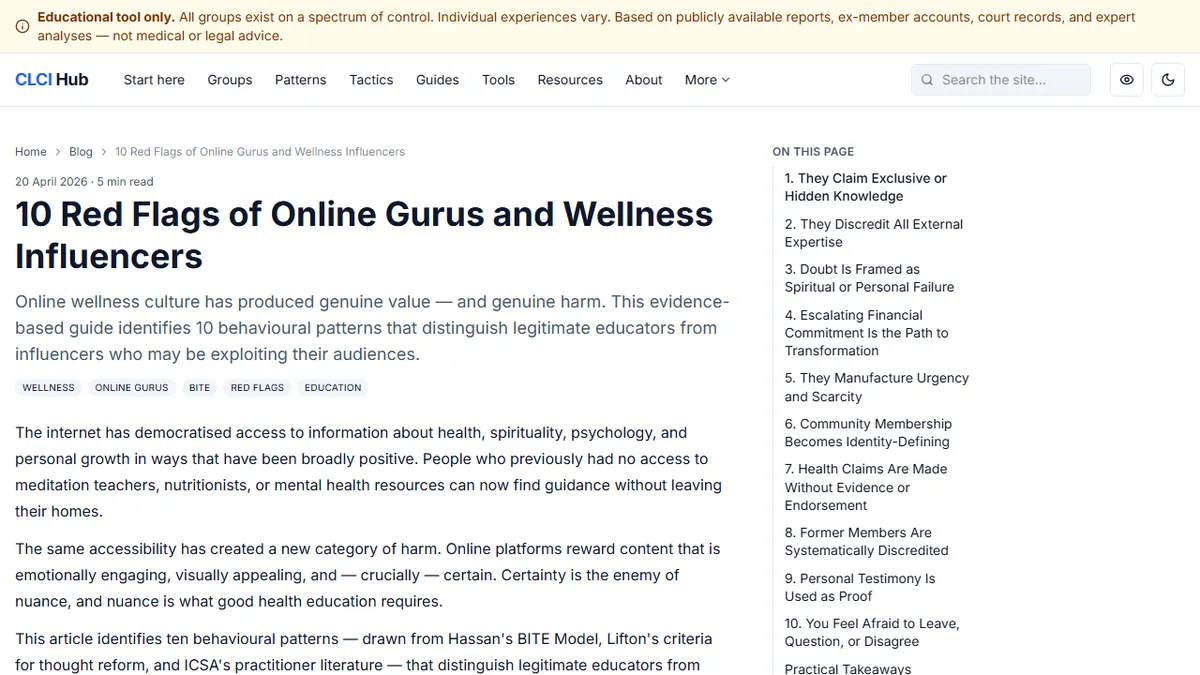
The evidence-based analysis of online guru warning signs documents this in more depth. What follows is a practical reference for anyone who wants to evaluate a wellness figure they follow or are considering following.
Red Flags 1–3: Information and Credibility Claims
Red Flag 1: All outside expertise is pre-emptively discredited. A wellness creator who consistently frames mainstream medicine, academic nutritional science, or regulatory agencies as captured, corrupt, or simply inadequate is doing something specific: they are teaching followers to distrust any source that might contradict them. The creator's content becomes, by design, the only reliable epistemological anchor. Healthy creators recommend specific practitioners, cite studies, and acknowledge the limits of their own knowledge.
Red Flag 2: The creator claims a proprietary discovery that experts refuse to acknowledge. This is a near-universal feature of high-control wellness content. The mechanism of suppression varies (pharmaceutical industry capture, academic gatekeeping, government conspiracy), but the core claim is always the same: this creator has access to knowledge that the establishment is hiding from you. This framing serves a dual purpose: it elevates the creator and it pre-emptively neutralises any expert criticism.
Red Flag 3: Testimonials replace evidence. Compelling personal transformation stories are powerful and, in moderation, legitimate. They become a red flag when they are the primary or exclusive form of evidence offered, when critical or neutral outcomes are absent from the narrative, and when followers who report negative experiences are systematically discouraged, dismissed, or removed from the community.
Red Flags 4–6: Financial Escalation Patterns
Red Flag 4: The free tier exists mainly to demonstrate inadequacy. Free content that consistently communicates "you can't get the full benefit without the paid programme" is a structured escalation model, not just marketing. The free content establishes the guru's credibility and the follower's problem; the paid tier promises the solution. When the paid tier also has a premium tier, and the premium tier has a mastermind, the architecture of financial capture becomes visible.
Red Flag 5: Purchase is framed as a commitment to your own healing. Spending money becomes morally charged when a creator suggests that not investing financially is evidence of self-sabotage, insufficient commitment, or unwillingness to prioritise your health. This framing transfers responsibility for outcomes from the creator to the follower, while simultaneously making non-purchase feel like a personal failing rather than a reasonable consumer decision.
Red Flag 6: Urgency and scarcity are permanent features of the sales environment. Occasional limited enrolment periods are standard marketing practice. When every product launch involves countdown timers, "never offered at this price again" language, and claims that spots are nearly gone. When this is the perpetual state of the creator's commercial environment, it signals that urgency is being engineered rather than genuine.
Red Flags 7–8: Community and Identity Capture
Red Flag 7: The community develops its own language that gradually excludes outsiders. In-group vocabulary is normal in any community with a shared interest. It becomes a red flag when the language specifically frames outside-world experiences and relationships, when it assigns negative labels to people who have not committed to the guru's framework, and when followers begin using the vocabulary to evaluate their own lives in ways that consistently prioritise the community. Loaded language is one of the clearest indicators of advancing thought control.
Red Flag 8: Followers are encouraged to see the community as their primary or only true support network. Wellness content that persistently frames conventional friendships, family relationships, and professional support as "low-vibe," "unsupportive," or insufficiently conscious is doing something recognisable: it is engineering social dependency on the community. Healthy wellness communities encourage members to build broad support structures, not narrow ones.
Red Flags 9–10: Exit Barriers and Fear Tactics
Red Flag 9: Leaving or questioning is associated with specific negative consequences. A high-control wellness creator who suggests, explicitly or implicitly, that people who leave the community will suffer relapse, energetic harm, loss of progress, or spiritual consequences is engineering what cult researchers call phobia indoctrination. The fear is not about losing access to content. The fear is about what happens to you as a person if you disconnect. This is among the most serious red flags on this list.
Red Flag 10: Former followers are publicly characterised in ways that serve as warnings to current ones. The treatment of people who leave a community reveals its actual values more clearly than any content about healing and empowerment. When departures are followed by public characterisation of the former member as unhealed, ungrateful, or spiritually compromised, the message to remaining members is precise: leaving means being talked about this way.
What to Do If You Recognise These Patterns
Recognising these patterns in a community you already belong to is genuinely uncomfortable. It does not necessarily mean you need to leave immediately, and it does not mean that everything you have received from the community is invalid.
What it means is that you have useful information, and you should think carefully about what to do with it. Talk to people outside the community about what you are noticing. Consult sources that are explicitly not endorsed by the creator. Pay particular attention to what happens when you try to access outside perspectives: whether that feels neutral, slightly guilty, or actively dangerous is itself diagnostic.
If you are supporting someone else who is involved with a creator displaying several of these flags, the evidence-based guidance from exit counsellors applies: maintain the relationship without reinforcing the community's authority, ask questions rather than making arguments, and be a bridge to the outside rather than an ultimatum.