What the CLCI Number Actually Measures
The number at the top of every CLCI Hub profile is not an opinion. It is the output of a structured assessment methodology grounded in decades of cult-studies research, and understanding how it is calculated is the first step to using it well.
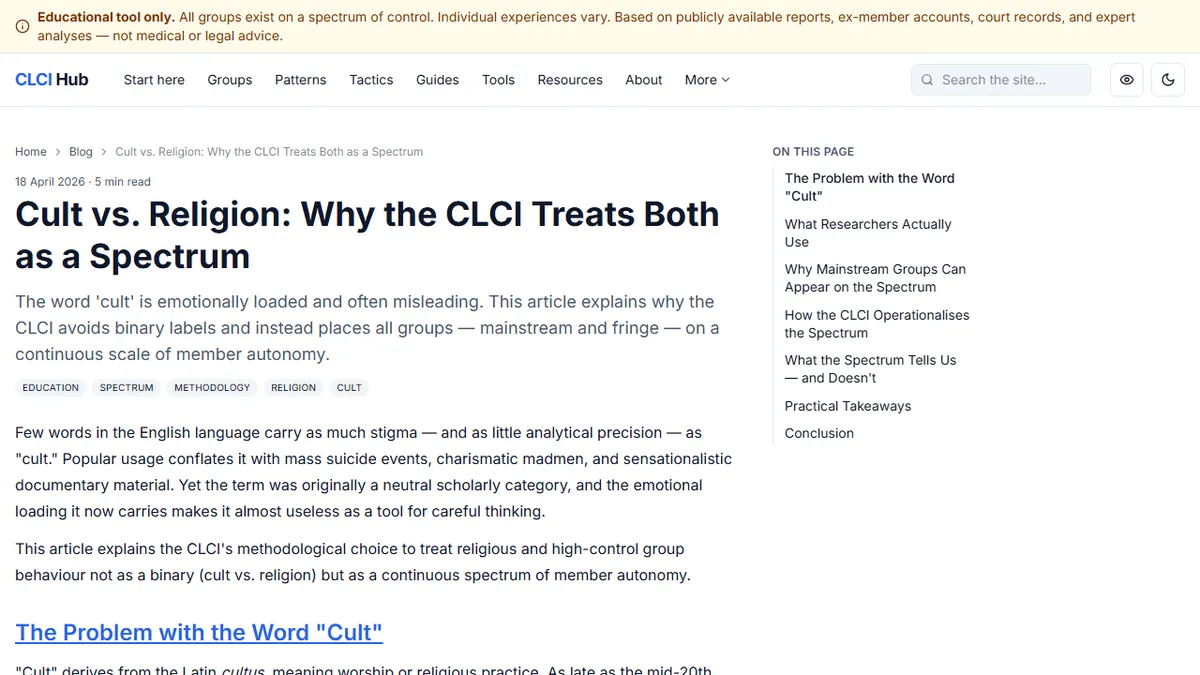
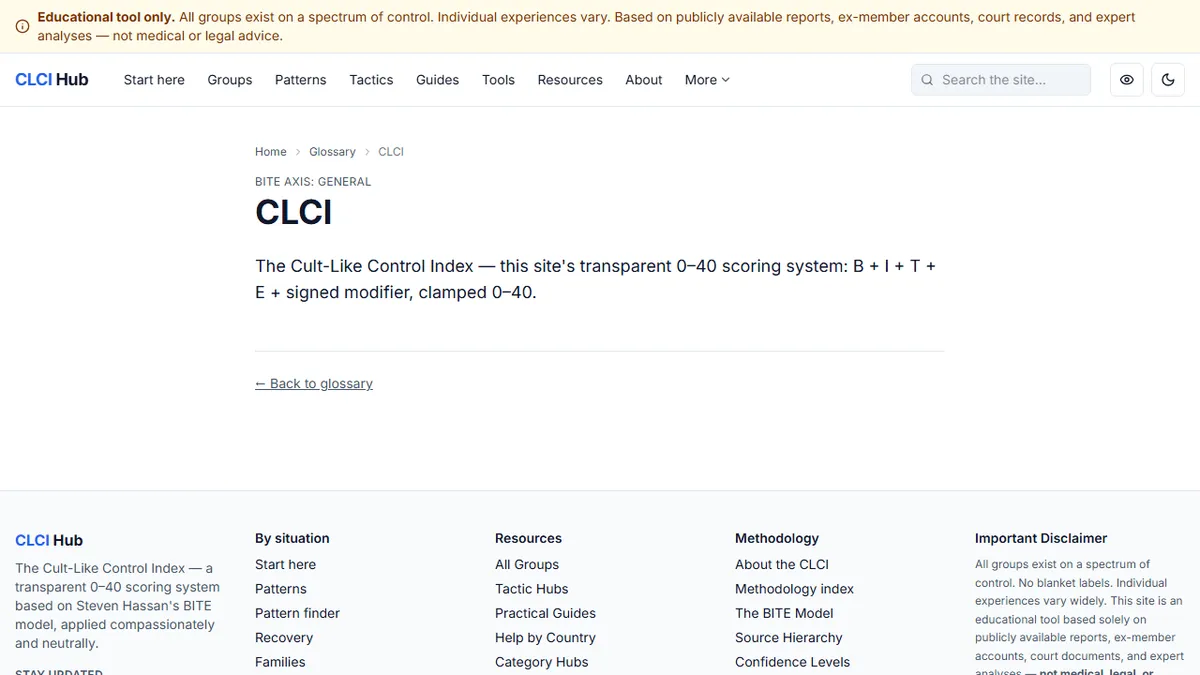
CLCI stands for Cult-Like Control Index. The score runs from zero to forty, and it measures the degree to which a group exercises systematic control over the lives, thoughts, and identities of its members. A score of zero does not mean a group is perfect. It means the available evidence does not demonstrate high-control patterns. A score of forty indicates that every dimension of the assessment points toward pervasive, harmful dominance. Most groups that end up on the database sit somewhere in the middle, which is exactly why the banding system matters.
For the complete scoring framework, the official CLCI definition and methodology explains both the calculation and its theoretical foundations in detail.
The Four BITE Categories: Behavior, Information, Thought, Emotional
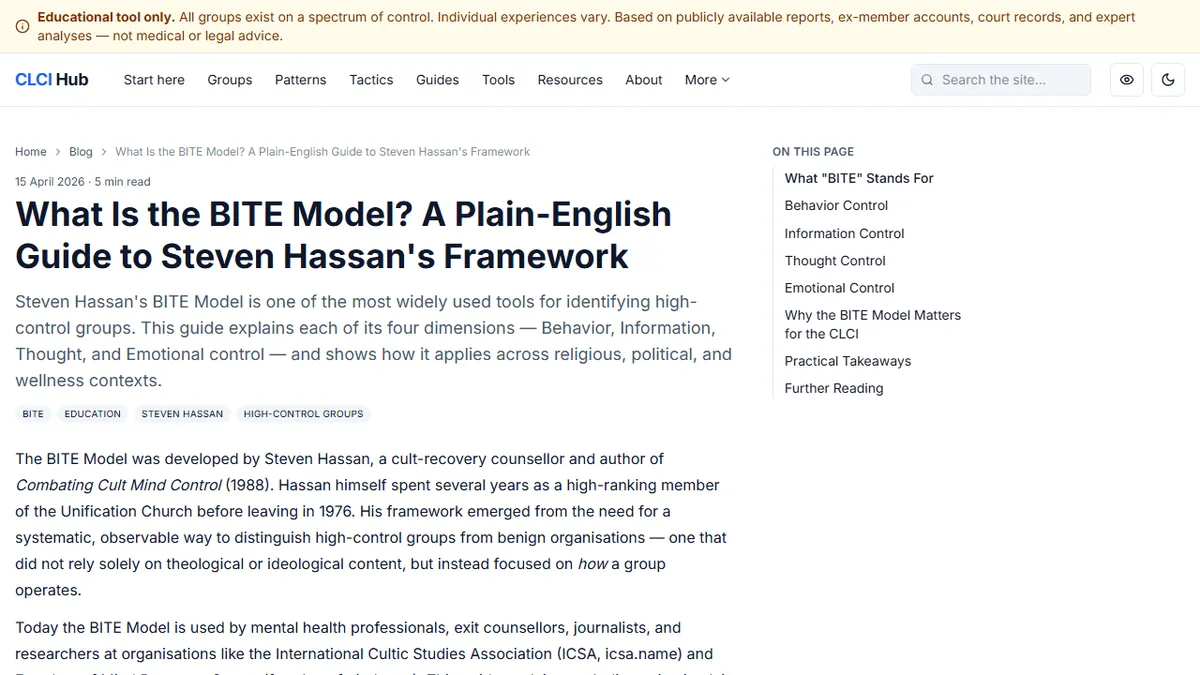
The score is built from four component categories, each rated from zero to ten. Together they form the BITE acronym (Behavior, Information, Thought, and Emotional), a framework developed by psychologist and former cult member Steven Hassan and published in his 1988 book on cult mind control.
Behavior control refers to how extensively the group dictates members' daily lives: sleep schedules, diet, dress, sexual practices, financial decisions, and use of time. A group that requires every waking hour to be structured around community activities scores higher here than one that simply holds weekly meetings.
Information control measures how the group manages what members are allowed to read, watch, discuss, and believe about the world outside. The more a group designates outside sources as dangerous, biased, or spiritually contaminating, the higher this dimension scores.
Thought control captures the use of loaded language, thought-stopping techniques, and the requirement to interpret all experience through the group's specific doctrinal framework. Groups that teach members to dismiss critical thoughts as "spiritual attack" or "reactive mind" score high in this dimension.
Emotional control describes how the group regulates members' feelings: through love-bombing new recruits, deploying guilt and shame as compliance tools, inducing phobias about the consequences of leaving, and using approval withdrawal as a disciplinary mechanism.
How the Modifier System Works (And Why It Can Go Negative)
After the four BITE scores are summed, a modifier between minus five and plus five is applied. The modifier captures factors that either compound harm or genuinely mitigate it — factors that do not fit neatly into the four main categories.
Positive modifiers are applied when there is documented physical harm to members, when the group targets especially vulnerable populations such as minors or people experiencing mental health crises, or when there is a pattern of financial exploitation serious enough to constitute a distinct control mechanism beyond the standard BITE analysis.
Negative modifiers reflect genuine institutional transparency, legal compliance, independent financial auditing, or other structural safeguards that meaningfully limit control despite elements that would otherwise push the score upward. A group that scores a combined twenty-two across its four BITE dimensions but has strong, demonstrable accountability mechanisms might carry a minus-two modifier and appear on the database at twenty.
The modifier system also explains why the scale can theoretically reach forty even if the raw BITE total is thirty-eight — and why occasional profiles carry a final score lower than the sum of their components.
Reading the Four Grading Bands: Low, Moderate, High, Destructive
The numerical score maps onto four descriptive bands that make the data more immediately usable.
A score between zero and ten falls in the Low band. This score falls short of meaning the group is ideal, only that the documented evidence of systematic control is minimal. Healthy religious communities, many political clubs, and most professional associations sit in this range.
Eleven to twenty is Moderate. Evidence of control patterns is present and documented, but the overall picture is not pervasively harmful. Many large denominations and some wellness communities fall here. Readers should treat a Moderate score as a signal to look more carefully rather than an automatic warning.
Twenty-one to thirty is High. At this level, the BITE evidence is substantial and corroborated. Members in High-band groups typically experience meaningful constraints on their autonomy, information access, and social lives. This is the range where exit costs become significant and professional support for those leaving becomes advisable.
Thirty-one to forty is Destructive and Extreme. The assessment evidence at this level indicates pervasive control across most or all BITE dimensions, often combined with documented physical harm, financial exploitation, or both. Groups in this band include those responsible for mass casualties and systematic abuse of children and adults over decades.
What a Score Does NOT Tell You
A CLCI score does not determine whether a group's theology is true or false. The database is not in the business of adjudicating religious claims. A group can hold unusual metaphysical beliefs and score low; a group can hold mainstream theological positions and score extremely high.
The score also does not mean that every member is equally harmed, or that leadership is necessarily acting in bad faith rather than genuinely believing what it teaches. Many high-scoring groups contain members who report positive experiences, which is actually a feature of how high-control dynamics work, not evidence against the score.
Finally, a high score is not a legal finding. The CLCI is an educational tool, and the database is explicit about this.
Practical Takeaways: Three Questions to Ask Before Drawing Conclusions
The most useful way to approach a CLCI profile is with a small set of interpretive questions. First: what is the confidence level on this entry? A High Confidence score rests on court records, peer-reviewed research, and multiple independent assessments. A Low Confidence score may be accurate but is drawing on thinner evidence, and should be weighted accordingly.
Second: which BITE dimension is driving the score? A group that scores heavily on Behavior control is doing something quite different from one that scores equally on Thought control. The dimension breakdown tells you where to focus your further research.
Third: is the score recent? Some entries reflect conditions that existed decades ago. Groups change (occasionally for the better) and the profile notes will indicate whether an assessment reflects current conditions or a historical snapshot.
Read the profile, read the sources it cites, and let the score be the beginning of your analysis rather than the end of it.