On this page
The Legal Definition Everyone Quotes — And Its Limits
The Federal Trade Commission distinguishes a legitimate multi-level marketing company from an illegal pyramid scheme primarily by asking whether the business generates meaningful revenue from retail sales to actual customers, or whether it exists mainly to recruit new distributors whose sign-up fees fund payouts to those above them.
This is a real distinction with real legal weight. Courts have used it, the FTC enforces it, and it matters for anyone evaluating whether a specific company's compensation structure is fraudulent under US law.
But it is an extraordinarily narrow lens. It answers the question of whether a company's financial structure qualifies as illegal fraud. It says absolutely nothing about whether that same company uses psychological control mechanisms that reshape members' identities, social relationships, and ability to think critically about their involvement. Those are different questions, and the CLCI database is designed to answer the second one.
What CLCI Scores Reveal About Financial Extraction Mechanics
The BITE framework captures financial exploitation as a modifier rather than as one of its four primary dimensions, which is appropriate, because the financial mechanics of a direct-sales organisation do not automatically produce high-control patterns. A company can structure its compensation in deeply exploitative ways while exercising minimal control over members' daily lives, information access, or social relationships.
Where financial extraction and psychological control converge in MLM structures is typically in the way spending is reframed as identity expression. These are positioned not merely as business expenses but as evidence of commitment, belief, and personal development: the starter kit, the monthly autoship order, the coaching programme, the mastermind retreat. When failing to spend becomes evidence of self-limiting beliefs, spending has been transformed into a loyalty test.
This architecture shows up clearly in CLCI assessments when the financial escalation is bundled with thought-control mechanisms that make financial non-participation feel like spiritual or personal inadequacy.
Identity Capture: How Some MLMs Score High on Thought Control
The thought-control dimension of the BITE assessment is where certain MLMs diverge most dramatically from ordinary bad-faith businesses.
A company can sell overpriced products via a broken compensation structure. That is financial exploitation. What takes a direct-sales company into high-control territory is when the company's ideological content progressively replaces members' pre-existing sense of self with a group-derived identity.
The mechanisms are recognisable: a proprietary vocabulary that reframes ordinary life as "corporate slavery" or "trading time for money"; a development curriculum that attributes career, relationship, and health challenges to mindset deficiencies that only the company's training can correct; leadership content that frames commitment to the business as equivalent to commitment to one's own worth as a human being.
When someone's business performance becomes the measure of their personal value, the organisation has achieved something that goes beyond financial exploitation. It has installed an evaluative framework in which leaving the organisation feels like abandoning not just an income source but a version of oneself.
Comparing Amway, Herbalife, and LuLaRoe on the BITE Scale
CLCI profiles for several of the largest and most scrutinised MLM companies illustrate the range within the category. The companies are not identical. Their control profiles differ significantly even when their financial structures look superficially similar.
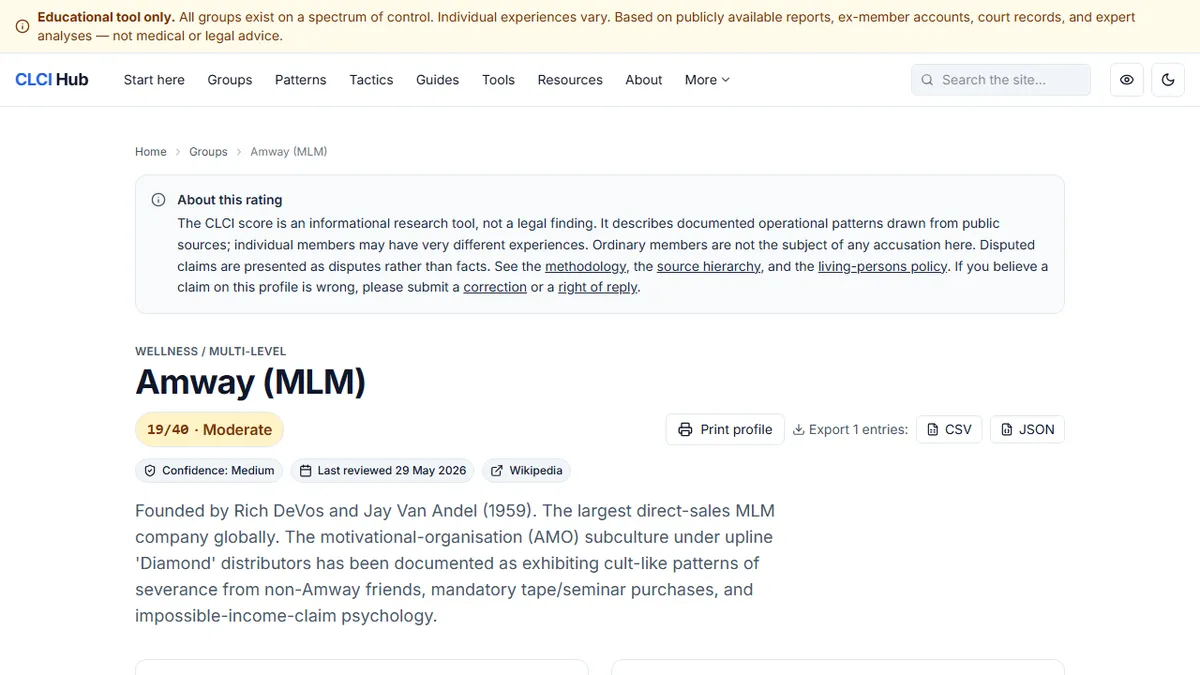
Amway's full CLCI profile and BITE breakdown reflects decades of documented practice in which certain Amway lines of sponsorship function with distinctly cultish characteristics: motivational organisations that run parallel to the official company structure, charging members for tapes, books, and conferences, and deploying a success ideology with strong thought-control characteristics. Amway corporate has attempted to distance itself from the most extreme manifestations, but the underlying architecture persists in many sponsorship lines.
Herbalife's documented conduct (extensively litigated in its 2016 FTC settlement) focused primarily on the compensation structure, but member testimony and internal communications also revealed elements of identity capture through health-coach training programmes and community events designed to generate deep social investment in the organisation.
LuLaRoe's CLCI score and identity-capture evidence reflects a company whose rapid growth between 2015 and 2018 was accompanied by extensive documentation of the emotional and financial harm to its predominantly female distributor base. The company's internal culture relied heavily on religious framing and testimonial culture, creating an environment in which financial losses were reinterpreted as spiritual lessons and doubt was treated as a faith failure.
The 'Boss Babe' Pipeline: Community as a Control Vector
One of the distinctive features of contemporary MLM control dynamics (particularly in companies targeting women) is the use of community as the primary control vector.
The boss-babe pipeline typically begins with aspirational content about financial independence, work-life balance, and sisterhood. It progressively creates social investment through group chats, local meetups, and national conferences. The community becomes the primary source of support, encouragement, and social life for active members. Departure from the business structure then becomes socially costly in ways that are entirely disconnected from the financial question of whether the compensation plan works.
This is textbook behavior and emotional control in a commercial packaging. The product being sold is belonging, identity, and a socially reinforced sense of purpose, not leggings or nutrition shakes. The financial extraction is almost secondary to the identity architecture that makes the financial extraction sustainable.
What to Ask Before Joining Any Direct-Sales Organisation
The questions that reveal the most about a direct-sales company's control dynamics are not the ones about income projections. They are about social architecture and identity pressure.
Ask what happens to people who decide to leave after a year. Ask whether you are expected to buy the products yourself on an ongoing basis regardless of customer sales. Ask whether the training content addresses your personal beliefs, mindset, or life philosophy in addition to sales techniques. Ask whether the community you would be joining is primarily composed of people who are also distributors, or whether you would maintain significant relationships outside the network.
Ask, specifically, what happens when someone expresses doubt about the opportunity. The answer to that question reveals more about whether an organisation operates with high-control characteristics than any income disclosure statement.