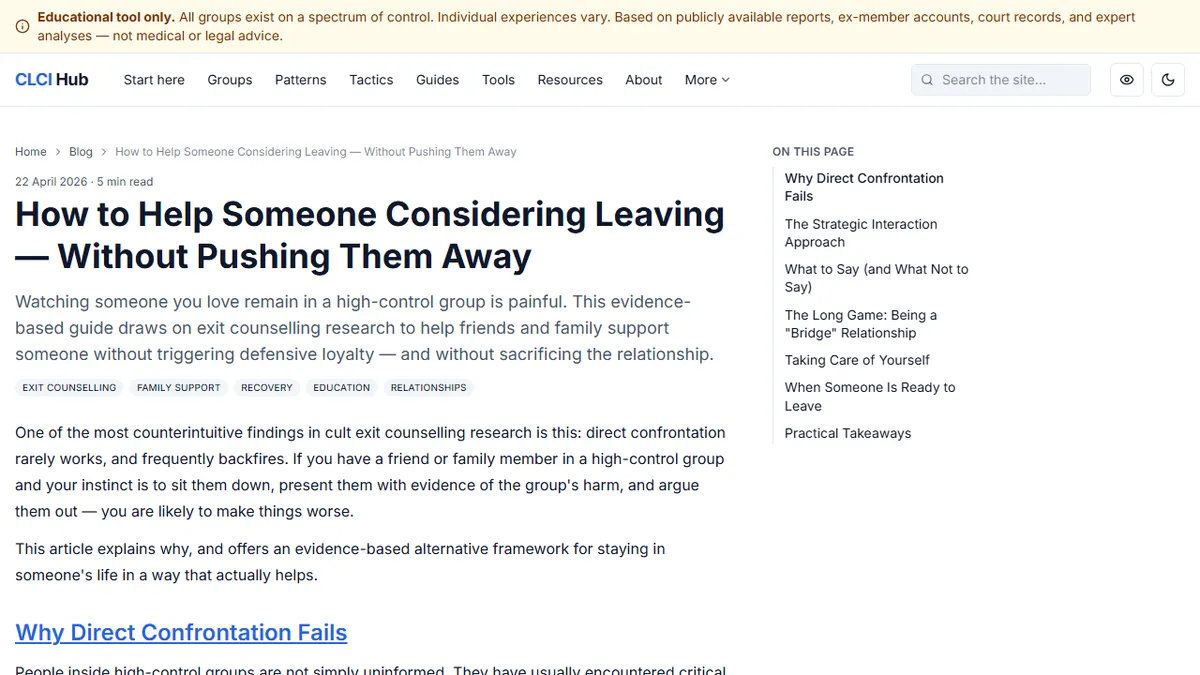
On this page
Why Direct Confrontation Almost Always Backfires
When someone you love is deepening their involvement in a group that you are increasingly worried about, the instinctive response is to confront them with the evidence. You find the exposé articles, the court documents, the survivor testimonies. You prepare your arguments. You sit down and make your case.
It almost never works. More often, it accelerates exactly the outcome you were trying to prevent.
This is not because the person is stupid or beyond reason. It is because high-control groups specifically train members to interpret outside criticism as evidence that critics are spiritually blind, psychologically damaged, or deliberately hostile. When you present your case, you are not being heard as a concerned family member. You are being processed as a textbook example of what the group warned the member to expect. Your intervention confirms the group's narrative rather than undermining it.
For the detailed rationale behind this dynamic and the approach professionals have developed in response, the exit counsellors' guide to supporting someone in a controlling group provides the foundational framework.
The Strategic Interaction Approach Explained
The alternative to confrontation is sometimes called the strategic interaction approach, a methodology developed by cult-studies researchers and exit counsellors over decades of direct work with families and survivors.
At its core, the approach is built on a paradox: you cannot pull someone out of a high-control group. You can only make it easier for them to leave when they are ready, and the single most important thing you can do is to remain a person they trust enough to reach when that moment comes.
This means shifting from a goal of changing their mind in any given conversation to a goal of maintaining the relationship over time. It means becoming curious rather than argumentative. It means asking questions that invite genuine reflection rather than making statements that require defence. It means being the person who treats them as a thinking human being capable of reaching their own conclusions, which is precisely what the group, by its design, does not do.
The strategic interaction approach does not require you to pretend the group is harmless. It requires you to recognise that the timeline for someone leaving a high-control environment is typically measured in years, not weeks, and that your role in that process is relational, not argumentative.
What to Say — And What to Avoid Saying
The content of conversations matters significantly. Certain approaches reliably open dialogue; others reliably close it.
Questions that invite reflection without requiring defence are valuable: asking about things the person enjoyed doing before joining the group, enquiring genuinely about their daily life, and expressing interest in their experiences without evaluating them. These conversations maintain connection and, over time, can gently surface the gap between the person's pre-group self and their current life.
Sharing your own feelings in the first person ("I miss spending time with you the way we used to") is generally safer than second-person observations that can feel accusatory. You are describing your experience, not evaluating theirs.
What to avoid is as important as what to include. Ultimatums (forcing someone to choose between the group and the family) almost always push the person deeper in, because the group has prepared them for exactly this choice and framed the family's reaction as evidence of the family's inadequacy. Similarly, sharing exposé content without an established context of trust simply activates the group's pre-loaded defences.
Humour, shared history, and the texture of ordinary life (food, hobbies, memory) are more powerful connection tools than rational argument, because they bypass the ideological filters the group has installed.
Being a 'Bridge' Relationship for the Long Game
Exit counsellors use the concept of a bridge relationship to describe the role that family members and close friends can play in a member's eventual departure. A bridge relationship is one that remains intact and warm enough that, when the person begins to have doubts, as the majority of members eventually do, they have someone outside the group to turn to.
Maintaining a bridge relationship requires accepting a genuinely difficult constraint: you will often not be able to say what you want to say, challenge what you want to challenge, or express the full extent of your concern. You are holding space for a future conversation rather than having the conversation you wish you could have now.
This is an act of strategic patience, not of agreement or complicity. The person who successfully maintains a bridge relationship over several years often becomes the most important factor in a loved one's eventual exit, not because of any single conversation, but because they remained reachable throughout.
Managing Your Own Mental Health During the Process
The guidance above is demanding enough when your emotional reserves are full. Most family members come to this work exhausted, frightened, and grieving. Those states make the calm, patient approach feel nearly impossible.
This is not a character failing. It is a normal human response to watching someone you love inhabit a reality that you believe is causing them harm. The frustration, the grief, the anger, the guilt: all of these are reasonable responses to an unreasonable situation.
Managing them requires the same seriousness you might bring to any extended personal crisis. Support groups specifically for families of cult members exist and are valuable precisely because the people in them understand the specific texture of this grief. Individual therapy from a practitioner who understands high-control group dynamics is different from, and in most cases more appropriate than, generic couples or family counselling. Setting boundaries on how much mental and emotional energy you allocate to the situation, while maintaining the relationship itself, is not giving up. It is sustainable practice.
When and How to Involve a Professional
Voluntary exit counselling (in which a trained professional facilitates structured conversations with a willing cult member) has a reasonable track record when the member is already experiencing doubts or has independently sought information. It is very different from the coercive "deprogramming" approaches of the 1970s and 1980s, which have been largely abandoned by the field on both ethical and practical grounds.
The International Cultic Studies Association maintains directories of cult-aware therapists and exit counsellors who can advise families on whether professional involvement is appropriate for their specific situation. The threshold typically involves a member who is themselves beginning to question, who has maintained some degree of contact with outside relationships, and whose family has established the trust necessary to facilitate a conversation.
Attempting professional intervention before those conditions exist is unlikely to help and may accelerate the group's influence by confirming the member's training about outside attacks on their faith community.
Signs That Someone May Be Ready to Leave
The most actionable intelligence families can gather is watching for signals that the person's own doubts are surfacing. These are not always dramatic. They are often subtle and easily overlooked.
Unprompted references to pre-group experiences, especially positive ones, suggest that the person is mentally revisiting a self that predates their membership. Questions about what life after the group might look like, even framed hypothetically, indicate that the person is at least imaginatively exploring the possibility. Expressions of frustration with specific group requirements, especially ones the person was previously enthusiastic about, suggest that the commitment is developing friction points.
None of these signals means the person is about to leave. They mean that the internal process of questioning has begun, and that the quality and depth of your relationship, built over however many months or years of strategic patience, is about to become directly relevant.