On this page
Who Were Lifton and Hassan, and Where Did Their Frameworks Come From?
Robert Jay Lifton was a psychiatrist and Harvard researcher who spent several years in the 1950s studying American POWs who had undergone ideological transformation in Chinese communist detention camps. His 1961 book, "Thought Reform and the Psychology of Totalism," synthesised his findings into eight specific criteria for what he called "ideological totalism," the conditions under which a system of thought captures its adherents so completely that independent judgment becomes impossible.
Lifton was working from a specific set of cases: educated adults subjected to intensive, involuntary political re-education in institutional settings. His framework reflects that origin. It is primarily concerned with ideology, with the structure of belief systems and the conditions under which they achieve total psychological dominance.
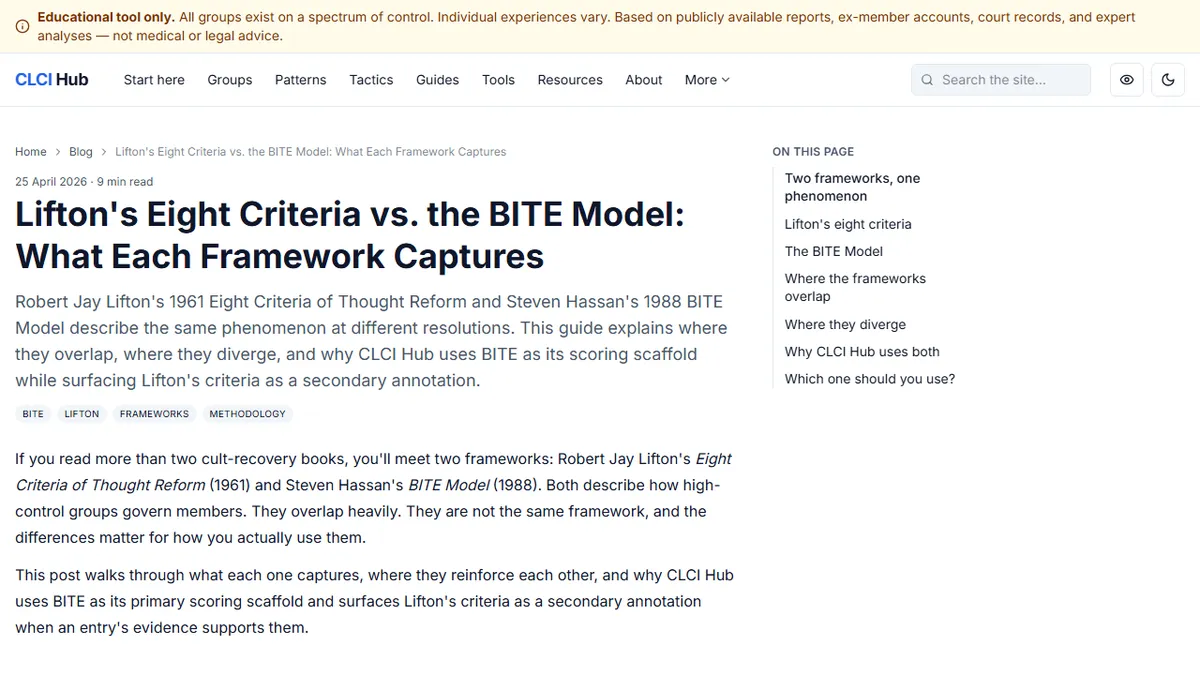
Steven Hassan came to the problem from a different direction. He was a member of the Unification Church, commonly known as the Moonies, in the 1970s. After leaving, he trained as a therapist and developed the BITE Model (Behavior, Information, Thought, Emotional) as a diagnostic instrument for evaluating groups across multiple dimensions of control, not just ideological content. For a detailed comparison of both approaches, CLCI Hub's full Lifton-vs-BITE comparison covers the evidence base that informed each methodology.
Lifton's Eight Criteria at a Glance
Lifton's framework describes thought reform environments through eight interconnected features. Milieu control refers to the management of all communication within the environment, the total domination of what information reaches the individual from the outside. Mystical manipulation is the orchestration of events to appear spontaneous and spiritually significant, creating the sense that the group's ideology is confirmed by ongoing experience rather than simply asserted.
The demand for purity distinguishes sharply between the sacred in-group and a contaminated outside world, and requires members to submit continuously to evaluation of their purity status. Confession (voluntary disclosure of thoughts, doubts, and transgressions to the group) serves both to generate compliance and to provide the leadership with detailed personal information.
Sacred science frames the group's ideology as ultimate truth beyond question. Loading the language creates a closed vocabulary that makes certain thoughts difficult to complete. Doctrine over person requires that personal experience be reinterpreted to fit doctrine when they conflict. Finally, dispensing of existence (the claim that non-members either lack full spiritual standing or are actively deserving of harm) provides the psychological foundation for shunning, exclusion, and in the most extreme cases, violence.
The BITE Model's Four-Dimension Approach
Hassan's framework shares some territory with Lifton's but is structured differently. Where Lifton identified eight criteria, each describing a feature of a thought-reform environment, Hassan identified four dimensions that together cover the full range of control mechanisms observable in high-control groups.
The four dimensions (Behavior, Information, Thought, Emotional) function as measurement categories rather than qualitative descriptors. Each dimension encompasses multiple specific indicators, and a group can score anywhere from minimal to maximal control within each one. This produces a profile rather than a classification: not "this group meets criterion X" but "this group exerts moderate behavior control, substantial information control, high thought control, and extreme emotional control."
The dimensional structure also reflects Hassan's interest in practical diagnosis. He designed the model to be usable by people without advanced academic training: by families trying to understand what is happening to a loved one, by therapists seeing patients with unusual belief systems, by journalists evaluating communities they are reporting on.
Where the Two Frameworks Overlap
The overlap between Lifton and BITE is most obvious in the thought and information dimensions. Lifton's "loading the language" maps directly onto Hassan's thought-control category. Milieu control corresponds closely to information control. The demand for purity and doctrine over person both contribute to the thought-control dimension in the BITE framework.
Both frameworks also emphasise the cumulative character of control. Neither was designed to be applied to isolated practices but to patterns of practice that together produce a specific effect on individual autonomy and judgment. A single criterion or a single BITE indicator is rarely conclusive; the picture emerges from the aggregate.
Both frameworks have also proved robust across very different cultural contexts. Lifton's work originated in a Chinese political setting; the BITE Model was first applied to religious groups in the United States. Both have since been applied to groups in dozens of countries with diverse theological, political, and commercial orientations, and both have largely held up.
Where They Diverge: Ideology vs. Mechanism
The most significant divergence is between Lifton's focus on ideology and Hassan's focus on mechanism.
Lifton's criteria are specifically designed to describe thought-reform environments in which an explicit ideology is the object of the reform. His framework is most useful when you are analysing a group with a clear, comprehensive worldview that members are expected to adopt wholesale: political movements, religious groups with extensive doctrinal systems, total institutions in Erving Goffman's sense.
The BITE Model is less concerned with the content of a group's ideology than with how the group treats its members. A commercial wellness programme with a minimal theological framework can score high on BITE if it exerts substantial behavioral, informational, thought, and emotional control. It would score low on many of Lifton's criteria because there is no developed ideology to become "milieu controlled" around.
This means that BITE is generally more useful for evaluating contemporary phenomena (MLMs, online communities, self-development programmes, therapy cults) where the controlling structure is commercial or interpersonal rather than primarily ideological.
Practical Decision Guide: Which to Apply and When
For analysing traditional religious high-control groups with developed theological systems (Jehovah's Witnesses, Scientology, the FLDS), both frameworks apply and generate complementary insights. Lifton reveals the ideological architecture; BITE reveals the control mechanics.
For analysing commercially structured groups, such as MLMs, certain coaching programmes, and wellness communities, the BITE Model is significantly more fit for purpose. The commercial entities typically lack the ideological architecture that Lifton's criteria presuppose.
For academic or historical analysis of political indoctrination systems, the original context of Lifton's research, his framework remains the more powerful tool, particularly the concepts of milieu control and mystical manipulation.
Frontline work means helping individuals evaluate their own situation, advising families, or informing legal proceedings. For that work, the BITE Model's measurability and its accessibility to non-specialists gives it a practical edge.
Why CLCI Hub Uses Both
The CLCI methodology was developed to be as comprehensive as possible across a database of more than 683 assessed groups ranging from mainstream denominations to terrorist organisations. Using BITE as the primary framework and incorporating Lifton's criteria as a secondary analytical layer allows for more nuanced profiles of ideologically intensive groups while maintaining the dimensional consistency that makes the database useful as a reference tool.
When a group's BITE profile is supplemented by analysis of which Lifton criteria it meets, the resulting picture is considerably richer than either framework alone would produce. It reveals not just how control operates mechanically but how the group's ideology gives that control its specific character and makes it resistant to outside challenge.