Why the First Apartment Decision Is So High-Stakes
Most expats moving to Bangkok for the first time make one of two classic errors. The first is choosing a neighbourhood based on what looked beautiful during a holiday (the photogenic canals of Thonburi, the lantern-lit streets of the Old Town) and discovering that living there as a working resident is logistically exhausting. The second is defaulting to Sukhumvit because every Bangkok expat article mentions it, and then spending months paying significantly more than necessary for an experience that could have been replicated cheaper two stops down the line.
The stakes are real. Bangkok apartment leases are typically twelve months with a two-month deposit, and breaking one costs you. More importantly, the neighbourhood you choose determines your commute stress, your social circle, your food options, and the background noise that either energises or grinds you down over a year. Getting this decision right from the start, rather than moving in, realising the error, and enduring a sub-optimal living situation, is worth careful consideration.
The Four Variables That Actually Matter: Rent, BTS Access, Vibe, and Noise
Every other consideration (proximity to a good gym, the number of Western restaurants nearby, whether there is a Tops supermarket within walking distance) flows from four primary variables. These are the ones worth interrogating before you book viewings.
Rent in Bangkok varies by a factor of three or four for equivalent-quality apartments depending on the neighbourhood and its BTS proximity. A decent one-bedroom in Phra Khanong runs 15,000 to 20,000 baht per month; the same apartment profile in prime Thonglor starts at 35,000. Both are on the same BTS line, separated by four stops.
BTS access is not binary, it is a spectrum. Being a five-minute walk from a station is fundamentally different from being a fifteen-minute walk. The latter, in Bangkok's heat and on Bangkok's footpaths, means you will use Grab far more than the train, which adds up to several thousand baht per month in additional transport costs that never appear in rental listings.
Vibe covers the genuine lifestyle character of an area. Some neighbourhoods are dense with young professionals, late-night options, and socialising infrastructure. Others are quieter, family-oriented, and shut down by nine. Neither is better, but the mismatch between your lifestyle preference and your neighbourhood's character is a source of sustained low-level unhappiness that new arrivals rarely anticipate.
Noise is the fourth variable and the one most frequently underweighted. Bangkok is not a quiet city, and certain areas (anywhere near a main road, a night market, or a popular bar street) generate sound levels after midnight that make sleep an optimistic proposition unless your apartment has serious window insulation.
Sukhumvit vs Silom: The Two Big Expat Corridors Compared
These two areas dominate Bangkok's expat conversation for good reason. Both have excellent BTS access, international infrastructure, and a density of restaurants, gyms, and social venues that makes settling in straightforward. The Sukhumvit versus Silom rent and lifestyle trade-offs are significant enough to determine which one is right for your specific situation.
Sukhumvit runs east from Asoke along a corridor that changes character every few stops. The area around Phrom Phong and Thonglor is Bangkok's most aspirational expat address (Japanese restaurants, high-end coffee shops, concept bars) but the rents reflect this. Ekkamai and Phra Khanong offer the same line at meaningfully lower prices, though the character becomes more local and less international the further east you go.
Silom is Bangkok's financial district by day and a concentrated entertainment district by night. The area attracts more professionals working in finance and law, and the residential character is slightly quieter than the upper Sukhumvit strip. Lumpini Park is within walking distance, which matters more than you might expect when you are looking for a morning run that does not involve dodging traffic.
Hidden Value: Ari, Phra Khanong, and On Nut for Budget-Conscious Movers
Bangkok's best rent-to-quality ratios are currently found in three areas that experienced expats know well but newcomers often overlook. Ari, on the BTS Sukhumvit line north of Chitlom, has evolved into a neighbourhood of independent cafes, street-food clusters, and low-rise apartment buildings that delivers a high-quality daily life experience at mid-range rents. It has none of the prestige of Thonglor but also none of the noise or the prices.
Phra Khanong and On Nut sit on the eastern Sukhumvit extension and are the pragmatic choice for anyone whose priority is maximising apartment quality per baht spent. The BTS still reaches both areas, but the journey to central Bangkok adds fifteen minutes compared to Phrom Phong. For a freelancer or remote worker whose commute is optional, this is an entirely acceptable trade-off.
Old Town Appeal: What You Sacrifice for Atmosphere
The historic core of Bangkok (the area around Rattanakosin Island, Banglamphu, and the Thonburi riverbank) is genuinely beautiful and culturally distinctive in a way that no other part of the city can replicate. Temples within walking distance, canal boats as a viable commute option, street food of a very different character to the Sukhumvit corridor.
What you sacrifice is BTS convenience. The Old Town has no Skytrain coverage, and while the MRT Blue Line now passes through the area, it does not connect naturally to the rest of the network for most work-related journeys. Anyone who needs to cross the city regularly will find that living here adds meaningful time and cost to every commute. The people who make it work are typically those whose work and social lives are concentrated in the same western half of the city.
Using the Neighborhood Compare Tool to Build Your Shortlist
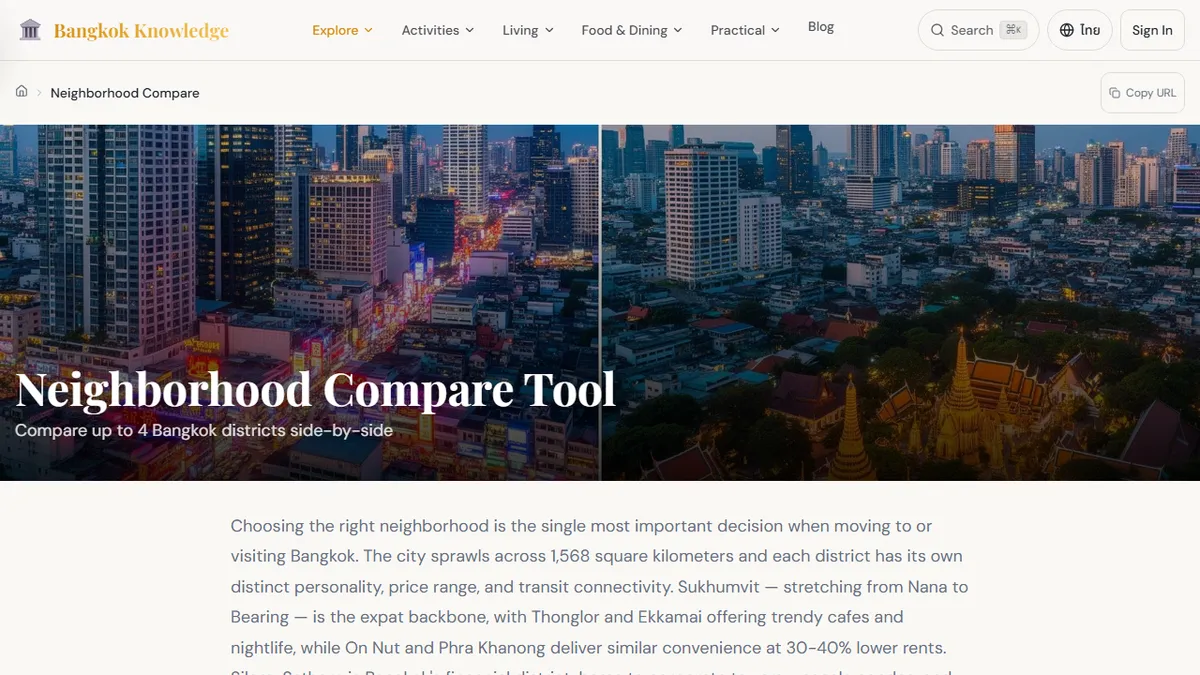
Once you have a clear sense of your four variables, building a shortlist becomes more methodical than instinctive. The side-by-side Bangkok neighborhood comparison tool is the most efficient way to map your preferences against what each area actually delivers, particularly for the rent and distance-to-BTS variables that are hard to hold in your head across multiple areas simultaneously.
The most useful exercise before visiting apartments is to commute from each neighbourhood you are considering to wherever you will spend your working hours. Do this during the time of day you will actually be commuting, not midday on a Tuesday, and time it honestly including the walk to and from stations.
Red Flags to Spot Before You Sign
The most common lease-signing regret in Bangkok involves noise from establishments that are not visible during afternoon viewings. Ask the landlord or agent directly whether there are bar venues, karaoke establishments, or live music venues within two hundred metres. Walk the block at 11pm before signing. Many of Bangkok's residential streets are quiet at 2pm and chaotic at 1am.
The second red flag is a building with a very high proportion of short-stay rental units. These buildings are effectively hotels with a residential facade, meaning the neighbours rotate every few weeks, security tends to be relaxed, and noise levels can be unpredictable. Check whether the building allows short-term rentals before committing.
Finally, test the water pressure and the internet connection. Bangkok's older building stock frequently has water pressure problems that are hard to fix and miserable to live with. Get a specific speed test and ask for the ISP provider and plan details: the difference between 50Mbps and 300Mbps matters enormously if you are working from home.