Myth 1: Street Food Is Inherently Unsafe to Eat
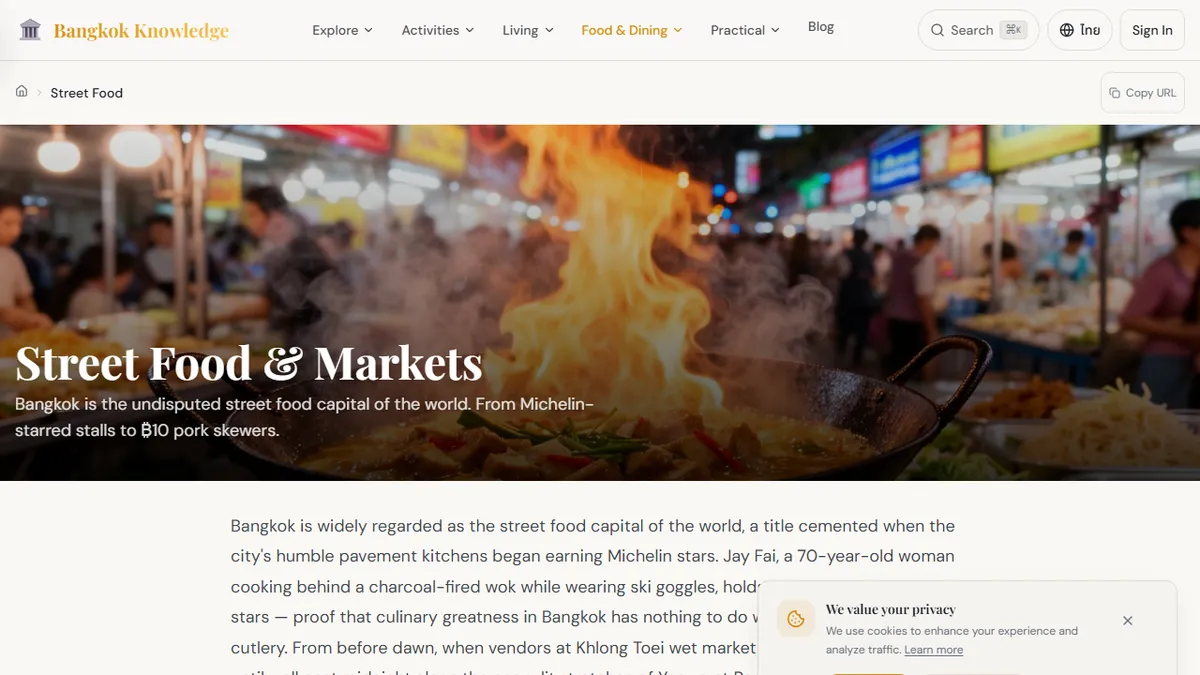
This is the foundational myth, and it persists despite being demonstrably wrong for the vast majority of Bangkok's street food vendors. The reasoning behind it (high heat, unknown water sources, open preparation) is understandable, but it misreads how street food economics actually work.
A vendor who operates from the same spot on the same street for ten or twenty years has survived because their food does not make people ill. Their business model depends on repeat customers: the office workers who eat pad kra pao for lunch four days a week, the taxi driver who stops every evening, the family from two blocks away who treat the stall as a household extension. A vendor who served food that regularly caused illness would be gone within weeks.
The practical risk factors for travellers are narrower than most guides suggest. Raw shellfish is the main one to treat with caution, particularly from vendors who do not have obvious refrigeration. Ice from unknown sources is a secondary concern, though Bangkok's commercial ice supply is now almost uniformly safe. Everything else (grilled meats, wok-cooked dishes, noodle soups) presents minimal risk when cooked to order in front of you.
Myth 2: Only Pad Thai and Som Tam Are Worth Trying
Pad thai and green papaya salad are exceptional dishes. They are also among the dozens of extraordinary things available from Bangkok's street vendors, not the beginning and end of the menu.
Some of the most rewarding street food experiences in the city involve dishes that Western travellers have rarely encountered: khanom jeen, fermented rice noodles served with an array of curries; moo ping, grilled pork skewers eaten at 7am with sticky rice; guay tiew reua, boat noodles with a rich broth that you order in multiple small portions at ten baht each. The guide to Bangkok's must-try street dishes covers the full range, but the mindset shift matters as much as the list, and treating the menu as broad rather than narrow opens up the best experiences.
Myth 3: You Need to Speak Thai to Order
You do not. Bangkok's street food culture has absorbed decades of tourist and expat interaction and developed robust pointing-and-indicating communication systems that function without a word of shared language. Most stalls have either visible food at various stages of preparation that you can point at, or they serve a narrow enough menu that the choices are obvious.
For noodle soups, the standard approach is to sit down and allow the vendor to bring you whatever they are serving that day, which is entirely normal and expected. For dishes with choices (spice level, meat, noodle type), a combination of pointing and holding up fingers for quantities resolves most situations. The Thai phrase "mai phet" (not spicy) is worth learning for heat management, but everything else is optional.
Myth 4: Floating Markets Are the Best Street Food Experience
Floating markets — particularly Damnoen Saduak — appear in almost every Bangkok food guide and attract enormous numbers of tourists. They are photogenic. They are also, in their most famous incarnations, among the least authentic food experiences available in the Bangkok region.
The vendors at the most-visited floating markets have pivoted almost entirely to tourist trade. Prices are multiples of what the same food costs elsewhere, portions are small and formatted for snacking rather than eating, and the atmosphere is the performance of a tradition rather than the tradition itself. The genuine Bangkok street food experience is on ordinary neighbourhood streets and in covered market halls, not in spots that have been curated for cameras.
Myth 5: Cheap Means Low Quality
The inverse is more reliably true: in Bangkok's street food economy, price correlates inversely with quality far more often than positively. The thirty-five-baht bowl of guay tiew from an unremarkable-looking cart in a Silom side street is frequently better (more complex broth, fresher ingredients, more confident seasoning) than the equivalent dish in an air-conditioned restaurant charging eight times as much.
The reason is structural. A street vendor running a single speciality for twenty years, cooking the same dish hundreds of times per day with the same suppliers, achieves a consistency and depth that restaurant menus spread across thirty dishes rarely match. The top stalls in Yaowarat for first-time visitors illustrate this principle well. Several of the city's most celebrated food experiences happen to be its cheapest.
Myth 6: Night Market Food Is Safer Than Daytime Carts
There is a widespread assumption that the formal infrastructure of a night market (fixed stalls, lights, signage) makes the food safer than a daytime cart with no fixed address. The evidence does not support this.
Safety in street food is a function of turnover, heat, and vendor practice. A busy daytime noodle cart cooking to order and serving a hundred portions before noon operates at a level of throughput that minimises food-safety risk. A night market stall that prepared food in the afternoon, set it out in the open at 6pm, and sells it slowly until midnight carries more risk than its surroundings suggest. The reliable indicator is not the setting but the pace — a vendor who is constantly cooking fresh is consistently safer than one displaying pre-made items.
Myth 7: Vegetarians and Vegans Have Nothing to Eat
Bangkok is, in fact, one of Southeast Asia's better cities for plant-based eating. It is simply less obvious than in destinations with a more developed Western health-food culture. The presence of a large Chinese-Thai Buddhist community means that Thailand has a long tradition of jae food: strictly vegan dishes marked by yellow flags that appear on street stalls, particularly in the Old Town and Chinatown areas.
Beyond jae food, Thai cuisine has a strong foundation of vegetable-forward dishes (morning glory stir-fry, mixed vegetable curries, pad pak ruam) that are available at almost every street kitchen. The challenge is not scarcity but communication: Thai dishes frequently contain fish sauce or shrimp paste in ways that are not immediately visible. Learning the phrase "gin jeh" (I eat vegan) and cross-referencing it with pointing at visible ingredients solves most situations. Specialist vegetarian restaurants are also concentrated in the Banglamphu and Phra Nakhon areas and are consistently underpriced compared to Western vegetarian dining.