On this page
Before comparing two complaint percentages, write down what each percentage divides by. A label such as “upheld” is not enough: a rate based on complaints closed by a firm answers a different question from a rate based on published final Ombudsman decisions.
This guide helps you check that calculation. It does not rank banks or estimate the outcome of an individual complaint.
Separate the three records
The FCA's first-half 2026 complaints publication reports complaints received, closed and upheld as separate measures. Its published uphold percentage uses closed complaints. The same page distinguishes firm-reported complaints from complaints referred to the Financial Ombudsman Service.
There is another distinction within Ombudsman information. The FOS decisions database contains published final decisions on individual cases. Do not describe that database as a list of every complaint the service receives.
Bank Conduct Index's method says its headline analysis uses published final decisions in banking, credit and mortgages. That is the scope of this particular index, not the scope of everything FOS does.
| Record you are reading | What to identify before using a percentage |
|---|---|
| A firm's complaints return | Whether the figure concerns complaints received, closed or upheld |
| An FOS complaints statistics release | The release's own definition of the cases and outcomes counted |
| An analysis of published final decisions | The decision filters, outcome coverage and period included |
Work through a fictional example
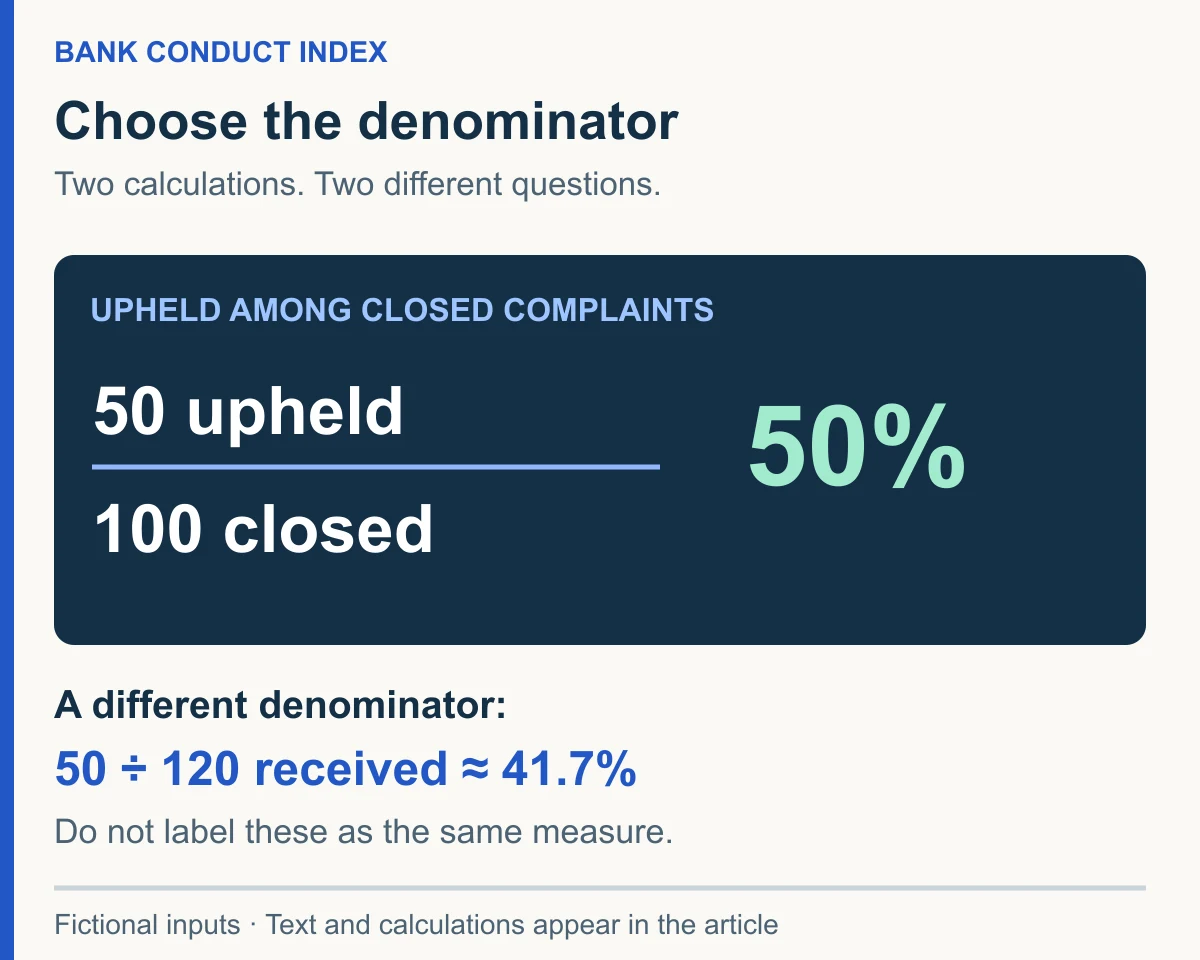
Suppose a fictional firm receives 120 complaints during a reporting period, closes 100 and upholds 50 of those closed complaints. These are invented inputs for checking arithmetic, not figures about a real bank.
The uphold percentage among closed complaints is:
50 ÷ 100 × 100 = 50%.
Dividing the same 50 by the 120 received gives approximately 41.7%. That calculation uses a different denominator. It should not be labelled as the same closed-complaint uphold percentage.
Nor does this example establish that the 100 closed complaints are a subset of the 120 newly received in that period. A calculation needs definitions of both the population and its dates; a shared reporting period alone does not identify the same set of cases.
Add the denominator to your notes
Our suggested research note is one line per measure:
Source URL · reporting period · population counted · numerator · denominator · calculation · retrieval date.
For the fictional example, that becomes “closed complaints in the example period; 50 upheld; 100 closed; 50%”. Leave an input blank if the source does not establish it. Do not fill the gap with another page's complaint count.
Stop before turning the figure into a forecast
The FOS database explains that individual decisions depend on their particular circumstances and are not a definitive statement of law or its approach. A percentage from past decisions therefore needs its original context; it is not a personal probability of success. FOS database explanation
Before sharing a number, try describing it without the word “rate”. If you cannot finish “this is the number of ___ divided by the number of ___”, keep the comparison unfinished until you can.