Why Confirmed Conspiracies Matter for Critical Thinking
The word "conspiracy theory" has acquired a dismissive undertone, shorthand for paranoid fantasy. That dismissiveness is a mistake, and it is historically uninformed. Governments, corporations, and intelligence agencies have engaged in genuine, documented conspiracies throughout the twentieth century. Court records confirm it. Declassified archives confirm it. In some cases, the perpetrators themselves confessed.
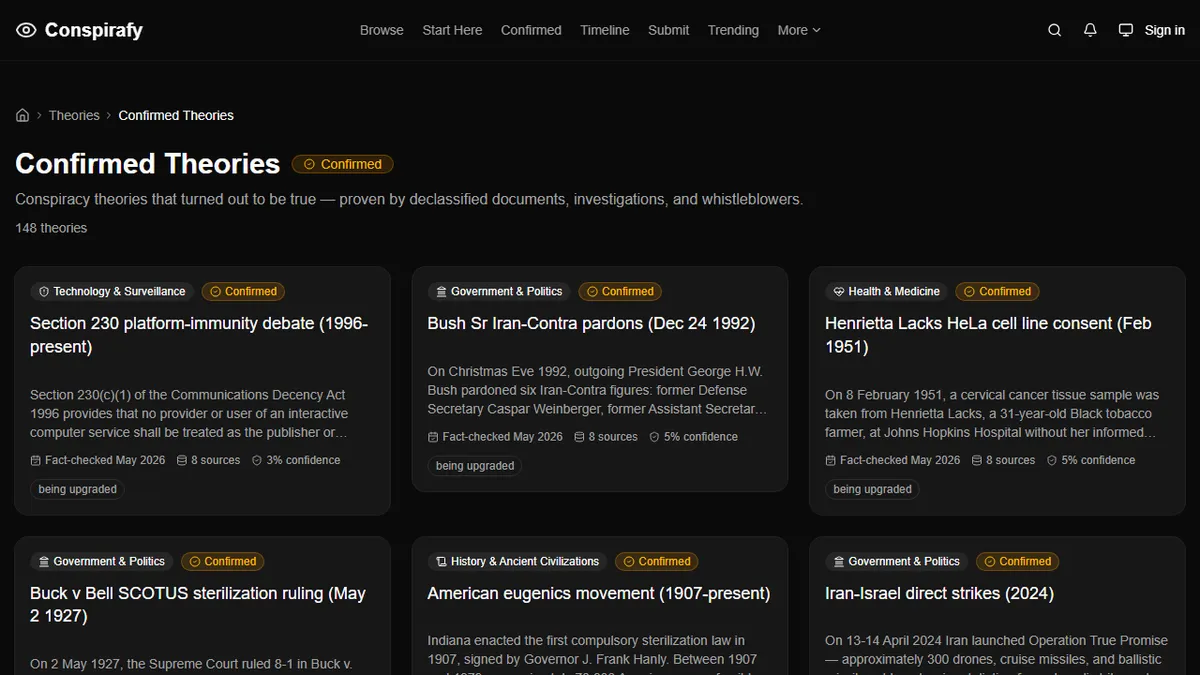
Understanding what confirmed conspiracies look like is not an invitation to believe every claim on the internet. It is the opposite: a calibration exercise. When you know what a real conspiracy requires — coordinated action, documented evidence, a paper trail — you are better positioned to notice when an alleged conspiracy has none of those things. The full catalogue of court- and document-verified conspiracies offers a rigorous starting point for that education.
The Template: Watergate and the Evidence Trail
Watergate is the clearest template for what a confirmed political conspiracy looks like, and it is worth examining not just as historical trivia but as a forensic model. In June 1972, operatives linked to President Nixon's re-election committee broke into the Democratic National Committee headquarters at the Watergate complex in Washington, DC. That much is the entry point. What followed is what makes Watergate instructive.
The conspiracy involved systematic cover-up: hush money paid to the burglars, abuse of federal agencies including the CIA and FBI to obstruct the investigation, and the recording of conversations in the Oval Office that ultimately documented the President's direct involvement. The "smoking gun" tape, released under court order in August 1974, captured Nixon explicitly directing the CIA to block the FBI investigation six days after the break-in. He resigned within weeks. Forty-eight people were convicted.
What makes Watergate a confirmed conspiracy is not suspicion, not circumstantial inference, but a documented chain of evidence (tapes, testimony, financial records) that left no credible alternative interpretation. That is the evidentiary standard.
Mind Control Gone Wrong: MKUltra's Declassified Files
Between 1953 and 1973, the CIA ran a programme codenamed MKUltra that conducted covert mind-control and drug experiments on US and Canadian citizens, most of whom had no idea they were research subjects. The programme involved the administration of LSD, barbiturates, and other substances; sensory deprivation; and psychological abuse, sometimes in coordination with hospitals and universities whose administrators were complicit.
MKUltra was confirmed by declassified documents, Senate Intelligence Committee hearings in 1977, and a subsequent presidential commission. CIA Director Richard Helms ordered the destruction of most MKUltra records in 1973 when he anticipated Congressional scrutiny. That means the full scope of what was done remains unknown. What survives in the archive is already damning enough. The programme resulted in deaths, including that of US Army biochemist Frank Olson, who died after being dosed with LSD without his knowledge.
The lesson for critical thinkers is not that every secret programme exists, but that secret programmes with significant institutional protection did exist, were eventually uncovered through document leaks and Congressional investigation, and left a recoverable paper trail.
Targeting Citizens: COINTELPRO and the FBI
From 1956 to 1971, the FBI ran a domestic intelligence and disruption programme called COINTELPRO (short for Counter Intelligence Program). Its targets included civil rights organisations, anti-war groups, and the Communist Party USA. The tactics included illegal wiretapping, infiltration by informants, harassment campaigns, and the deliberate spreading of false information designed to destabilise organisations and pit individuals against each other.
Among the programme's most documented excesses was the bureau's sustained campaign against Martin Luther King Jr. FBI memos, declassified decades later, show that bureau director J. Edgar Hoover considered King a direct threat and authorised anonymous letters urging King to commit suicide before an unspecified "bombshell" was made public. The letters were forged government documents. King never knew the author.
COINTELPRO came to light primarily through a 1971 burglary of an FBI field office in Media, Pennsylvania, by activists calling themselves the Citizens' Commission to Investigate the FBI. They copied files and distributed them to journalists. The documents they found triggered years of Congressional investigation and eventually confirmed the programme's illegal scope.
Arms, Cash, and Lies: Iran-Contra
In the mid-1980s, officials in the Reagan administration secretly arranged arms sales to Iran (then under an arms embargo) and used the proceeds to fund Contra rebels in Nicaragua, in direct violation of the Boland Amendment, which prohibited such funding. The operation was managed partly through private networks to avoid Congressional oversight.
The affair came to light in 1986 through a combination of a Lebanese newspaper report and a plane shot down over Nicaragua carrying US-supplied weapons. Congressional hearings followed. Independent Counsel Lawrence Walsh spent years investigating and ultimately secured convictions and guilty pleas from key figures, including National Security Advisor John Poindexter and aide Oliver North. Bush Sr. pardoned six Iran-Contra defendants on Christmas Eve 1992, an act Walsh's final report described as part of an ongoing cover-up.
Walsh's report, published in 1993, documented that senior officials including President Reagan had been aware of the operation. Reagan's own diary entries, released years later, confirm his knowledge. Court records, testimony, and internal government documents form the evidentiary basis for every element of this account.
What All Confirmed Conspiracies Have in Common
Looking across Watergate, MKUltra, COINTELPRO, and Iran-Contra, a pattern emerges that is absent from most unverified conspiracy theories. Each involved a bounded group of named actors with documented roles. Each produced a paper trail — memos, tapes, financial records, sworn testimony — that survived even partial destruction efforts. Each was eventually confirmed not through whistleblower rumour or internet sleuthing but through formal legal processes: Congressional hearings, court trials, document releases compelled by litigation or legislation.
This pattern is the evidence standard. When evaluating a new conspiracy claim, ask whether it meets any of these criteria. Are there named actors with documented roles? Are there primary source records? Has any formal investigative body examined and confirmed it? Confirmed conspiracies answer yes to all three. Most conspiracy theories cannot answer yes to any.