Step 1 — Steelman the Claim Before You Dismiss It
The reflexive response to a conspiracy claim is usually one of two extremes: immediate dismissal or credulous acceptance. Both are epistemically lazy. The more useful starting move is steelmanning: constructing the strongest possible version of the argument before evaluating it.
Ask yourself: what would this claim look like if a careful, intelligent person believed it in good faith? What evidence would they point to? What historical precedent might give it surface plausibility? Watergate was real. COINTELPRO was real. A reader who knows that documented conspiracies exist at all is better positioned to take the next step.
Steelmanning is not the same as agreeing. It is the intellectual discipline of engaging with what the argument actually says rather than a caricature of it. Only once you understand the claim at its strongest can you meaningfully assess whether the evidence supports it.
Step 2 — Separate Adjacent Facts From Unsupported Inferences
Most durable conspiracy narratives anchor themselves to a genuine, verifiable fact — then build an elaborate superstructure of inference on top of it. The adjacent fact is real; the conclusions drawn from it may not be.
Take a common template: a real event occurred (true), the official explanation has gaps (sometimes true), therefore a hidden actor orchestrated the whole thing (unsupported). Notice that the third step does not follow from the first two. Gaps in an explanation are evidence of incomplete investigation, human error, or bureaucratic failure, all of which are historically common. They are not, by themselves, evidence of orchestrated deception.
When you read a conspiracy claim, draw a firm line between the factual assertions and the interpretive leaps. List them separately. Then ask what additional evidence would be needed to bridge that gap, and whether that evidence exists.
Step 3 — Check the Source Hierarchy: Primary Records vs Viral Screenshots
The most important single question in evaluating any claim is: what is the closest-to-source document available? Primary records (court filings, declassified government documents, peer-reviewed studies, official transcripts) carry far more evidential weight than secondary accounts, and those carry more weight than viral social media posts.
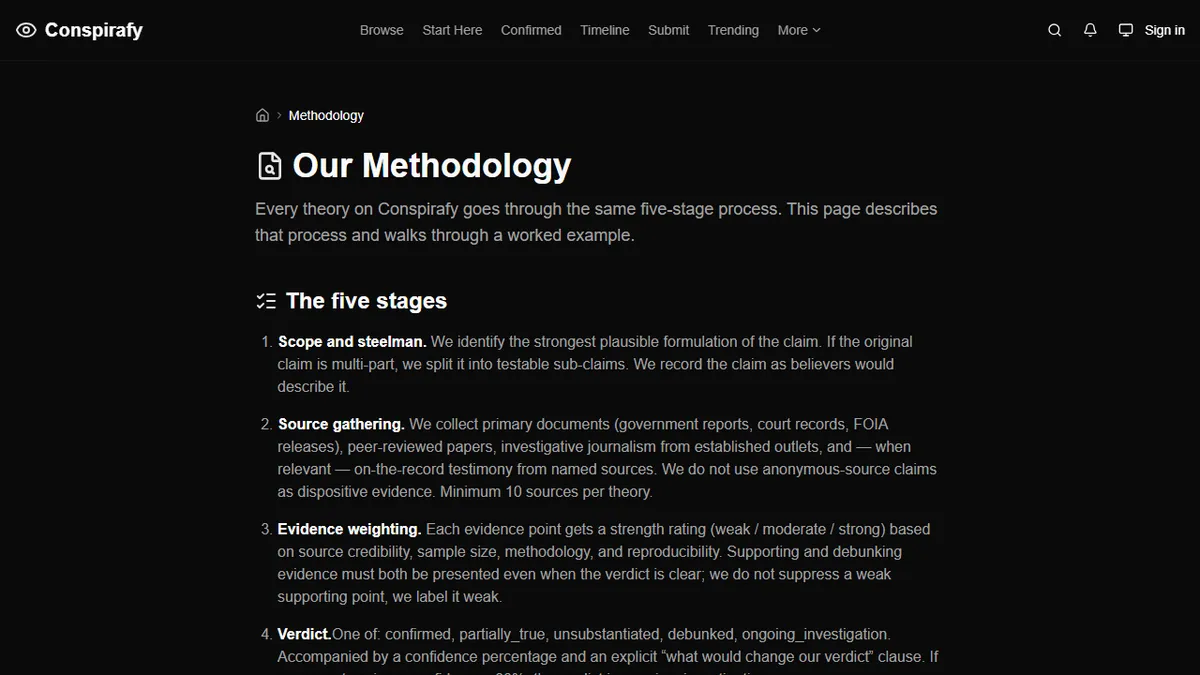
A screenshot of a tweet quoting a blog post paraphrasing a news article is four steps removed from any primary source. Each step introduces the possibility of distortion, selective quotation, or outright fabrication. The conspirafy evidence-weighing methodology explained step by step describes this hierarchy in practical terms: before sharing or accepting a claim, trace it back to its earliest documented form.
If no primary document is available to support a central claim, that absence is itself significant data. Many conspiracy narratives survive precisely because readers never ask to see the underlying source.
Step 4 — Look for the Verdict Label (Confirmed / Debunked / Ongoing)
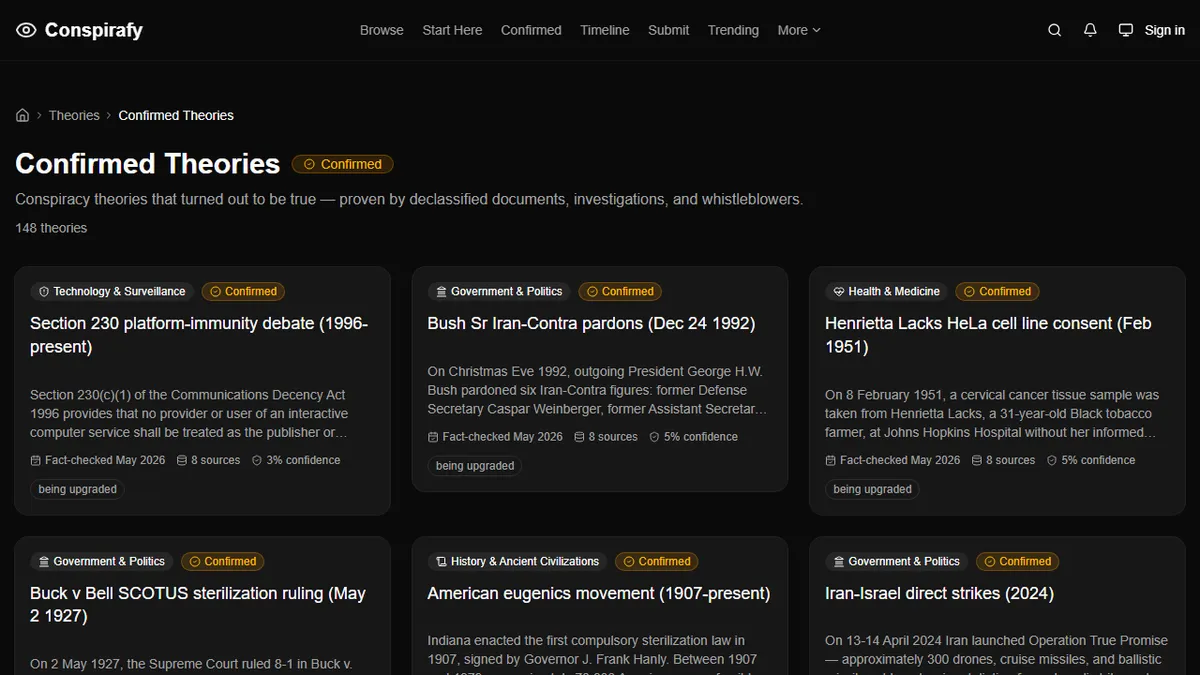
Professional fact-checkers use a controlled vocabulary that carries epistemic precision. A claim that is "confirmed" has primary-source documentation. A claim that is "debunked" has been tested and found unsupported by the available evidence. A claim under "ongoing investigation" has credible elements but lacks the documentary chain needed for a firm verdict.
One of the most common errors in popular discourse is treating the absence of a debunking as evidence of confirmation. Something has not been confirmed merely because it has not been refuted. The null hypothesis (that a claim is unverified) should hold until sufficient evidence arrives to move the label.
When you evaluate a claim, ask yourself where it sits on this spectrum. Has anyone with access to primary sources actually investigated it? What was their finding? Labelling uncertainty accurately is not a concession to official narratives; it is the only honest position available when evidence is genuinely incomplete.
Step 5 — Identify Which Logical Fallacy Is Doing the Heavy Lifting
Almost every persistent conspiracy claim has at least one logical fallacy carrying the argument forward. Identifying that fallacy does not disprove the underlying claim (a fallaciously argued conclusion can still turn out to be true), but it does show you where the argument is weakest and most in need of independent evidence.
The most common culprits include: post hoc reasoning (two events occurred in sequence, therefore the first caused or orchestrated the second); appeal to ignorance (the absence of a full explanation is treated as evidence for a specific alternative explanation); and cherry-picking (only the evidence consistent with the preferred conclusion is included). When a narrative relies heavily on rhetorical questions ("isn't it suspicious that...?") rather than affirmative evidence, that pattern is itself diagnostic.
Putting It All Together: A Quick Practice Run
Suppose you encounter the claim that a major pharmaceutical company suppressed a cheap cancer cure. Run the checklist. Steelman it: given documented pharma misconduct, the premise that a corporation might prioritise profits over a cure has historical credibility. Now separate facts from inferences: pharma misconduct is real; specific suppression of this specific cure requires its own documentation. Check sources: is there a whistleblower affidavit, an internal email, a court record? What is the verdict from independent oncologists or regulatory bodies?
If that audit produces only second-hand accounts, viral clips, and rhetorical questions, you now know what the evidence actually shows — and what it does not. That is the honest finding, and it is far more valuable than either reflexive dismissal or credulous acceptance.
This five-step process applies equally whether the claim concerns government operations, corporate misconduct, or public health. The framework does not predetermine the outcome; it simply ensures that the outcome is determined by evidence rather than assumption.