What Is a Peptide, and How Does It Differ From a Protein or a Hormone?
At its most basic level, a peptide is a chain of amino acids joined by peptide bonds. The distinction between a peptide and a protein is largely one of length: molecules with fewer than roughly 50 amino acid residues are conventionally called peptides, while longer chains that fold into stable three-dimensional structures are proteins. Hormones like insulin (51 residues) sit near the boundary, and in biological practice the categories overlap.
What makes short peptides pharmacologically interesting is partly this smallness. Compounds with fewer than 30 residues can cross cell membranes, survive partial degradation in biological fluids, and in some cases enter the nucleus to interact directly with gene-regulatory machinery. Proteins cannot do this without specialised transport. That combination of biological reach and structural simplicity is one reason so many ageing researchers have turned to synthetic short peptides as research tools.
Not all peptides studied in ageing research fit neatly into a single mechanistic bucket. Some are synthetic analogues of naturally occurring sequences, like Sermorelin, which corresponds to the first 29 amino acids of the hypothalamic growth-hormone-releasing hormone. Others, like the Khavinson-programme short peptides, were derived from tissue extracts and refined into synthetic sequences over decades of in-house research. Others still, like Humanin and MOTS-c, were discovered to be encoded within the mitochondrial genome itself, a finding that reshaped how researchers think about mitochondrial function.
Why Researchers Study Peptides in the Context of Ageing
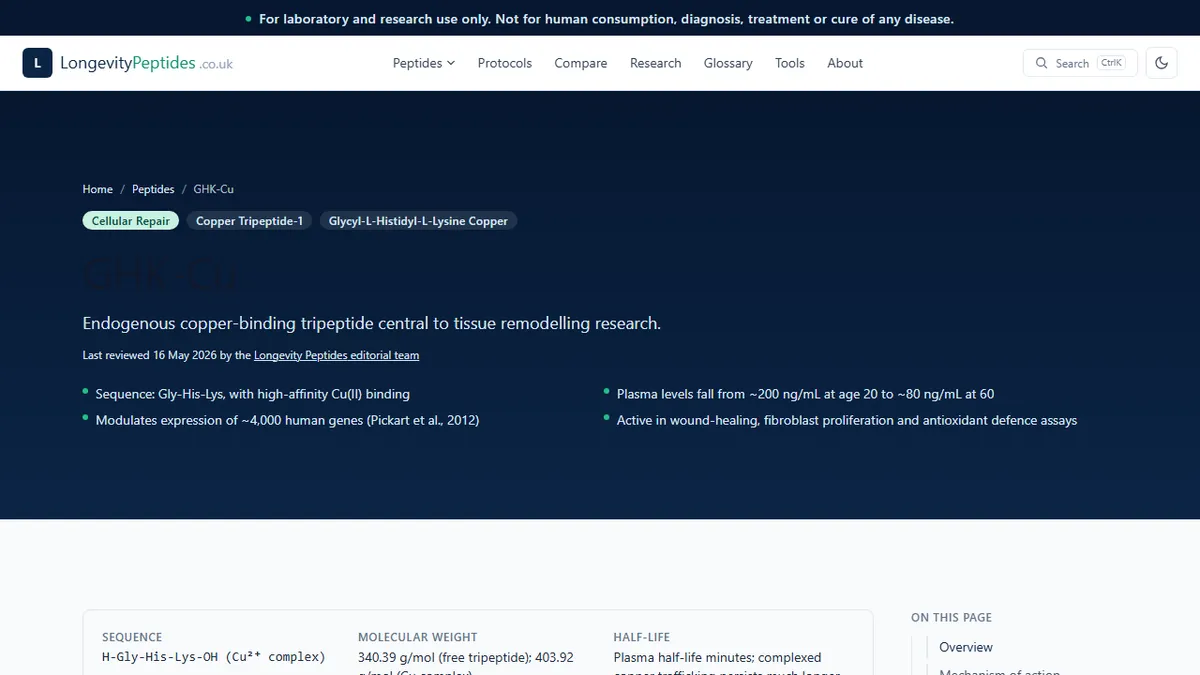
The case for peptide-based ageing research rests on several converging observations. First, many endogenous peptides demonstrably decline with age. Circulating Humanin falls roughly 30 percent between early adulthood and age 70. GHK-Cu levels in plasma drop from around 200 nanograms per millilitre in a 20-year-old to around 80 in a 60-year-old. MOTS-c plasma concentrations correlate inversely with insulin resistance and fall across the adult lifespan. These age-related declines suggest that restoring the signalling these peptides provide might address a real biological deficit.
Second, some of the hallmarks of ageing that are most firmly established (telomere shortening, mitochondrial dysfunction, immunosenescence, loss of proteostasis) map onto mechanisms where specific peptides have demonstrated biological activity in laboratory and preclinical settings. This isn't coincidence; researchers have deliberately selected compounds that interact with those mechanisms.
Third, peptides are, at the molecular level, more tractable than many alternative approaches. They are synthetically accessible, relatively small, and in many cases structurally related to endogenous molecules that the human body already produces.
The Five Main Categories in Current Longevity-Peptide Research
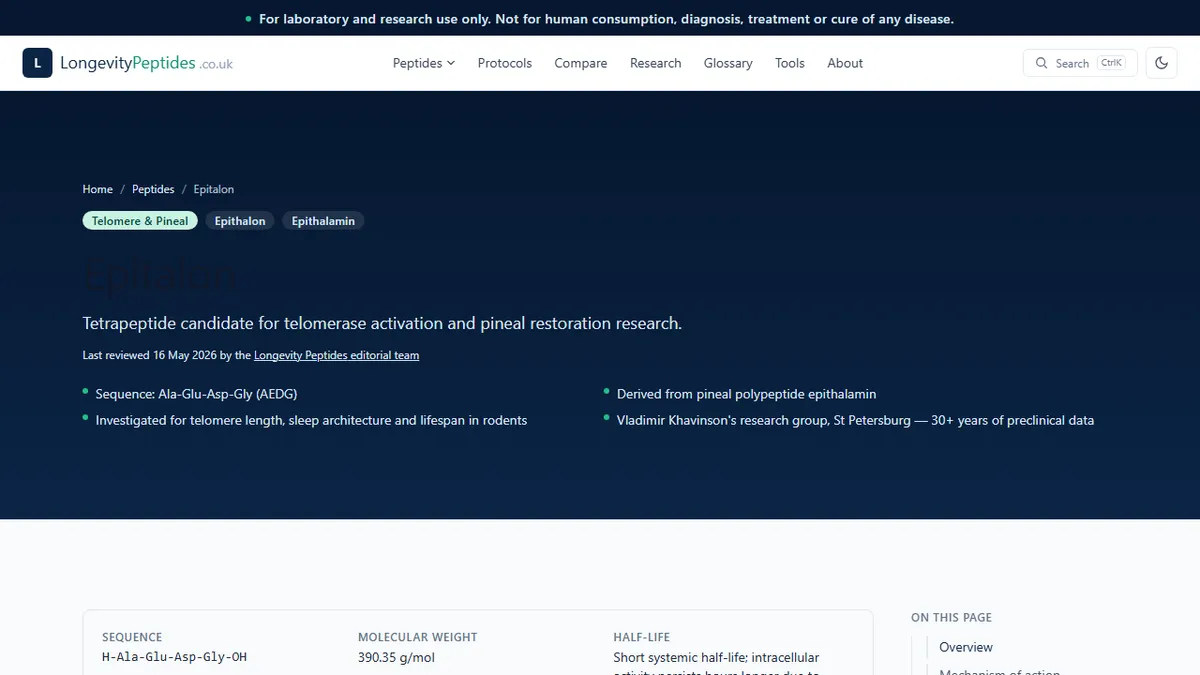
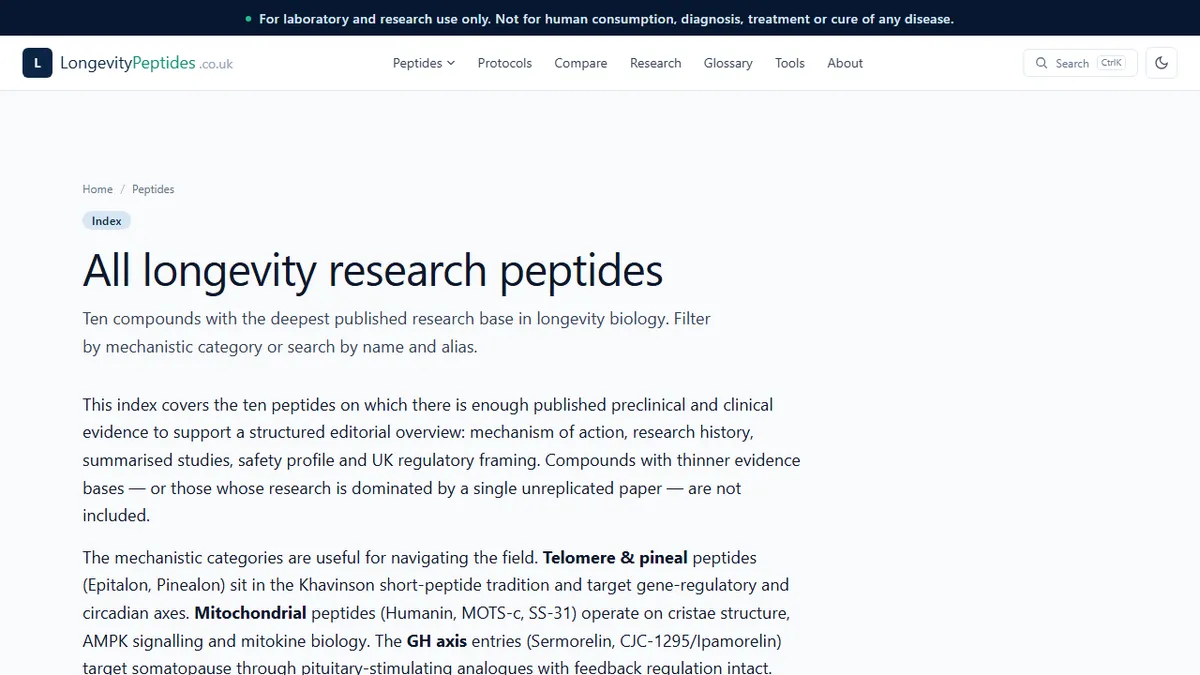
The longevity-peptide literature broadly organises itself into five mechanistic groupings. Telomere and pineal-axis peptides, led by Epitalon (the four-amino-acid AEDG tetrapeptide), are studied for effects on telomerase activity and on the pineal gland's circadian-regulation function. Mitochondrially-derived peptides (including Humanin, MOTS-c, and the SHLP family) are encoded within the mitochondrial genome and act as systemic signals coordinating metabolic and stress-response programmes. Mitochondrial structural stabilisers, primarily SS-31 (elamipretide), protect the inner-mitochondrial-membrane architecture through cardiolipin binding. Cellular-repair peptides, most notably GHK-Cu, influence gene expression and tissue remodelling at a scale that places them in a category of their own. And GH-axis peptides, including Sermorelin and the CJC-1295/Ipamorelin combination, target the well-documented age-related decline in growth-hormone output.
You can explore the full catalogue of longevity peptides and their research categories to see how individual compounds are classified and what evidence exists for each.
What 'Research Use Only' Actually Means in the UK
The label that appears on every UK-supplied research peptide ("for laboratory and research use only, not for human consumption") has a specific legal meaning under the Human Medicines Regulations 2012. Those regulations prohibit the supply of unlicensed medicinal products for human use. Compounds carrying research-only labelling are not permitted to be presented as treatments, cures, or medicines of any kind.
This does not mean the compounds are unregulated in a broader sense. Legitimate UK research-peptide suppliers are subject to standard trading-standards obligations, cannot make therapeutic claims, and must supply material appropriate for laboratory handling. The research-use framing is a genuine legal category, not a loophole.
For institutional researchers, this means standard operating procedures for handling unlicensed investigational compounds apply, including appropriate documentation, waste disposal, and biosafety protocols.
How to Read a Preclinical Study Without Over-Interpreting It
A preclinical study (one conducted in cell culture or in animal models) establishes biological plausibility. It demonstrates that a compound can produce a measurable effect under defined experimental conditions. It does not demonstrate that those effects will translate to human subjects at safe and effective doses, and it cannot establish clinical benefit.
Several specific features warrant attention when reading longevity-peptide literature. The model organism matters: effects in C57BL/6 mice on high-fat diets may not predict outcomes in aged humans with normal metabolic function. The end-point matters: measuring a biomarker improvement (say, plasma IGF-1 levels) is not the same as demonstrating an improvement in healthspan or lifespan. The source of the study matters: a compound's discoverers publishing exclusively within their own research programme is a signal to look carefully for independent replication before giving the results full weight.
The Biggest Misconceptions Beginners Bring to This Topic
The most persistent misconception is the conflation of mechanistic plausibility with clinical proof. A compound that activates telomerase in a cell-culture dish has not been shown to extend human lifespan. A compound that improves insulin sensitivity in aged mice has not been demonstrated to prevent metabolic syndrome in older adults. The bridge between those statements requires controlled human trials with appropriate endpoints, and for most compounds in this field that bridge has not yet been built.
A second common error is treating the absence of published harm as equivalent to established safety. The research-peptide category is, by definition, a preclinical one. The absence of a reported side-effect in a rodent toxicology study does not constitute a human safety profile. That distinction matters when readers encounter confident claims about tolerability.
A third misconception concerns the phrase "naturally occurring." Some peptides studied in this field are endogenous: Humanin, MOTS-c, and GHK-Cu exist in the human body. Others are synthetic analogues of natural sequences, and others still are purpose-designed synthetic compounds with no direct natural counterpart. Endogenous origin does not by itself establish safety at exogenous doses, nor does it imply regulatory approval.
Where to Go Next: A Map of the Evidence Landscape
The evidence base in longevity peptides is genuinely heterogeneous. SS-31 (elamipretide) has completed phase II and III trials in primary mitochondrial myopathy. It occupies the best-evidenced position. Thymosin Alpha-1 holds marketing authorisation in more than 30 countries for hepatitis indications and has a 30-year clinical safety record. GHK-Cu has extensive cosmetic-use and cell-biology data. At the other end, several Khavinson short peptides have exclusively Russian-language preclinical datasets with no independent replication.
Reading in this field benefits from keeping those tiers of evidence clearly distinguished. Preclinical data, single-group human pilots, and multi-site randomised controlled trials are not interchangeable. The most useful research in this space treats that hierarchy seriously rather than collapsing it.