Why GHK-Cu Declines With Age: The Albumin-Proteolysis Mechanism
GHK-Cu was first identified in the early 1970s by Loren Pickart at the University of California, San Francisco, during work on a plasma fraction from young donors that appeared to stimulate regenerative gene expression in ageing hepatocyte cultures. The active species turned out to be the tripeptide glycyl-L-histidyl-L-lysine bound to divalent copper — a compound that, it emerged, is already present in human blood.
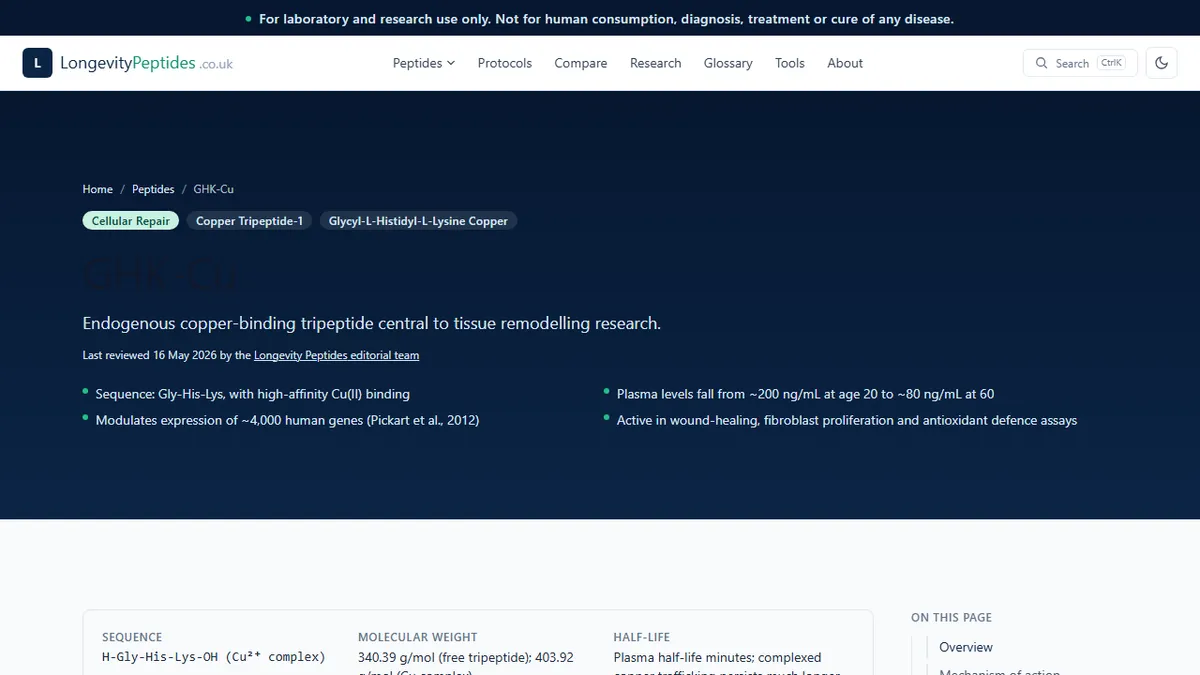
The age-related decline in circulating GHK levels is a well-documented feature of the literature. Plasma concentrations run at roughly 200 nanograms per millilitre in young adults in their twenties and fall to around 80 nanograms per millilitre by age 60. The mechanism behind this decline is linked to albumin proteolysis: GHK is bound to a fraction of circulating albumin and released through the action of proteases. Both the rate of proteolytic release and total plasma GHK levels fall across the lifespan, with the result that older tissues receive less of this endogenous repair signal.
This age-related decline is the biological rationale for examining GHK-Cu as a longevity-research tool. A peptide that is naturally present, naturally declines, and has measurable downstream effects on tissue biology is a more tractable research target than many alternatives. Whether exogenous replacement of a declining endogenous signal produces clinically useful outcomes is a separate question, but the starting rationale is sound.
Copper Trafficking: What GHK-Cu Actually Delivers to Tissue Enzymes
The 'Cu' in GHK-Cu is not decorative. The copper-bound form of the tripeptide is the biologically active species, and the copper-trafficking mechanism is one of the most mechanistically interesting aspects of the compound.
GHK acts as a physiological copper carrier with sub-nanomolar binding affinity for Cu(II). Its biological role appears to be delivery of divalent copper to enzymes that require it as a cofactor, including lysyl oxidase, which cross-links collagen and elastin in connective tissue; superoxide dismutase, which catalyses the neutralisation of superoxide radicals; and cytochrome c oxidase, the terminal electron acceptor in the mitochondrial respiratory chain. Critically, GHK delivers copper in a form that supports these enzymatic functions without leaving free redox-active copper in the tissue environment, where it would otherwise catalyse the generation of damaging hydroxyl radicals via Fenton chemistry.
This dual role (supplying copper where it is needed, while sequestering it from where it would cause oxidative damage) is unusual among copper-binding biological molecules. It is part of why GHK-Cu occupies a distinct position in the cellular-repair peptide literature rather than being categorised simply as an antioxidant or a growth factor mimic.
The 2014 Genome-Wide Microarray Finding and What 4,000 Gene Targets Means
The result that repositioned GHK-Cu from a dermatology ingredient to a serious longevity-research candidate was published in 2014 by Pickart, Vasquez-Soltero and Margolina in BioMed Research International. Using genome-wide microarray analysis of human fibroblasts and Connectivity Map bioinformatics, the study reported that GHK at low-nanomolar concentrations modulated the expression of approximately 4,000 human genes (roughly one-fifth to one-third of the expressed genome, depending on the threshold applied).
That scale of transcriptional effect is striking. Most compounds studied in ageing biology produce targeted effects on defined pathways; GHK-Cu apparently operates more broadly. The pattern of modulation was systematic: up-regulation was concentrated in DNA-repair genes (including PRKDC and BRCA1), antioxidant-defence genes (HMOX1, SOD2), and extracellular-matrix components. Down-regulation was concentrated in inflammatory-response genes and genes associated with metastatic behaviour.
Connectivity Map analysis (a bioinformatics approach that maps gene-expression signatures onto a database of known compound profiles) classified GHK-Cu as a functional "reverser" of the transcriptional signatures characteristic of several cancer and inflammatory tissue types. The analysis is correlative and does not establish causal anti-tumour activity, but the classification is consistent with the anti-inflammatory and antioxidant biological mechanisms described elsewhere in the literature.
What does influencing 4,000 genes mean for a researcher? It means GHK-Cu is unlikely to be a simple single-target probe. It is more accurately characterised as a systems-biology perturbation — a compound that shifts the global transcriptional state of cells in a direction associated with younger, healthier tissue biology. That breadth is both the compound's attraction and one of the interpretive challenges in the research literature.
Anti-Inflammatory and Antioxidant Signatures: NF-kB Suppression and HMOX1 Up-regulation
Two specific pathway effects deserve particular attention for longevity-oriented researchers. The first is suppression of the NF-kB inflammatory signalling pathway. In macrophage models exposed to lipopolysaccharide challenge, GHK-Cu produces dose-dependent reduction in secretion of IL-6, IL-1 beta, and TNF-alpha — the canonical pro-inflammatory cytokine profile. NF-kB is the transcription factor that drives this programme, and its suppression is a consistent finding across multiple GHK-Cu in vitro models.
The relevance to ageing is direct. Chronic low-grade elevation of circulating inflammatory cytokines — sometimes called inflammaging — is one of the most consistent biological signatures of ageing and is correlated with multiple age-related pathologies. A compound that suppresses NF-kB-driven inflammation in cell-culture models is doing something relevant to that biology, even if extrapolating to systemic anti-inflammatory effects in humans requires substantially more evidence.
The second is up-regulation of HMOX1, the gene encoding haem oxygenase-1. HMOX1 is an inducible cytoprotective enzyme that degrades haem, produces the signalling molecule carbon monoxide, and generates biliverdin and ferrous iron. Its induction is a marker of activation of the NRF2 antioxidant-response pathway, and HMOX1 up-regulation is associated with protection against oxidative-stress-induced cell death across multiple model systems.
The Skincare-to-Research-Peptide Divide: Same Molecule, Different Regulatory Status
GHK-Cu has an unusual position in the UK regulatory landscape. Copper tripeptide-1 is approved for cosmetic use in the United Kingdom under standard CPNP notification, and has been an ingredient in topical skincare formulations for decades. Parenteral GHK-Cu and research-peptide presentations are not licensed medicines under the MHRA and are supplied only for laboratory and preclinical work.
This distinction matters for researchers in both directions. For readers approaching from the cosmetic literature: the safety profile established through topical use does not transfer automatically to systemic administration. Systemic exposure from parenteral use is of a different order than dermal absorption from a cream, and the regulatory history of cosmetic use says nothing about parenteral safety.
For researchers approaching from the longevity-peptide angle: the cosmetic history provides a useful starting point (the compound has been handled by the human body for decades at dermal doses without mutagenic or carcinogenic signals emerging), but it does not constitute the systemic safety characterisation that a parenteral research protocol requires. The GHK-Cu mechanism, studies and UK regulatory framing details how the compound is classified and what each regulatory category permits.
What Questions Remain Open for Longevity-Oriented Research
The GHK-Cu research landscape in 2026 has a specific shape. The in vitro biology is unusually well-characterised for a research peptide: copper-trafficking mechanism, gene-expression signature, anti-inflammatory and antioxidant effects, and connective-tissue-remodelling activity are all documented across multiple publications and partly independently replicated. The cosmetic-use track record provides a long-horizon tolerability signal for topical exposure. Cell-based models are credible and internally consistent.
What the literature lacks is a clinical-stage human dataset that evaluates systemic administration of research-grade GHK-Cu with longevity-relevant endpoints. Whether the broad gene-expression modulation documented in fibroblast cultures is reproduced in living human tissue at physiologically achievable concentrations remains unknown. Whether the NF-kB suppression and HMOX1 induction observed in cell culture translate to measurable reductions in systemic inflammatory markers in older adults has not been tested in a rigorous human pilot.
The field's most productive next step would be a well-designed human pharmacokinetic and pharmacodynamic study establishing what plasma and tissue concentrations are achievable with different administration routes, followed by a biomarker-driven pilot in an appropriately characterised older-adult research population. The foundation in cell biology is strong enough to justify that investment; without it, the gap between laboratory finding and clinical inference remains wider than the compound's compelling basic-science profile would warrant.