Why Comparing BTC and ETH Is Like Comparing Gold and Electricity
The framing of Bitcoin versus Ethereum as competitors is almost always wrong, and starting from that framing leads to confused thinking about which to buy. They emerged from different motivations, operate under different technical architectures, serve different primary use cases, and are held by substantially different communities for substantially different reasons.
A more useful analogy is to think of Bitcoin as digital gold and Ethereum as a shared computing platform. Gold is valued because it is scarce, durable, and functions as a long-term store of value, not because you can do things with it easily. Electricity is valued because you can do things with it: power devices, run machines, enable processes that would otherwise be impossible. Both have genuine value. Neither is a replacement for the other. The question of which to buy first is really a question of what function you want your first crypto holding to serve.
Bitcoin: Store of Value, Capped Supply, and Why That Matters
Bitcoin was designed around a fixed total supply of 21 million coins, enforced by the protocol itself. Approximately every four years, the reward paid to miners for processing transactions is cut in half (an event called the halving), which progressively reduces the rate at which new supply enters circulation. The final bitcoin is projected to be mined sometime in the next century.
This scarcity is not a marketing claim. It is a property of the code that every node in the network enforces, and changing it would require convincing the distributed network to adopt a protocol modification that the majority of participants have consistently rejected. The supply constraint is credibly immutable in a way that fiat currencies and most other assets are not.
Bitcoin's blockchain is deliberately limited in functionality. It does not support complex smart contracts or decentralised applications. That narrowness is often criticised as a weakness, but advocates argue it is a feature: the network optimises for security and reliability rather than flexibility. Bitcoin has never experienced a successful protocol-level attack. Its settlement finality and on-chain security record are unmatched in the industry.
Ethereum: Programmable Money and the Ecosystem It Powers
Ethereum was conceived as a general-purpose programmable blockchain. Rather than only recording value transfers, it allows developers to deploy smart contracts — code that executes automatically when defined conditions are met, without any centralised party controlling the outcome. Every decentralised exchange, lending protocol, NFT marketplace, and stablecoin mechanism running on Ethereum traces back to this foundational capability.
Ethereum does not have a fixed supply cap in the same way Bitcoin does. Since transitioning from Proof of Work to Proof of Stake in 2022, its monetary policy has been deflationary under conditions of high network usage, because fees paid to the network are partially burned, permanently removed from circulation. The long-term supply trajectory depends on network activity, which introduces a degree of variability that Bitcoin does not have.
What Ethereum offers that Bitcoin does not is programmability. Owning ETH gives you access to the largest decentralised application ecosystem in crypto. If you ever want to participate in DeFi, use a decentralised exchange, earn yield through staking, or interact with NFT protocols, you will need ETH to pay for transaction processing.
Risk Profile Differences: Volatility, Liquidity, and Attack Surface
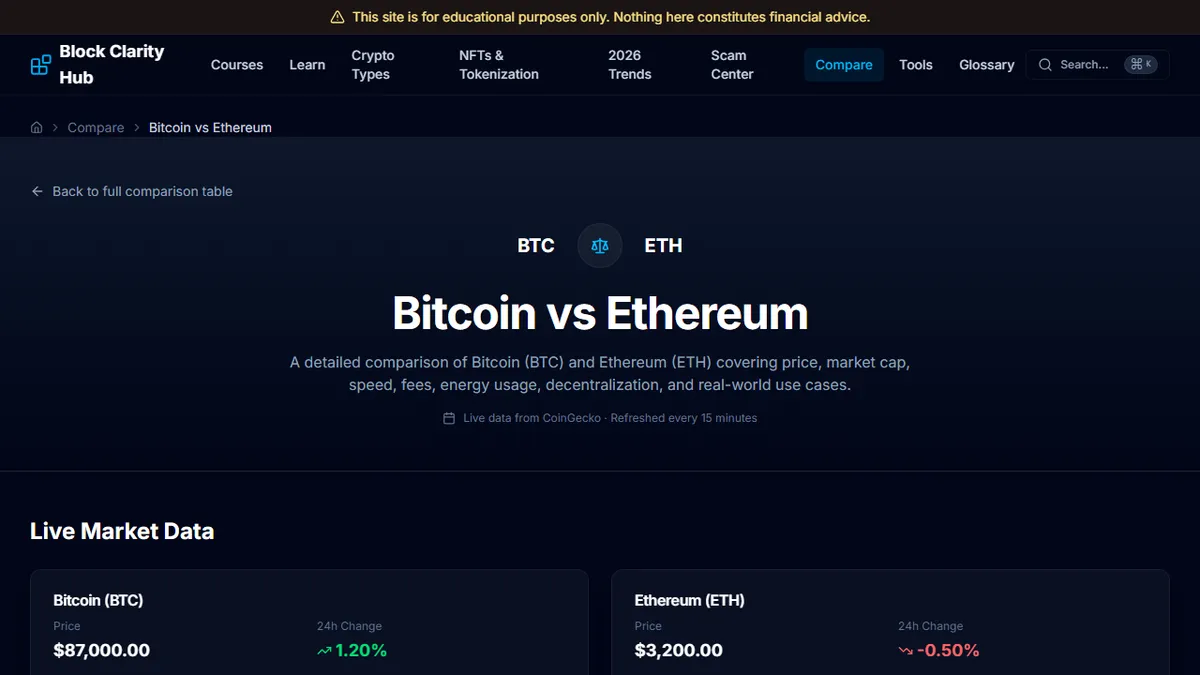
Both assets are volatile by the standards of traditional finance, but there are meaningful differences in how that volatility manifests. Bitcoin's market is deeper and more liquid, particularly among institutional participants, which tends to moderate short-term price swings relative to Ethereum during periods of market stress. The side-by-side Bitcoin vs Ethereum metrics chart the differences in market cap, trading volume, and volatility measurements across historical periods.
Ethereum's attack surface is structurally larger than Bitcoin's. The flexibility that makes smart contracts powerful also introduces complexity, and complexity creates more potential for bugs or unexpected interactions. A vulnerability in a major DeFi protocol built on Ethereum can cause significant ETH price disruption even if the Ethereum base layer itself is not compromised. Bitcoin's simpler architecture has fewer such exposure points.
That said, Ethereum's transition to Proof of Stake has not produced the security failures some critics predicted. The validator network is large, slashing conditions for misbehaviour are economically punishing, and the protocol has been stable since the Merge.
What You Can Actually Do With Each
With Bitcoin, the primary activity is holding (often called HODL in community shorthand) and occasionally using it for peer-to-peer value transfer or, increasingly, as collateral in centralised financial products. The Lightning Network enables fast, low-cost Bitcoin payments for smaller transactions, but mass consumer adoption of BTC as a spending currency has not materialised in most markets.
With Ethereum, the practical applications are substantially broader. Staking ETH through a liquid staking protocol earns yield. Lending it through protocols like Aave earns interest. Providing it as liquidity to a decentralised exchange earns fees. Participating in governance of protocols you use requires holding their tokens, many of which only exist because Ethereum's infrastructure made them possible. Each of these activities carries its own risks, but the optionality is genuinely different from Bitcoin.
A Simple Decision Framework for First-Time Buyers
If your primary goal is a simple long-term exposure to crypto with the least operational complexity, Bitcoin is the more straightforward choice. It has the longest track record, the most liquid markets, the simplest custody story, and no requirement to understand smart contracts or DeFi to hold it responsibly.
If you are interested in engaging with decentralised applications, earning yield, or understanding how the broader crypto ecosystem works at a technical level, Ethereum is the more educational first purchase. The learning curve is steeper and the ongoing risks require more attention, but the ecosystem it gives you access to is vast.
A third legitimate option is splitting a modest first allocation between both, which allows you to compare the experience of holding each while limiting total exposure. What is rarely the right answer is making the decision based on recent price performance. Neither asset's past returns are predictive of near-term future returns, and chasing recent winners is one of the most consistent ways beginners lose money.