The Five-Day Onboarding
The phrase "red-pill pipeline" gets thrown around so loosely that it sounds like a metaphor. It is not. On TikTok, the process has a measurable shape: a fresh account that starts with ordinary male-interest content can be majority-misogynistic within five days. The red pill itself is a worldview that claims to reveal the hidden truth about women and dating: that female attraction is driven by hypergamy, that male value is tied to status and looks, and that modern society has rigged the game against men. The pipeline is the route a boy takes to get there.
The clearest evidence is a test that pushed a fresh feed from 13% to 56% misogynistic content in five days. The people who run this pipeline are not a secret cabal. They are recommendation systems optimising for engagement. The content that holds a teenage boy's attention longest happens to be content that tells him his problems are not his fault.
Day One: The Seed
The seed is not a red pill. It is a normal question: How do I get a girlfriend? How do I get stronger? Why does nobody respect me? A boy searches one of these, lingers on a video, watches it twice. The algorithm registers the signal and serves more of the same: gym clips, style advice, confidence tips. None of this is sinister. It is the same machinery that recommends cooking videos after you watch one recipe.
But the male self-improvement niche has a long tail, and the tail ends in grievance. The boy does not need to discover the grievance himself. The algorithm will show it to him because it has already learned that a viewer who watches one "female nature" video will watch another. The algorithm does not need to know his name. It needs a signal: a five-second pause, a rewatch, a like. That is enough.
Day Two: The Vocabulary
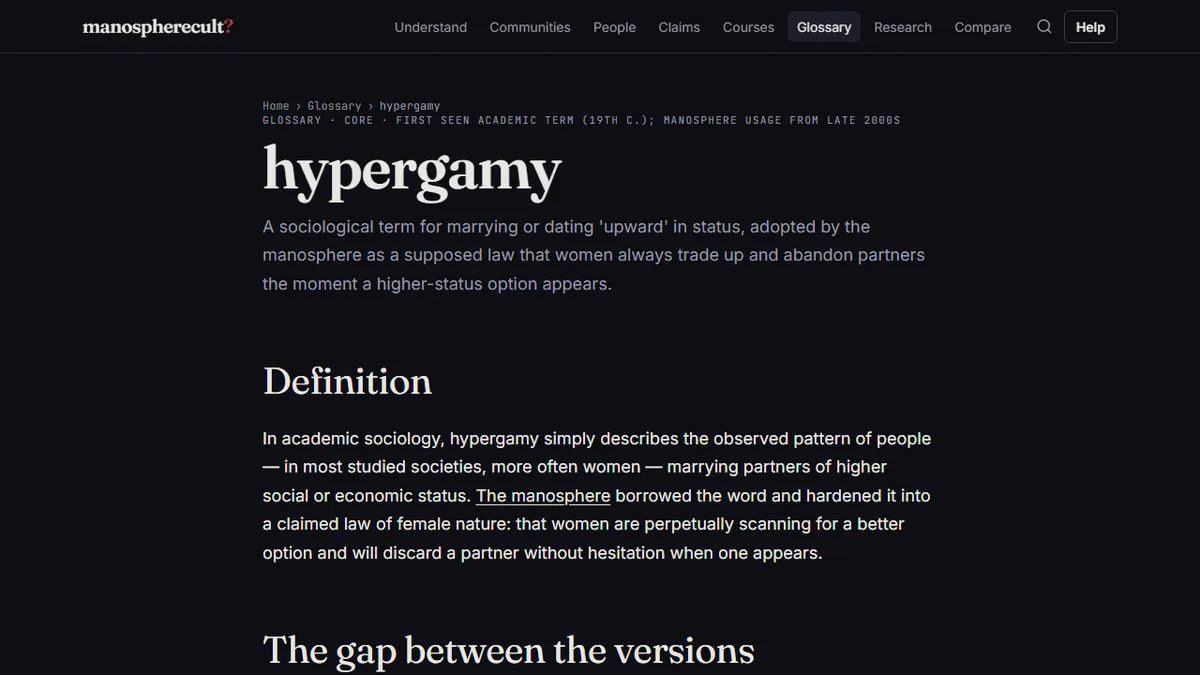
By day two, the vocabulary arrives. Words like hypergamy, body count, and AWALT start appearing in captions and voiceovers. The boy does not need to seek them out; they come to him. These terms do real work. They compress a painful, confusing experience (a rejection, a breakup, a feeling of invisibility) into a single explanation.
Body count reduces a woman's sexual history to a number that supposedly predicts loyalty, while the hypergamy claim states that women instinctively seek higher-status partners. AWALT (all women are like that) turns individual differences into a universal law. The terms are sticky because they are simple. A boy who has been rejected three times does not need a nuanced study of mate preferences; he needs a one-word explanation. A rejection becomes not a personal mismatch but an instance of a universal female trait. That feels like knowledge. It is actually a script. Once he accepts the vocabulary, he has accepted the frame.
Day Three: The Sorting System
The script gets a cast of characters. There are alphas and betas, Chads and Stacys, high-value men and low-value men. There is the wall, the 80/20 rule, the body count. The taxonomy sorts everyone into slots, and the wall claim, that a woman's romantic value collapses around thirty, is one of its more brutal rules. A boy learns to sort himself, his peers, and every woman he meets into the same hierarchy.
The algorithm rewards this by serving comparison content: why she chose him over you, what separates a high-value man from a low-value one, why women in their thirties are "past their prime." Looks theory ranks faces and skulls on numeric scales. None of this is science, but it does not need to be. It needs to feel predictive. The categories become a lens. Once the lens is on, it is difficult to take off. Every future interaction is filtered through it, and the filter confirms itself.
Day Four: The Cure
Once the diagnosis is fixed, the cure appears. Semen retention, mewing, jaw exercises, cold showers, monk mode, paid courses that promise to turn a low-value man into a high-value man. Some of this is harmless self-help dressed in pseudo-biology. Some of it is a direct monetisation of the pipeline: a guru tells a boy he is broken, then sells him the fix.
The most visible version is Andrew Tate's The Real World, a paid "university" that promises to teach men how to make money and dominate. It is not education; it is the final product of a funnel that begins with a lonely boy and ends with a subscription. The boy pays, not because the course works, but because the course promises an end to the pain the algorithm has been amplifying. The cure is always just out of reach. There is always another protocol, another supplement, another level of discipline. The pipeline has become a subscription.
Day Five: The Commitment
By day five, the worldview is no longer a set of videos. It is an identity. The boy has a vocabulary, a taxonomy, an enemy, and a solution. He may join a subreddit or a Discord server where the same ideas are repeated as doctrine. The algorithm now treats him as a reliable consumer. It stops needing to show him soft entry points. It can serve him directly misogynistic content, because he has demonstrated that he will watch it.
The boy may not even notice the shift. What felt like self-improvement on day one feels like clarity by day five. The scale of this ecosystem is not marginal. It is visible in the reach the ecosystem's biggest names achieved before platform bans: hashtags associated with Andrew Tate alone had accumulated 14.1 billion TikTok views by the time of his ban. That number does not mean every viewer became a recruit. It means the funnel is wide. And the funnel does not end at the screen. The vocabulary he has learned will shape how he talks to friends, how he approaches dating, and how he interprets every future rejection.
Why the Algorithm Builds the Cage
The algorithm is not woke, not anti-male, not political. It is agnostic. It optimises for watch time, completion rate, shares, and comments. Misogynistic content performs well on those metrics because it produces strong emotional responses: outrage, validation, the thrill of secret knowledge. A video that tells a lonely boy his loneliness is not his fault will be watched to the end. A video that tells him women are the problem will be shared.
The feedback loop is not a conspiracy. It is worse than a conspiracy. It is an incentive structure with no off switch. The same mechanism that recommends cat videos to a grandmother recommends red-pill content to a teenage boy. The difference is not the algorithm but the content that happens to exploit the boy's vulnerabilities most efficiently. The algorithm does not care which videos those are. It only cares that they work.
The Exit Ramp
The pipeline is not destiny. The research on incels is nuanced, and the manosphere's real-world effects are real but uneven. Most incels remain non-violent, and the majority of young men who encounter red-pill content do not become extremists. What matters is interruption. A parent, teacher, or friend who can name the mechanism ("the algorithm is showing you this because anger holds your attention") breaks the spell. Intervention does not require a lecture. It requires a competing narrative delivered with the same emotional force.
So does exposure to a different set of male voices: mentors who do not sell cures, communities that do not sort people into winners and losers, and spaces where a boy can be uncertain without being told that uncertainty is weakness. Media literacy helps. So do help resources that name the pipeline without moralising. The five-day pipeline can be built in both directions. The same feed that taught a boy to distrust women can teach him to distrust the feed itself.