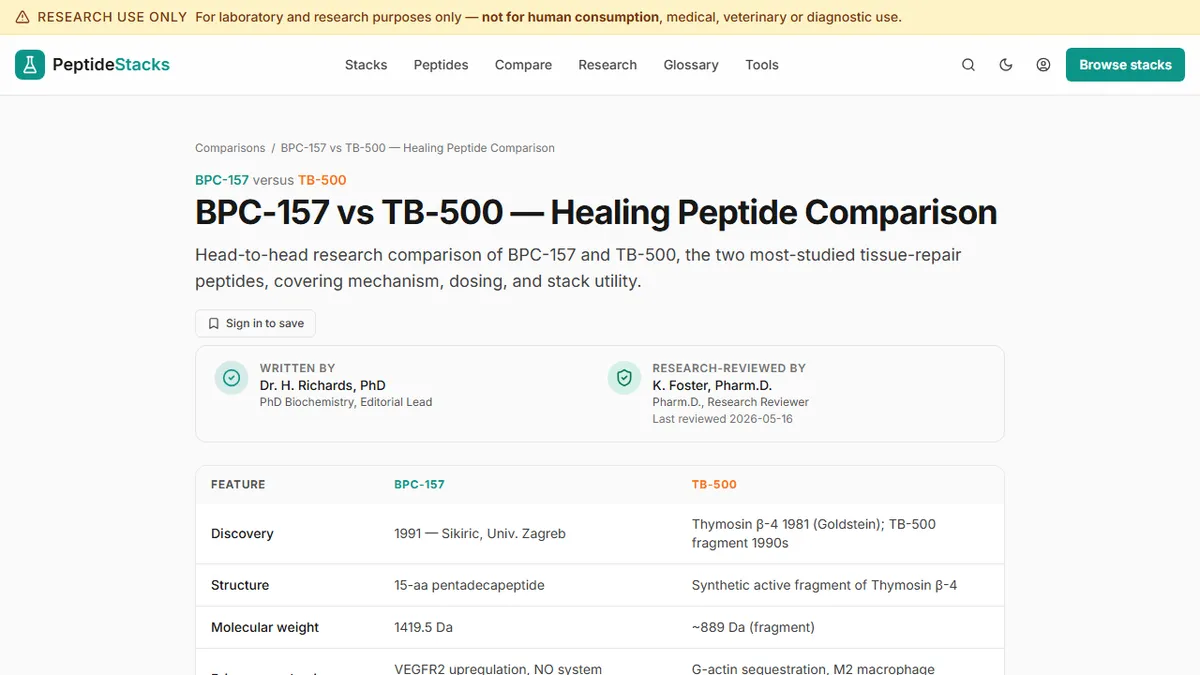
The Core Mechanistic Split — VEGFR2 Angiogenesis vs G-Actin Sequestration
BPC-157 and TB-500 are often treated as interchangeable healing compounds in informal research discussion. They are not. Their mechanisms diverge at a fundamental level, and understanding that divergence is the first step in determining which compound belongs in a given study design.
BPC-157 is a 15-amino-acid synthetic peptide derived from a partial sequence of a protein found in human gastric juice. Its most robustly documented mechanism is the upregulation of vascular endothelial growth factor receptor 2 (VEGFR2) on endothelial cells. By increasing VEGFR2 density, BPC-157 amplifies the tissue's sensitivity to circulating VEGF, driving capillary sprouting into hypoxic or injured zones. The angiogenic programme this initiates is well-documented in Hsieh and colleagues' 2017 work, which confirmed that selective VEGFR2 blockade abolishes the compound's pro-angiogenic effect in both culture and in vivo models. The early vascular response to injury is BPC-157's primary domain.
TB-500, also known as Thymosin beta-4, works through an entirely different axis. It is a naturally occurring 43-amino-acid peptide that functions primarily by sequestering G-actin monomers (the building blocks of the actin cytoskeleton). When cells need to migrate into a wound bed, they require cytoskeletal reorganisation, and the availability of G-actin is a rate-limiting factor in that process. By modulating G-actin availability, TB-500 facilitates the migration of keratinocytes, endothelial cells, and progenitor cell populations into sites of tissue damage. It also promotes M2 macrophage polarisation, shifting the local inflammatory milieu away from the destructive M1 phenotype and toward a resolution and repair phenotype.
In summary: BPC-157 addresses the vascular supply problem, and TB-500 addresses the cellular population problem. Both are necessary for complete tissue repair, but they are not substitutes for each other.
Where BPC-157 Leads: Gastric Mucosa and Early Tendon Outgrowth
The deepest and most replicated body of BPC-157 research concerns the gastrointestinal tract. Predrag Sikiric's laboratory in Zagreb has published extensively since the early 1990s on BPC-157's capacity to accelerate healing in gastric ulcer models, attenuate NSAID-induced intestinal damage, and support mucosal barrier integrity through tight-junction stabilisation. This is the compound's home territory, the biological context in which it was originally characterised and in which independent replication has come closest to occurring.
Beyond the gut, tendon and ligament repair are the second-strongest area of BPC-157 evidence. Chang and colleagues demonstrated that BPC-157 promotes tendon outgrowth from explant cultures and increases cell survival under oxidative stress conditions. The angiogenic mechanism is directly relevant here because tendons are avascular tissues with inherently limited repair capacity; increasing local capillary density in adjacent tissue supports the nutrient and oxygen delivery that early repair depends on.
For researchers designing studies focused on early-phase healing in these tissue types, BPC-157 is the more mechanistically targeted choice. Its angiogenic signal operates immediately upon administration and peaks before the cellular migration phase that TB-500 addresses.
Where TB-500 Leads: Cardiac Ischaemia-Reperfusion and Systemic Tissue Distribution
TB-500's most compelling evidence outside standard soft-tissue models comes from cardiac research. Thymosin beta-4 has been studied in ischaemia-reperfusion injury models with notable results: administered after cardiac ischaemia in rodent models, it reduces infarct size, promotes cardiomyocyte survival, and activates dormant epicardial progenitor cells. The mechanistic basis includes both its anti-apoptotic effects and its capacity to mobilise endogenous repair cell populations, a distinct mechanism from BPC-157's angiogenic drive.
The other key distinguishing feature of TB-500 is its pharmacokinetic behaviour. Because Thymosin beta-4 is an endogenous peptide present throughout the body, its repair-promoting effects appear to distribute systemically rather than being confined to the injection site. This systemic coverage is particularly relevant for researchers studying diffuse tissue injuries or multi-site repair processes, where a locally acting compound would require multiple injections to achieve comparable coverage.
Half-Life and Dosing Cadence — Why They Call for Different Schedules
BPC-157 has a short circulating half-life, which forms the mechanistic basis for twice-daily dosing in most published research protocols. Its stability in aqueous solution is relatively good compared to other research peptides, but the rapid clearance means that maintaining a continuous angiogenic signal requires frequent administration. Most protocols space doses approximately twelve hours apart.
TB-500, derived from a naturally occurring protein with different pharmacokinetics, is typically studied at longer dosing intervals. Published research protocols most commonly use twice-weekly administration. This reflects the compound's more sustained presence in circulation and the slower timescale of its cellular migration and macrophage polarisation effects. The cellular processes TB-500 influences (progenitor cell recruitment, matrix reorganisation, M2 polarisation) unfold over days rather than hours.
These scheduling differences are not trivial from a research design perspective. A study comparing both compounds within the same protocol needs to account for the fact that their respective mechanisms are producing signals on different timescales.
Five Research Questions and Which Compound Answers Each
Researchers approaching the choice between these compounds can use their mechanism to guide the decision. For studies examining early angiogenesis in tissue repair or the role of VEGFR2 signalling in wound healing, BPC-157 is the more direct tool. For studies examining gastrointestinal mucosal integrity or NSAID-induced epithelial damage, BPC-157 is again the more targeted choice given its gastric origin and the depth of the mucosal evidence base.
For studies examining cellular migration dynamics (particularly keratinocyte or endothelial cell movement into a wound bed), TB-500's G-actin mechanism makes it the more appropriate compound. For research into M2 macrophage polarisation and its role in inflammation resolution, TB-500 is again the better fit. For cardiac ischaemia-reperfusion models where progenitor cell activation is the primary variable, TB-500's evidence base is more directly applicable.
When Combining Both Is the Rational Choice
The full mechanism-by-mechanism breakdown of BPC-157 versus TB-500 makes the case for combination most clearly: the two compounds address phases of tissue repair that are sequential but non-overlapping. BPC-157's vascular signal precedes and enables the cellular migration and matrix organisation that TB-500 supports. Running both produces coverage across the early angiogenic phase and the subsequent cellular proliferation phase without redundancy.
This makes the BPC-157 plus TB-500 stack the most frequently cited and most mechanistically justified pairing in the tissue-repair research literature. It is not a combination driven by commercial logic. It reflects a genuine complementarity at the biological level. For any study design targeting soft-tissue healing across the full repair arc, the combination is typically more informative than either compound studied in isolation.