Why Single Peptides Often Can't Cover a Full Biological Process
Most biological repair and regulation is not the work of a single molecular actor. Take wound healing: it begins with acute inflammation and clot formation, moves through angiogenesis and fibroblast proliferation, and concludes with matrix remodelling and tissue reintegration. Each of those phases is driven by a distinct set of signalling molecules operating on different timescales, targeting different cell types, and occupying different anatomical compartments. Asking one peptide to address the full cascade is a bit like expecting one tool to build an entire house.
This is the core rationale behind studying peptide combinations. When researchers talk about stacking, they are describing protocols that pair compounds with complementary or sequential mechanisms, so that what one molecule cannot reach, another can. The logic is not additive marketing: it is the same mechanistic reasoning that underpins polypharmacy in established medicine, where a statin and an ACE inhibitor are prescribed together precisely because they address cardiovascular risk through independent pathways.
Understanding that rationale before diving into any specific protocol is what separates a careful reader of the literature from someone copying a forum post.
The Three Phases of Wound Healing — and Which Peptides Cover Each
The wound-healing model is the clearest worked example of why combination research makes sense. In the inflammatory phase, the primary concern is microbial defence and pro-inflammatory cytokine management; KPV, the C-terminal fragment of alpha-melanocyte-stimulating hormone, has attracted research interest here because of its documented suppression of NF-kappaB signalling in intestinal and macrophage models. The proliferative phase demands new blood vessel formation and cellular migration into the wound bed; BPC-157's VEGFR2 upregulation addresses the angiogenic component, while TB-500's G-actin sequestration supports keratinocyte and endothelial-cell mobility. The remodelling phase requires collagen cross-linking and extracellular matrix organisation; GHK-Cu's activation of lysyl oxidase is the most studied mechanism at this stage.
No single one of those compounds addresses all three phases. Running BPC-157 alone produces strong angiogenic data in rodent models but does not directly improve collagen matrix quality. Running GHK-Cu alone supports matrix remodelling without meaningfully driving new vessel formation. The combination produces a richer, multi-phase coverage that more closely mirrors the biology of actual tissue repair.
What 'Additive' Actually Means vs True Synergy
These two terms are used interchangeably in informal peptide discussion, and they should not be. In pharmacology, additivity has a precise meaning: the combined effect equals the sum of each compound's individual contribution. If peptide A produces a 30% improvement in a given marker and peptide B produces a 20% improvement via the same mechanism, running both together should produce roughly 50%. That is additivity.
Synergy, properly defined, means the combined effect exceeds the arithmetic sum. This requires either positive receptor cross-talk, where one compound increases sensitivity to another at the receptor level, or genuine mechanistic interdependence, where the downstream product of one compound becomes the substrate or enabler for the other. True synergy is relatively rare and difficult to confirm without dose-matrix experiments across multiple concentration combinations.
Most peptide combinations in the research literature are best described as additive or as complementary-mechanism coverage rather than synergistic. The distinction matters because it affects how you interpret results: if you are studying two compounds that address different phases of a cascade, you expect improved outcomes compared to monotherapy without expecting an exponential effect.
The science behind studying peptide combinations examines these distinctions in greater depth and explains how dosing table designs are built around the additive model.
How to Read a Stack Research Page
A well-structured stack research page contains several distinct sections that serve different analytical purposes. The dosing table lists each compound, its research dose, frequency, and route of administration. This is the operational summary. Mechanism cards provide a compound-specific breakdown of the relevant receptor targets, documented in vitro and in vivo findings, and the known limitations of each data set. A combined-studies section describes any research that has examined the compounds together rather than separately; for most peptide combinations, this section is thin, because direct combination studies are rarer than independent monotherapy work.
The UK regulatory note is not a footnote: it carries practical significance for anyone handling these compounds. Research-grade peptides in the United Kingdom operate under a specific and evolving MHRA framework that distinguishes between laboratory handling and human administration. A stack page worth reading will state this clearly rather than burying it.
Difficulty bands typically range from beginner to advanced. They reflect the complexity of the dosing schedule, the reconstitution requirements, and the specificity of the research context. A beginner stack uses two compounds with straightforward reconstitution, clear dosing intervals, and broad mechanistic rationale. An advanced stack may involve three or more compounds with timing dependencies and narrower experimental applications.
Choosing Your First Stack: Difficulty Bands Explained
For researchers new to the combination literature, the BPC-157 plus TB-500 healing stack is consistently the most accessible entry point. Both compounds have the deepest independent evidence bases of any pairing in the tissue-repair space. Their mechanisms are complementary without being interdependent, their dosing schedules align naturally, and the research questions they address (angiogenesis and cellular migration in soft-tissue repair) are among the most studied in the preclinical peptide literature.
A step up in complexity involves compounds with precise timing requirements, such as growth hormone axis peptides that depend on the timing of natural pulsatile GH secretion. These stacks require a stronger understanding of endocrine physiology before the protocol design makes sense.
More complex still are immunomodulatory stacks involving sequential activation of the innate-to-adaptive cascade, which require an understanding of cytokine kinetics and thymic physiology that goes well beyond surface-level reading. These are not beginner territory.
Where to Go Next — Individual Monographs vs Comparison Pages
Two types of resource serve different stages of research planning. Individual peptide monographs are the foundation: they provide the compound-specific mechanistic detail, the primary literature citations, the known pharmacokinetic parameters, and the documented limitations. Reading the monograph for each component of a stack before reading the stack page itself is the most defensible way to approach combination research.
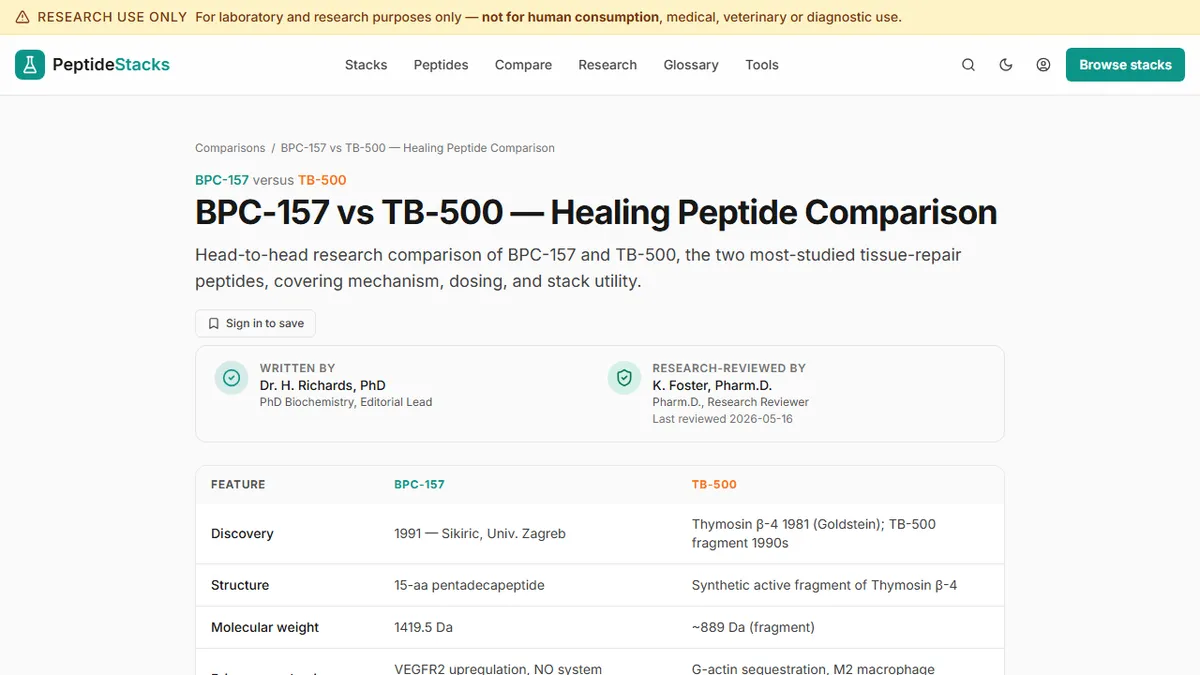
Comparison pages serve a different function. They sit between two monographs and ask a specific analytical question: for a given research objective, which of these two compounds is the better design choice? The mechanism-by-mechanism layout forces a direct contrast that a monograph cannot provide. If you are trying to choose between compounds that address overlapping targets, the comparison page is the more useful starting point than reading two separate monographs and trying to synthesise the contrast yourself.
Together, monographs and comparisons provide the foundational reading before a stack page makes full sense. Treating the stack page as the beginning of the research process rather than the conclusion of it is the approach most likely to produce meaningful results.