The Two Main Entry Options for Most Visitors
Most travelers arrive in Cambodia holding one of two documents: a tourist e-visa applied for online before departure, or a visa on arrival collected at the border itself. Both grant a standard 30-day tourist stay. Both are available to citizens of the vast majority of countries. The difference lies in cost, processing time, and (critically) the entry points where each one is accepted.
That last distinction is the one most guides gloss over, and it is the one that can derail a carefully planned trip. Choosing your visa type without mapping it to your actual route is how travelers end up stuck at a land crossing that refuses to process their online application.
E-Visa: What It Costs, How Long It Takes, and Where It Works
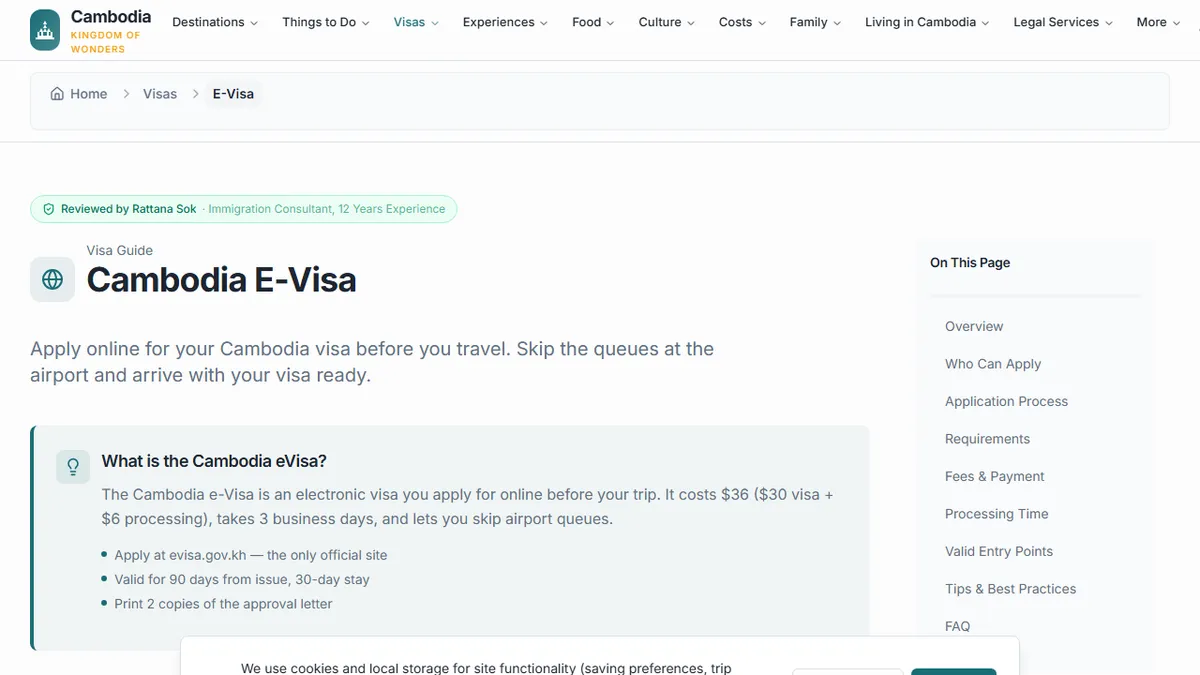
The Cambodia e-visa is processed through the official government portal and currently costs USD 36 for a tourist visa, inclusive of a service fee. Processing is officially quoted at three business days, though most applicants receive approval within 24 to 48 hours. You apply before you travel, receive an approval letter by email, and present it alongside your passport at the border.
The appeal is obvious: no queuing at a visa counter, no needing USD cash ready at the crossing, and documentation sorted before you leave home. For anyone flying into Phnom Penh International Airport or Siem Reap International Airport, the e-visa is efficient and sensible. The official e-visa requirements and processing steps lay out exactly what documents you need to upload, including a passport-style photo and a scan of your biographical page.
The limitation that matters: the e-visa is accepted at a select number of entry points, not all of them. If your itinerary takes you overland from Thailand via Poipet, or across from Vietnam via Bavet, the e-visa works at those specific crossings. Smaller rural crossings are a different matter entirely.
Visa on Arrival: The Fastest Route — With Caveats
The visa on arrival remains the most used entry method for Cambodia, particularly among independent travelers and those arriving on short notice. It is available at Phnom Penh and Siem Reap airports as well as many of the major land border crossings. The fee is USD 30 for a tourist visa, making it slightly cheaper than the e-visa on paper.
At airports, the process is straightforward: join the visa on arrival queue, hand over your passport, one passport photo, and the fee in USD, and walk away with a stamped entry. Total time at the counter is typically under five minutes once you reach the front. At land borders during peak periods the queue can run to an hour or more, particularly at Poipet, which is one of the busiest crossings in Southeast Asia.
One practical note: the USD 30 fee is cash only and should be exact. Border officers rarely make change willingly, and attempting to break a large bill often results in unofficial "change fees" appearing out of nowhere. Have small bills ready.
Which Entry Points Accept Which Visa (The Detail Most Guides Skip)
Here is where the choice between e-visa and visa on arrival becomes genuinely consequential. The full list of land and airport border crossings that accept visa on arrival includes details that change based on current border policy. That policy shifts more often than most travel articles are updated to reflect.
As a general rule: all three international airports (Phnom Penh, Siem Reap, and Sihanoukville) accept both e-visa and visa on arrival. The major land crossings (Poipet, Bavet, Koh Kong, and Prek Chak) accept both. Smaller and more remote land crossings may accept neither, operating on pre-arranged visas only, or may only process visa on arrival.
If you are crossing from Laos via the northeastern borders or using any minor crossing, research the specific point before you travel. An e-visa rejected at a remote crossing leaves you in a difficult position with no obvious alternative.
4 Traveler Scenarios: Which Visa Wins Each Time
Flying into Phnom Penh or Siem Reap: The e-visa is slightly easier (paperwork done, no queue at the counter) but visa on arrival works just as well at both airports. The USD 6 difference is negligible. Either is fine; e-visa wins marginally on convenience.
Overland from Bangkok via Poipet: Both visa types are accepted at Poipet. The e-visa is worth considering here because Poipet is busy and the visa on arrival queue adds time to an already exhausting crossing. Arriving with your approval letter already printed speeds things up.
Overland from Ho Chi Minh City via Bavet-Moc Bai: Same logic as Poipet: both accepted, e-visa reduces queue time. The crossing itself is quieter than Poipet, so the time saving is less significant.
Using a small or off-the-beaten-path land crossing: Do not rely on either tourist visa type without confirming in advance. Some minor crossings process visas on arrival only; others require advance arrangement entirely. Verify the specific crossing through current traveler reports.
What to Bring at the Border Either Way
Regardless of which visa you choose, certain documents are non-negotiable at every entry point. Your passport must be valid for at least six months beyond your intended entry date. One passport-sized photograph is required for visa on arrival and for the e-visa application. USD cash is needed for visa on arrival fees; have exact change or small denominations. If applying for an e-visa, print your approval letter. Border officers want paper, not a phone screen.
A secondary practical point: dress presentably at the crossing. This sounds unnecessary until you encounter a border officer on a slow day who has wide discretion over entry decisions. Looking like a traveler who has prepared for the crossing is better than looking like someone who improvised it.