Why Carry-On Confiscations Happen
The assumption most travellers carry through the security lane is that confiscations are reserved for people trying to smuggle something dangerous. In practice, a sizeable share of items lost at airport security belong to ordinary passengers who packed legally owned goods in the wrong container, the wrong bag, or the wrong quantity. Security officers are not making judgment calls about your intentions. They are applying rules that have very little tolerance for edge cases.
Understanding this distinction shifts the problem from the item itself to the decision you made when packing. Most confiscations are reversible in hindsight, which makes them uniquely frustrating.
Mistake 1: Misunderstanding the 100ml Liquids Rule
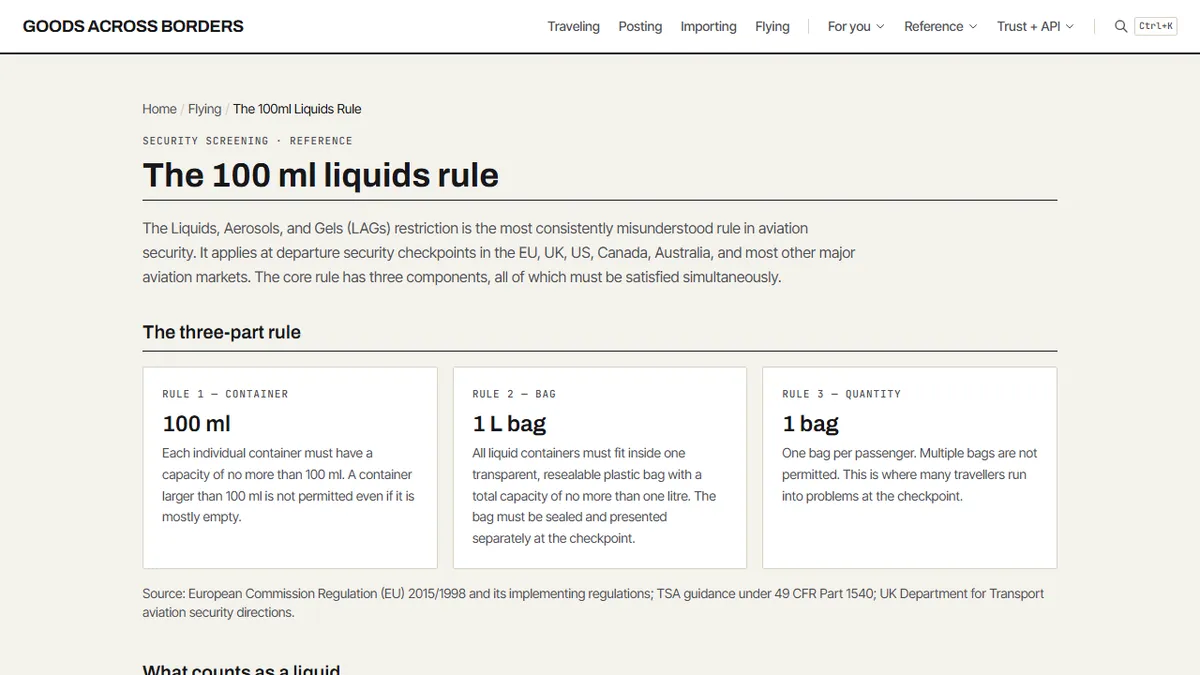
The 100ml rule is probably the most-cited, least-understood rule in aviation security. The limit applies per individual container, not per liquid category, so four 50ml bottles of shampoo are four compliant containers. But a 200ml bottle that is half empty is still a non-compliant container. The measurement is the vessel, not its contents.
The rule also applies to gels, pastes, and aerosols, categories that surprise people who associate "liquid" strictly with something that pours. Toothpaste, peanut butter, spreadable cheese, mascara, and lip gloss all fall under the same restriction. For a full breakdown, the international 100ml liquids rule explained covers every category with worked examples.
The one-litre transparent resealable bag requirement compounds the confusion. Many travellers know about the 100ml limit but underpack the bag itself or bring the wrong size. Officers at most major hubs will not pass a bag that does not close properly, regardless of the individual container sizes inside.
Mistake 2: Forgetting That Duty-Free Sealed Bags Have Airport-Specific Rules
Buying alcohol or perfume in a duty-free store after clearing security sounds like a reliable workaround to the 100ml rule, and at many airports it is. But if your journey involves a connecting flight, particularly one that requires passing through security again, the sealed duty-free bag and its receipt may not protect you.
The rules around Security Tamper-Evident Bags differ by country and even by terminal. Some connecting airports accept the sealed bag and its receipt as sufficient. Others will confiscate the contents regardless, especially if the original purchase was at an airport outside the EU or certain treaty zones. Always check the transit airport's policy, not just your departure or arrival airport.
Mistake 3: Packing Lithium Power Banks in Checked Luggage
This mistake costs travellers their power banks at baggage check-in rather than at the security scanner, but it belongs on this list because it is so consistent. Power banks (portable battery chargers) are prohibited in checked luggage on almost every airline globally. The reason is fire risk: a thermal runaway in a lithium cell is far harder to manage in an aircraft hold than in a cabin where crew can intervene.
The rule does not distinguish between a small 5,000 mAh unit and a high-capacity 30,000 mAh device in terms of placement, though capacity limits do apply to what you can carry on. Read the cabin vs hold rules for lithium batteries before you pack. The watt-hour thresholds are specific and not widely advertised.
Mistake 4: Carrying Sharp Objects With No Checked-Bag Fallback
Pocket knives, scissors with blades over 6cm, box cutters, and certain multi-tools are prohibited in carry-on luggage at most international airports. Travellers frequently lose these items simply because they forgot an item was in a bag: a folding knife in a hiking daypack or embroidery scissors tucked into a craft bag that made the transition to carry-on.
The fix is straightforward: sharp objects that might be in any bag you plan to bring on board need to be actively moved to checked luggage before you arrive. Discovering the item at the security lane and offering to go back and check it in is only possible if you have checked luggage to add it to. This is another reason the "carry-on only" traveller faces higher confiscation risk for this category.
Mistake 5: Bringing Food Without Checking the Destination's Biosecurity Rules
This mistake does not typically surface at departure security but at arrival customs, though some airports do have combined checkpoints. The underlying error is treating food as a neutral category when in reality many fresh or organic items trigger strict biosecurity controls at destinations including Australia, New Zealand, and the United States.
Bringing undeclared mangoes into Sydney or fresh pork products into Auckland can result in fines, and the biosecurity declaration forms on arrival explicitly ask passengers to disclose what they are carrying. Processed and commercially packaged items clear more easily than fresh produce, but even tinned meat can be flagged depending on the country of origin.
Mistake 6: Assuming Your Home-Country Rules Apply at Every Stop
A traveller flying from Amsterdam to Bangkok with a stopover in Doha might be used to Dutch security norms at departure. The rules at the connecting airport are a separate matter entirely. Possession rules for substances, quantities of prescription medication, and even certain electronic devices vary by jurisdiction, and the jurisdiction that matters is the one you are physically in at any given moment.
This gap bites most often at transit points in countries with stricter personal possession laws than the traveller's home country. Even if you are not technically entering the country on a visa, you are subject to that country's security and customs laws while inside its airport.
Mistake 7: Not Declaring Medication You Are Legally Entitled to Carry
Controlled or prescription medication carried in unlabelled containers or without supporting documentation creates risk at security even when the traveller has every right to possess it. The problem is not legality — it is verification. Security staff and customs officers cannot confirm your legal right to carry a substance if you cannot demonstrate it.
The minimum standard for any controlled prescription is: original pharmacy-labelled packaging, a copy of the prescription, and ideally a covering letter from your prescribing doctor. In some countries (Japan being the most widely cited example), a specific import certificate is required for certain drug categories regardless of packaging. Failing to bring the right documentation does not strip you of your medication at every border, but it creates unnecessary risk and delays at some of the most strictly enforced ones.
The Pattern Across All Seven
What these mistakes share is a disconnect between what travellers believe the rules are and what the rules actually say. Security lanes and customs desks operate on written regulations, not on reasonable inference. Packing with the rules explicitly in mind, rather than relying on habit or assumption, eliminates most of these confiscations before the bag is ever zipped.