What Incoterms Actually Govern — and What They Don't
Incoterms, the International Commercial Terms published by the International Chamber of Commerce, do one specific job: they define the point at which risk and responsibility for a shipment transfer from seller to buyer. They also define who pays for freight, insurance, and export and import formalities at each stage of transit.
What they do not govern is equally important. Incoterms say nothing about payment terms, title of ownership, or what happens if goods are lost before the risk transfer point. They are not a substitute for a proper contract of sale. And they apply to a single shipment, not to the whole trading relationship. You can agree a different term for every order if the logistics logic supports it.
The ICC updates the terms periodically. The current edition, Incoterms 2020, introduced one significant change from the 2010 version: under CIF and CIP, insurance requirements differ: CIP now mandates higher coverage than CIF. That distinction matters if you are comparing like for like against older contracts.
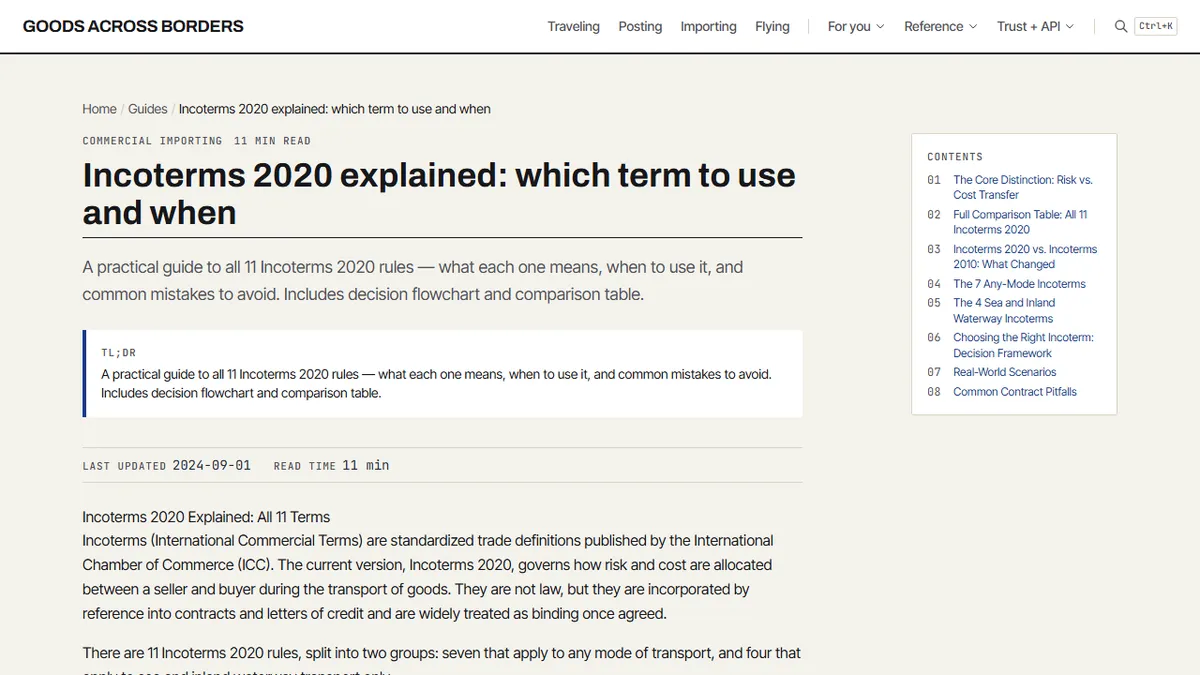
For a thorough orientation before negotiating with a new supplier, Incoterms 2020 explained: which term to use and when is the clearest structured resource to work through.
EXW: When Collecting from the Factory Makes Sense
Ex Works is the seller's easiest term: their obligation ends the moment goods are made available at their premises. The buyer pays for everything: loading, domestic haulage to the export port, export customs clearance, ocean or air freight, import customs, and final delivery.
That sounds burdensome, and for most small importers it is. EXW only makes commercial sense when you have your own freight forwarder operating inside the origin country who can handle origin-side logistics at competitive rates. Without that, you are paying origin-country logistics at a disadvantage. Your forwarder is working remotely while the supplier's nominated carrier has local relationships and scale.
One underappreciated risk with EXW: the buyer bears responsibility for export customs clearance in the origin country. If the seller's government restricts or audits certain export classifications, you as the buyer become the responsible party in a jurisdiction where you have no legal presence. For most small importers, this is an unnecessary complication.
FOB: The Classic Seller-to-Port, Buyer-from-Port Split
Free On Board is the most widely used Incoterm in ocean freight for a reason: the responsibility split is intuitive. The seller handles everything up to and including loading goods onto the vessel at the named port of export. From that moment, the buyer bears risk and cost for ocean freight, marine insurance, import customs duties and taxes, and inland delivery to the final destination.
FOB gives the buyer meaningful control over freight cost without requiring them to manage origin-side logistics. You choose your own freight forwarder and, by extension, your carrier. That means you can negotiate your own rate rather than absorbing the supplier's margin on freight.
The one limitation worth understanding: FOB is only appropriate for conventional ocean freight and inland waterway transport. It should not be used for container shipments where the goods are handed over at the container freight station before loading; in those cases, FCA (Free Carrier) is technically more accurate. Most trade practitioners continue using FOB regardless, but it creates a contractual gap if a dispute arises.
CIF vs CIP: Why Letting the Seller Arrange Insurance Often Costs More
Cost, Insurance and Freight places the cost of ocean freight and a minimum-coverage insurance policy on the seller, with risk transferring to the buyer once goods are loaded on the vessel (the same risk transfer point as FOB), but with the seller booking and nominally paying for freight.
The problem is straightforward: the seller is booking freight with their preferred carrier and adding a margin. That margin is often not visible to the buyer. In practice, many importers find that calculating landed cost under CIF versus FOB plus self-arranged freight reveals a meaningful price gap, especially on high-volume routes where good freight rates are accessible to buyers directly.
CIP (Carriage and Insurance Paid To) is the equivalent term for all modes of transport, and under Incoterms 2020, it requires the seller to provide Institute Cargo Clauses (A) coverage, the broadest standard marine insurance. CIF only requires the minimum Clauses (C). If your product value is high, the insurance differential matters.
DDP: The Convenience Premium and Its Hidden Dangers
Delivered Duty Paid is the most seller-heavy term: the supplier covers everything, including import duties, taxes, and final delivery to your named destination. For the buyer, it looks like the cleanest possible arrangement: a single price, no logistics headaches, no duty surprise.
In practice, DDP is often the most expensive Incoterm for buyers to accept, and it introduces a risk that most importers overlook. When the seller arranges import customs clearance on your behalf, they are typically doing so through their own nominated broker in your country, at their rate, not yours. More critically, the importer of record on customs documents may be the seller or their agent, creating complications if customs later questions the declared value or classification.
The DDP Delivered Duty Paid: what the seller covers guidance explains why DDP also creates regulatory exposure: if duties were underpaid, liability in some jurisdictions falls on the importer of record, which under DDP may be your supplier's broker rather than someone you can contractually pursue.
DAP: The Middle-Ground Option Most Importers Overlook
Delivered at Place is the option that often makes most sense for small and mid-sized importers who want the seller to handle international freight but prefer to control import customs clearance themselves. Under DAP, the seller bears risk and cost up to the named destination (typically your warehouse), but the buyer is responsible for unloading and for all import duties and taxes.
The advantage over DDP is control: you use your own customs broker, you control the declaration, and you are not absorbing the seller's margin on duty payment. The advantage over FOB is simplicity: you do not need to appoint a freight forwarder and negotiate ocean or air rates separately.
For businesses with a reliable customs broker but no established freight forwarding relationship, DAP often represents the best risk-cost balance.
Matching the Incoterm to Your Freight Provider Setup
The right Incoterm depends entirely on what infrastructure you already have in place. If you have a freight forwarder in the origin country, EXW or FCA gives you maximum cost control. If you use a regular import broker but no origin-side agent, DAP gives you import control without origin-logistics complexity. If you are a first-time importer with no existing relationships, DDP may be worth the premium initially, but treat it as a temporary arrangement while you build the broker and forwarder relationships that will make FOB or DAP more attractive.
Red Flags in Supplier-Quoted Incoterms
Suppliers who insist on DDP for every shipment regardless of volume or destination should prompt scrutiny. DDP gives the seller control over freight selection and duty payment, and both are revenue opportunities for intermediaries. A supplier who refuses to quote FOB is either protecting a freight margin or managing a logistics relationship that is not in your interest.
Similarly, watch for EXW quotes from suppliers who have nominated a specific logistics company for collection. The practical effect is CIF pricing with EXW liability: you bear the risk while they control the cost structure. A genuine EXW arrangement means the buyer freely selects their own origin-country freight agent.
Getting Incoterm selection right before you place an order is a meaningful lever on landed cost. The difference between DDP and FOB on a modest shipment can represent several percentage points of margin — quietly extracted in a part of the transaction most importers never examine.