On this page
The Core Difference: Liquidation vs. Reorganization
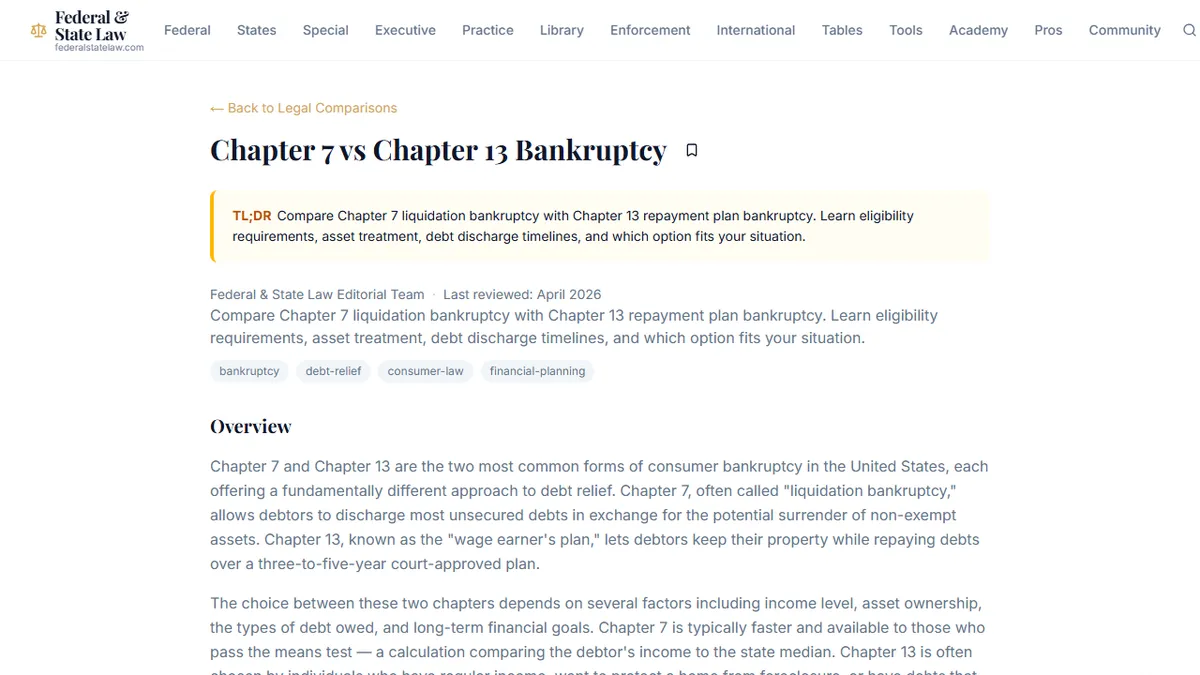
Bankruptcy law offers struggling debtors two primary paths under the federal Bankruptcy Code, and the fundamental difference between them is philosophical. Chapter 7 is liquidation bankruptcy: a trustee appointed by the court sells your non-exempt assets and distributes the proceeds to creditors. The process is fast (typically three to six months) and most unsecured debt is discharged at the end. Chapter 13 is reorganization bankruptcy: you keep your assets and instead propose a structured repayment plan that runs three to five years, after which remaining qualifying debt is discharged.
The right chapter depends on five variables that interact differently for every debtor: income, asset profile, debt composition, credit timeline, and how urgent the relief needs to be. Before doing anything else, review the side-by-side breakdown of Chapter 7 versus Chapter 13 to get a structured foundation for the comparison.
The Means Test: Qualifying for Chapter 7
Not everyone can choose Chapter 7. The Bankruptcy Abuse Prevention and Consumer Protection Act of 2005 introduced the means test as a gatekeeping mechanism designed to push higher-income filers into Chapter 13.
The means test works in two stages. First, your average monthly income over the six months before filing is compared to the median income for a household of your size in your state. If you fall below the median, you pass automatically and can file Chapter 7. If you exceed the median, the second stage applies: a detailed calculation of allowable monthly expenses subtracted from your monthly income. If the remaining disposable income falls below a statutory threshold, you still qualify. If it exceeds that threshold, a Chapter 7 filing will likely be dismissed or converted to Chapter 13.
This means test explains why Chapter 13 is sometimes not a choice but a requirement. High earners with significant unsecured debt who genuinely cannot afford repayment still face Chapter 13 if their income clears the median.
Chapter 13 Repayment Plans: How They Work
In Chapter 13, you propose a repayment plan and submit it to the court for confirmation. The plan must pay priority debts (back taxes, domestic support obligations, wages owed to employees) in full. Secured creditors, like a mortgage lender or car lender, must receive at least the value of their collateral or the contractual payment, whichever protects them better. Unsecured creditors receive whatever is left after priority and secured claims are covered, which may be pennies on the dollar.
The plan must be feasible: your projected disposable income over the plan period must be sufficient to fund it. A bankruptcy trustee and your creditors can object, and the court will not confirm a plan it finds unrealistic or that fails to meet the minimum payment requirements for each claim category.
The key advantage is the automatic stay, which halts all collection actions (including foreclosure) the moment you file. A Chapter 13 debtor who is two months behind on a mortgage can use the plan to cure the arrears over three to five years while maintaining current payments going forward.
Asset Protection: What Each Chapter Lets You Keep
Under Chapter 7, the trustee can liquidate any asset that is not protected by a bankruptcy exemption. Federal exemptions and state exemptions vary dramatically. Some states require filers to use the state exemption schedule; others allow a choice between state and federal exemptions.
Common exemptions protect a portion of home equity (the homestead exemption), a vehicle up to a certain value, retirement accounts, household goods, clothing, and tools of the trade. In many Chapter 7 cases, filers have no non-exempt assets; the case is a "no-asset" case and nothing is liquidated. But if you have significant home equity beyond your state's homestead exemption, or substantial savings, or a valuable second vehicle, a liquidation trustee may take those assets.
Chapter 13 offers a different calculus. You keep all assets as long as your plan pays unsecured creditors at least as much as they would have received in a Chapter 7 liquidation: this is the "best interests of creditors" test. A debtor with $50,000 in non-exempt home equity would need to ensure unsecured creditors collectively receive at least $50,000 over the plan period. If you have significant assets you want to keep, Chapter 13's reorganization structure often provides the only path to doing so.
Timeline and Credit Impact Compared
Speed is one of Chapter 7's clearest advantages. From filing to discharge typically takes three to four months, occasionally up to six. Chapter 13 requires three years of plan payments for below-median-income filers and five years for above-median filers, followed by discharge. The day-to-day commitment (monthly plan payments, cooperation with the trustee, compliance with reporting requirements) extends over years rather than months.
Both chapters damage credit significantly, but the duration of the mark differs. A Chapter 7 bankruptcy remains on a credit report for ten years from the filing date. A Chapter 13 filing stays on for seven years. The shorter reporting window for Chapter 13 matters most for people planning major credit applications within a decade (buying a home, for instance).
Lenders and landlords treat the two chapters differently. Some mortgage programs have shorter post-bankruptcy waiting periods for Chapter 13 discharges than for Chapter 7 discharges, on the theory that a Chapter 13 debtor demonstrated the financial discipline to complete a multi-year repayment plan.
Costs: Filing Fees, Attorney Fees, and Hidden Expenses
Filing fees are set by federal statute and are identical regardless of chapter. As of current schedules, the Chapter 7 filing fee is $338 and the Chapter 13 filing fee is $313. Both fees may be paid in installments or waived for filers below 150% of the federal poverty line.
Attorney fees differ substantially. Chapter 7 cases are simpler and typically cost $1,000 to $3,500 for attorney representation, depending on complexity and geography. Chapter 13 cases are far more work. Attorneys must draft a repayment plan, attend a confirmation hearing, respond to trustee or creditor objections, and sometimes modify plans mid-case. Fees commonly range from $3,000 to $6,000, with variations by local court practice. Some jurisdictions allow attorneys to take a portion of Chapter 13 fees through the plan itself, reducing the upfront cash burden.
There are also indirect costs. In Chapter 7, the primary hidden cost is the asset you may lose to liquidation. In Chapter 13, the hidden cost is the opportunity cost of years of constrained cash flow while a repayment plan consumes your disposable income.
Making the Decision: A Step-by-Step Framework
Begin with the means test. If your income disqualifies you from Chapter 7, the decision is largely made. If you qualify for both, work through the asset question. Identify everything you own and compare it against your state's exemption schedule. If you have significant non-exempt assets you cannot afford to lose, Chapter 13 is the protective path.
Next, look at your debt composition. Mortgage arrears, back child support, and recent tax debt are non-dischargeable in Chapter 7 and must be paid regardless of which chapter you file. Chapter 13's ability to cure arrears and repay non-dischargeable debt through the plan structure may be essential if those debts are the core problem.
Finally, factor in time. If you need relief from creditors quickly and have few assets to protect, Chapter 7's speed is a genuine advantage. If you are trying to save a home from foreclosure or manage a car loan on a vehicle worth keeping, Chapter 13's flexibility may justify the longer commitment.
Neither chapter is inherently superior. The right answer emerges from the specifics of your financial situation, and knowing those specifics before you consult an attorney will make that conversation far more productive.