What Is Federal Preemption and Why Does It Exist?
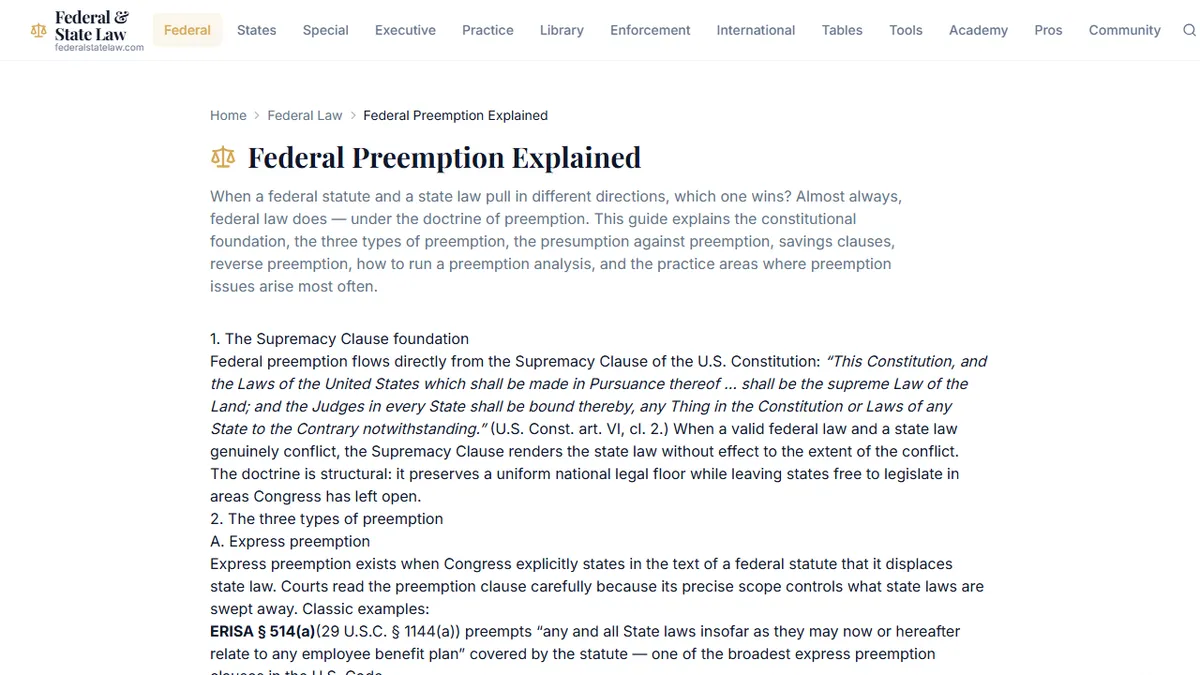
The U.S. Constitution's Supremacy Clause (found in Article VI) establishes that federal law is the "supreme law of the land." When a state enacts a rule that conflicts with federal law, the federal rule wins. This is preemption in its most basic form: the displacement of state authority by a federal act of Congress or a federal agency regulation.
The doctrine exists because the framers understood that a patchwork of fifty incompatible legal regimes would make interstate commerce, national defense, and uniform civil rights protections nearly impossible to sustain. Without a mechanism to resolve conflicts between levels of government, courts would be paralyzed by jurisdictional chaos every time a federal and state rule pointed in different directions.
For ordinary citizens, the consequences are immediate and practical. The rules governing your pharmaceutical label, your workplace safety standards, and your airline ticket refund rights are federal, even if your state has tried to set different standards. Preemption is why those federal rules stick.
For a deeper grounding, the federal preemption doctrine explained in plain English provides a structured reference covering statutory text, regulatory context, and leading case law.
Express Preemption: When Congress Says So Explicitly
The clearest form of preemption occurs when Congress writes it directly into a statute. A preemption clause (typically phrased as something like "no state may enact any requirement different from or in addition to" a federal standard) removes all ambiguity about congressional intent.
The Airline Deregulation Act of 1978 is a well-known example. Its preemption clause explicitly bars states from enforcing any law related to airline prices, routes, or services. When states have tried to impose their own consumer protection standards on airlines, courts have repeatedly struck those efforts down. The federal statute occupies the space entirely.
Federal medical device regulations under the Food, Drug, and Cosmetic Act contain a similar clause, which is why manufacturers of Class III devices (pacemakers, for example) face fewer state tort claims than manufacturers of unregulated consumer goods. The statutory preemption language creates a de facto shield.
Implied Preemption: Field and Conflict Preemption Compared
Not every preemption situation comes with an explicit clause. Courts have developed two categories of implied preemption that apply when Congress has not spoken directly.
Field preemption applies when federal regulation is so comprehensive that it occupies an entire area of law, leaving no room for parallel state rules. Immigration enforcement is the clearest current example. The federal government has regulated immigration so extensively (visas, deportation, naturalization) that states cannot impose their own immigration frameworks even where no specific federal statute directly prohibits the state rule. When Arizona attempted to create state-level immigration enforcement mechanisms, the Supreme Court struck down most of the law on field preemption grounds.
Conflict preemption is narrower. It applies only where following both a federal rule and a state rule is physically impossible, or where the state rule obstructs the achievement of federal objectives. A state minimum wage higher than the federal floor does not conflict with federal law; both can be satisfied simultaneously by paying the higher amount. But a state law requiring product labeling that directly contradicts a federally mandated label would create an impossibility conflict, triggering preemption.
5 Real-Life Areas Where Preemption Shapes Daily Life
Preemption is not an abstract constitutional concept. It governs the rules you live under in concrete ways.
Marijuana: More than forty states have legalized cannabis in some form, but federal Schedule I classification under the Controlled Substances Act still applies. Federal agencies, federal contractors, and federally subsidized housing can enforce federal prohibition regardless of state law.
Minimum wage: Federal law sets a floor of $7.25 per hour, but states can and do set higher floors. There is no conflict here. The higher state rate governs in those states. Preemption does not run upward to prevent states from being more protective than federal law requires.
Prescription drug labels: The FDA approval process preempts certain state failure-to-warn claims for brand-name drugs, because the label is federally controlled. Generic drug manufacturers face even broader preemption.
Banking regulation: National banks chartered under federal law are largely immune from state consumer protection regulations that would impose requirements "different from" federal banking rules, under a line of Office of the Comptroller of the Currency regulations.
ERISA employee benefits: The Employee Retirement Income Security Act preempts virtually all state laws that "relate to" employer-sponsored benefit plans, which is why your employer's health insurance plan can legally exclude coverage your state's insurance regulations would otherwise require.
When States Win: Areas Reserved for State Authority
Preemption has limits. The Tenth Amendment reserves to the states all powers not delegated to the federal government, and courts are generally reluctant to find federal preemption unless Congress has made its intent reasonably clear.
States have broad authority over domestic relations: marriage, divorce, child custody, and property inheritance remain largely state-law domains. Criminal law, contract law, tort law, and professional licensing are also primarily state functions, with federal law playing a supplementary rather than displacing role in most circumstances.
Family law is perhaps the most striking example. The federal government has no general family code. If your divorce involves property division, child support, or custody disputes, state law governs almost entirely. Federal law enters only at specific pressure points (interstate child support enforcement or international parental abduction, for instance).
How Courts Resolve Preemption Disputes
When a preemption question reaches a court, judges follow a structured inquiry. The starting point is always congressional intent: what did the relevant statute actually mean to accomplish? If Congress expressed clear intent, that intent controls. If not, courts look at the structure and purpose of the federal regulatory scheme.
The Supreme Court has cautioned that preemption should not be found casually in areas where states have traditionally exercised authority. This "presumption against preemption" is strongest in fields like health and safety, where states have historically been the primary regulators.
Preemption cases often turn on the precise scope of a federal statute's language and the extent of the regulatory scheme an agency has erected beneath it. Small changes in statutory wording can determine whether a state consumer protection class action survives or is wiped out by a single federal regulation.
Key Takeaways: What Ordinary Citizens Need to Know
If you are ever told that federal law permits something your state prohibits, or that your state law provides protection your employer says federal law overrides, preemption is likely the operative doctrine. The key questions are: Did Congress expressly prohibit the state rule? Has federal regulation occupied the field so completely that no room remains for state law? Or does compliance with both laws require something impossible?
In most everyday situations, the answer matters most when you are asserting a legal right, challenging a product defect, claiming a wage violation, or contesting a housing rule. Knowing which law actually governs you is the first step to knowing whether a valid claim exists.
The doctrine is more nuanced than "federal beats state." It depends on the subject matter, the statutory language, and the regulatory context, which is why preemption disputes still generate significant litigation decades after the Supremacy Clause was ratified.