A price comparison is unfinished until you can explain the amount payable, the period it covers and the usage it includes. Start with those three questions before deciding whether a plan fits your budget.
Best AI Tools Wiki's pricing directory provides a starting list of tools and displayed plan prices. Treat a directory entry as a lead: check the vendor's current pricing and checkout information before recording a quote. This exercise does not endorse any listed price or product.
Write the price as a complete statement
Instead of copying “£12 per month”, use our suggested worksheet:
| Field | What to copy or establish from the vendor |
|---|---|
| Product and plan | The exact plan name and official URL |
| Currency and unit | Currency, per-person or shared price, and billing period |
| Payment commitment | Amount due now and any stated minimum term |
| Included usage | The relevant units, allocation period and whether shared |
| Additional costs | Required add-ons and the stated treatment of usage beyond the allowance |
| Taxes and renewal | What the displayed quote says about tax and the next payment |
| Observation | Date and account or regional setting used to obtain the quote |
Do not turn a missing entry into zero. If the vendor has not made a necessary condition clear, record the question and keep the comparison provisional.
Compare a fictional annual and monthly offer
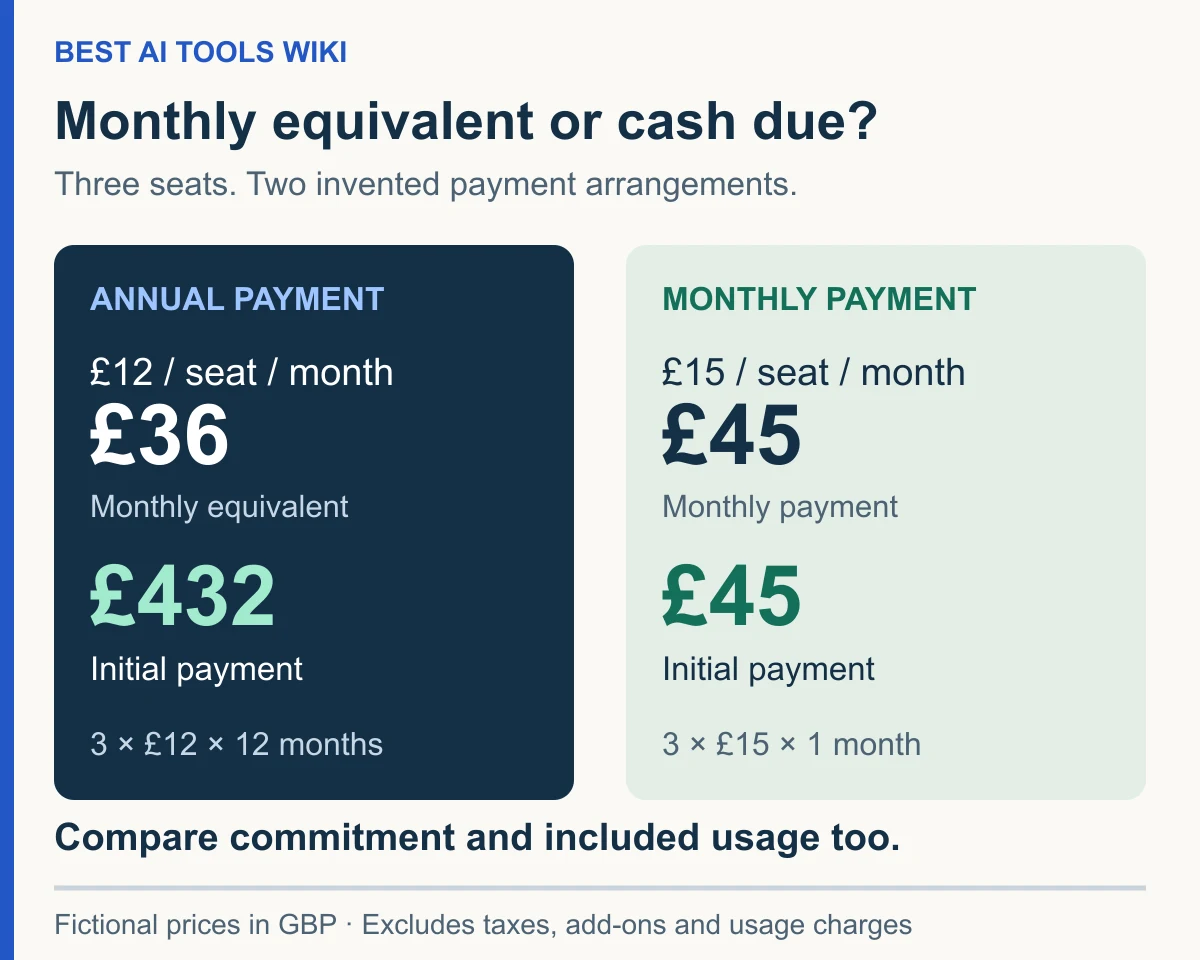
Suppose a fictional team needs three seats. Offer A is £12 per seat per month, paid for twelve months in advance. Offer B is £15 per seat with monthly payment. These are invented prices, not offers from named suppliers.
| Calculation | Offer A | Offer B |
|---|---|---|
| Three-seat monthly equivalent | 3 × £12 = £36 | 3 × £15 = £45 |
| Initial payment under these assumptions | £36 × 12 = £432 | £45 |
| Twelve months if retained throughout | £432 | £45 × 12 = £540 |
The twelve-month difference is £108. The initial payments differ by £387. Those are different comparisons: the monthly equivalent alone does not show how much cash this fictional purchase requires upfront.
The example excludes taxes, usage charges and add-ons. It makes no assumption about cancellation, refunds or price changes. Copy those terms from a real offer before applying the arithmetic to it.
Put the allowance beside the money
An amount is only half the worksheet. Define a small workload you want the plan to cover, such as three people each preparing five short drafts during a month. That is an invented planning input, not a prediction of your usage.
Then identify the vendor's actual unit. A “draft” in your workload is not automatically one credit, message or generation in its billing system. If you cannot map the workload to the published allowance, leave the estimated usage cost unresolved.
Keep your candidate comparison separate from the final vendor quote. Before buying, revisit the quote and check that the plan, currency, payment period and essential limits still match your notes. Your decision sheet should show both the known total and the questions that could change it.