Write the start and end dates above each financial figure before comparing it. Two columns labelled “2025” may describe different periods, and two twelve-month totals do not reveal what happened in their overlapping months.
This exercise helps you decide which comparison the available documents support. It does not adjust or replace a charity's filed accounts.
Give each figure a complete label
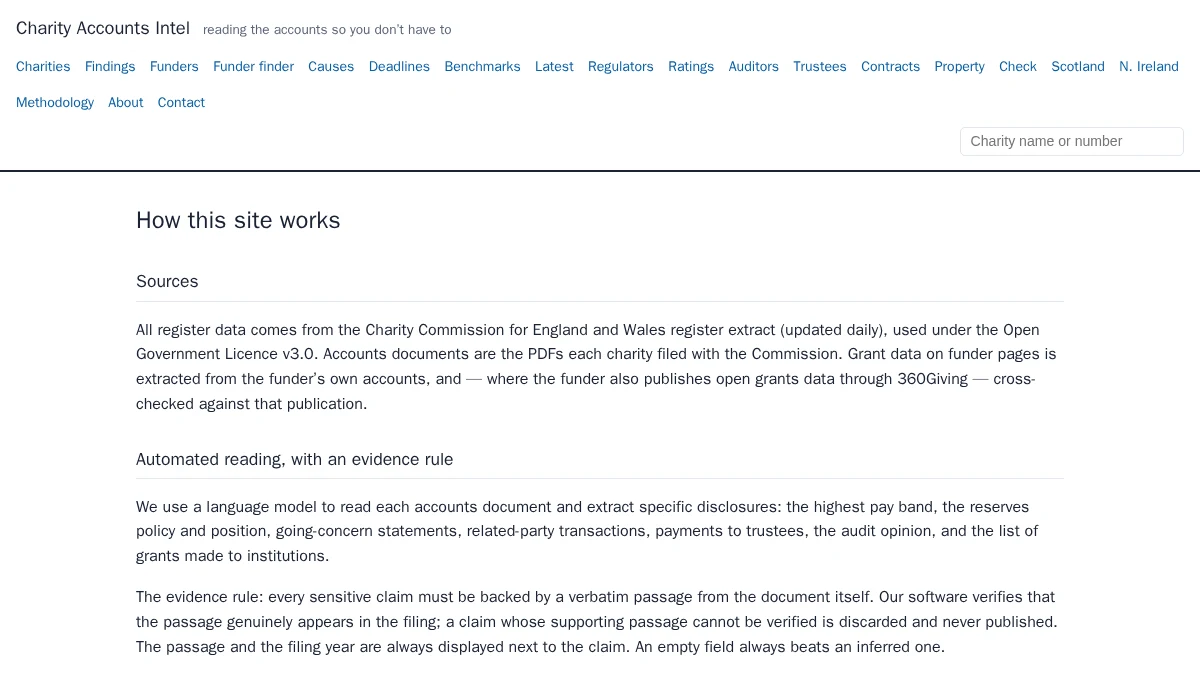
Charity Accounts Intel provides links into its accounts analysis. Its methodology says findings carry the supporting passage and filing year. Use that information to locate the original accounts, then read the period printed in the document itself.
Before copying a total, record:
- The charity number and precise organisation or group described.
- The beginning and end of the reporting period.
- The measure's full label, currency and displayed unit.
- The column, page or note from which you took it.
- Any qualification or restatement identified in the document.
For charities in England and Wales, the official register gateway lets you search by name or number and directs readers to the separate registers for Scotland and Northern Ireland. Keep the correct register reference in your comparison sheet.
Check what the overlap actually tells you
Consider two invented accounts documents:
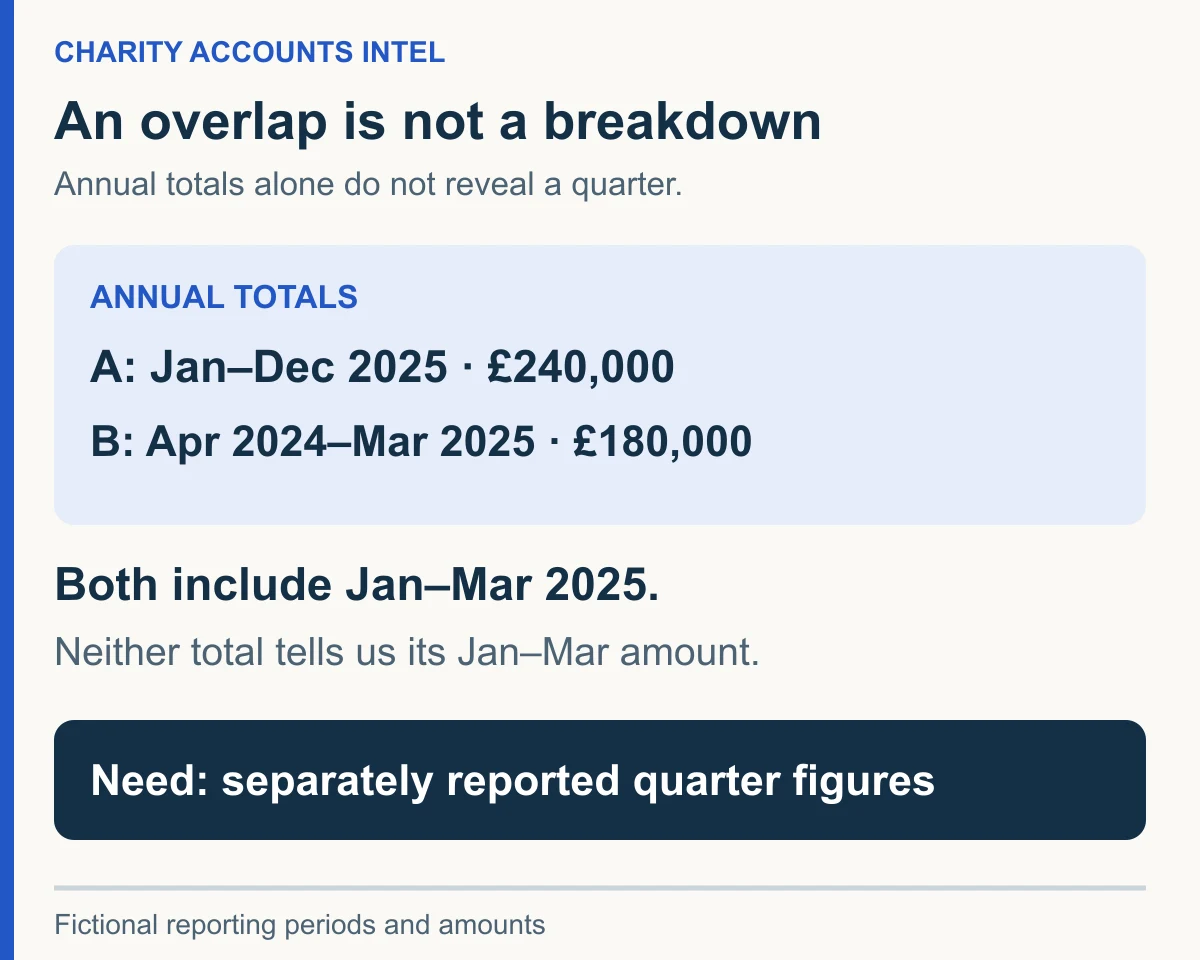
| Fictional accounts | Reporting period | Total labelled income |
|---|---|---|
| A | 1 January–31 December 2025 | £240,000 |
| B | 1 April 2024–31 March 2025 | £180,000 |
Both cover twelve months. Their overlap is 1 January–31 March 2025. Neither annual total, by itself, supplies the income for those three months.
Dividing A's total by four would produce £60,000, but that would be an allocation assumption, not a reported first-quarter result. The same problem applies to dividing B's total. Do not use those invented quarterly figures as though you had found them in the accounts.
With only the two annual totals, your table can describe the different reporting periods. It cannot support a like-for-like comparison of the overlapping quarter.
Compare a narrower period only when it is supplied
Now suppose the fictional documents also provide separate January–March 2025 income figures: £50,000 for A and £45,000 for B. Assume explicitly that the figures use the same income definition and comparable organisational scope.
Under those assumptions, the difference for the stated quarter is £50,000 − £45,000 = £5,000. Keep the source references beside those quarterly inputs. Do not derive them from the annual totals or project them forward to predict a full year.
If the required breakdown is missing, the next useful action is to look for a relevant published note or ask for clarification. A blank comparison is more informative than an unsupported adjustment.
Finish by reading the table title against its contents. “Income reported for different year ends” and “income for the same quarter” describe different work. Neither, on its own, measures the quality or impact of a charity's activities.