On this page
Write down what you want from a community before comparing its numbers. A place to discuss a particular game in your language is a different requirement from a large announcements feed.
GuildRegister offers public server records and count comparisons. Its about page describes approximate measurements from Discord's public invite API. Use those figures as one part of a comparison, alongside the information that actually matters for your purpose.
Label the presence ratio accurately
Discord defines the relevant API fields as approximate online-member and total-member counts. They are not message counts or a daily-engagement measure. See the official invite documentation.
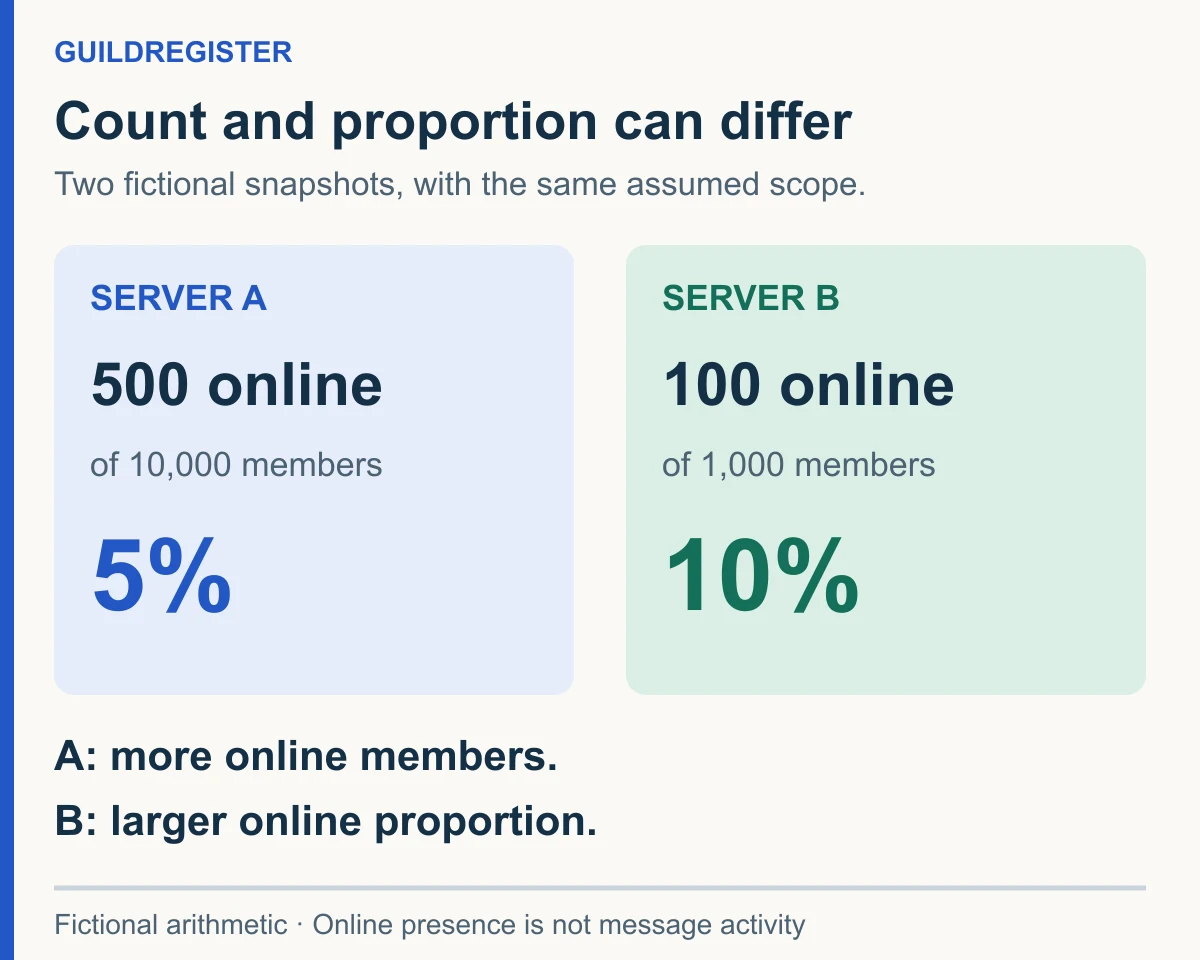
Here is a fictional pair of snapshots taken under the same assumed conditions:
| Fictional server | Total members | Online | Online / total |
|---|---|---|---|
| A | 10,000 | 500 | 5% |
| B | 1,000 | 100 | 10% |
The calculations are 500 ÷ 10,000 × 100 = 5% and 100 ÷ 1,000 × 100 = 10%. B has the larger online proportion; A has more online members in absolute terms. Both observations can be true.
Neither result tells you how many members are writing useful messages, whether a question will be answered or whether the environment suits you. Do not label B “twice as engaged” on this evidence.
Compare against your own requirements
This original worksheet adds questions that the counts cannot answer:
| Requirement | What to look for | What to record |
|---|---|---|
| Topic fit | Public description and relevant channels, if accessible | A specific match or mismatch |
| Language and timing | Published language or event information | The information and its date |
| Community expectations | Published rules and reporting route | What is stated, without assuming enforcement quality |
| Participation | What you can actually observe | A bounded observation, not a whole-community verdict |
If information is available only after joining, leave that row unknown until you have decided whether joining is appropriate. Do not invent a moderation rating from the presence ratio or a directory badge.
Keep the comparison dated
Save the record URL and measurement time beside each count. If the two records have different measurement times, say so. A later refresh is a new observation; retain the earlier one if you are studying change.
In the fictional example, someone seeking a small discussion group might investigate B's topic and rules first. Someone seeking a large announcements community might investigate A. Those are choices about requirements, not conclusions that either server is better or safer.
Make a narrow decision
Finish with a sentence such as: “B matches my stated topic, but I have not checked its rules or invitation source.” This is more useful than a numerical winner unsupported by the information you collected.
Before following an invitation, apply Discord's scam-prevention checks. A public record and a favourable comparison do not remove the need to verify the invitation you actually received.