Why Key Choice Is Narrative: The Problem Voss Set Himself
Every choice in a song cycle carries meaning beyond its immediate sound. When a composer selects a key for an individual song, that choice does not exist in isolation. It arrives in the context of every key that has come before, and it prefigures every key that will follow. In a cycle built around a central metaphor (in this case, the progressive extinction of every kind of light the world contains), the choice of tonal home in each song is not decorative. It is structural. It is the argument made in the language of harmony.
The problem Voss set himself with Das Verlöschen was specific and demanding: to compose a fourteen-song cycle in which the tonal centre descends over the course of the work in a way that mirrors the extinction of light. The descent must feel inevitable in retrospect while remaining locally surprising in the moment. Each song needs to establish its own key convincingly, while the larger arc pulls relentlessly in one direction. The solution he arrived at is worth understanding in some detail, because it illustrates what separates a genuinely architectural song cycle from a collection of songs that happen to share a theme.
E Major to B-flat Minor: Tritone Descent as Structural Metaphor
The cycle opens in E major. This is significant for reasons that extend beyond the brightness of the key itself. E major, in the harmonic universe the cycle inhabits, is the point of maximum luminosity, the keynote from which every subsequent tonal move constitutes a form of withdrawal. The opening song, "Votive," states this luminosity plainly. It is the one moment in the cycle when the music is unambiguously lit.
The destination is B-flat minor. The interval between E major and B-flat minor is a tritone, traditionally the most unstable, most dissonant, most harmonically charged distance available in tonal music. Medieval theorists called the tritone diabolus in musica, the devil in music, precisely because of the tension it creates and the difficulty of resolving it gracefully. Voss makes this tension structurally explicit: the fourteen songs trace the journey between these two poles, and the cycle ends in B-flat minor precisely because arriving there from E major produces the maximum sense of irresolution and unease. It is not just a different key. It is the furthest possible remove from where you began.
Station by Station: The Tonal Map of All 14 Songs
The descent from E major to B-flat minor does not proceed by equal steps. Each song establishes a tonal centre, and the route between the opening and closing keys follows a path that balances local contrast against the overall direction of fall. After the opening E major, the cycle moves to C-sharp minor for the second song, a third lower, already shadowed. The third song settles into B minor, the fourth continues in B minor, and by the fifth the harmony has slipped into the Mussorgskian modal pallor of A minor.
The sixth song provides the cycle's one warm flat-side oasis, in A-flat major, a Brahmsian autumnal pause before the descent resumes. From there, the route through G minor, F-sharp minor, F minor, and E-flat minor traces a path of inexorable dimming. The eleventh song offers a brief blazing instant in D-flat major before the twelfth moves into C minor and the drama intensifies. The penultimate song settles into B minor, and the cycle closes in B-flat minor. That is the destination the whole architecture has been moving toward.
The Lamp Motif as Harmonic Glue
The tonal architecture would function as a formal exercise without something to make the journey feel lived rather than diagrammatic. That something is the four-note leitmotif that unifies the cycle: a rising whole tone, a falling semitone, and a falling third. This figure is stated in its simplest form at the opening of the first song, and from that point it becomes the element that ties the shifting sequence of keys together.
The motif does not stay fixed. As the cycle descends through its sequence of keys, the motif is subjected to the full range of contrapuntal transformation: inversion, augmentation, diminution, fragmentation. By the time the sixth song arrives — the interior hinge of the work — the motif appears in full inversion, the flame turned downward. By the tenth song, "Variations on a Dying Flame," the motif has been driven into the bass as the ground of a chaconne, stripped of its harmonic context and reduced to its own bare outline. The progression from luminous statement to bass-register skeleton is the cycle's emotional argument enacted at the level of a single four-note cell.
The Withheld Cadence: What It Means to Refuse Resolution
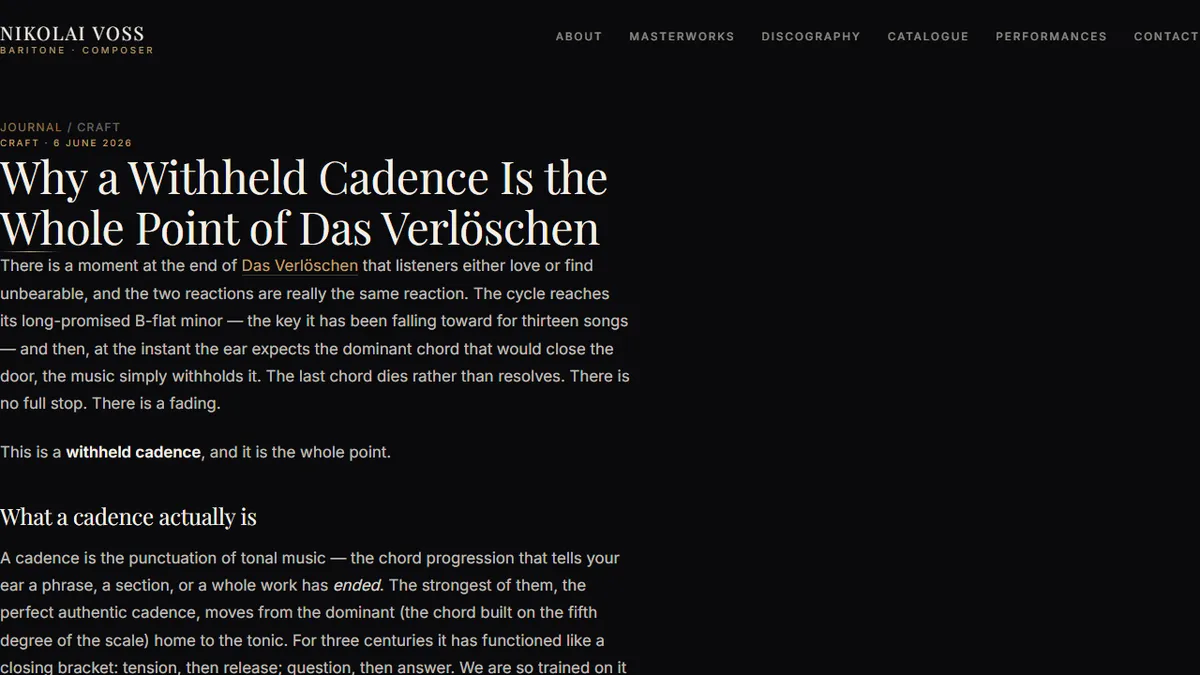
The final song of Das Verlöschen reaches its long-promised B-flat minor. What it withholds is the dominant: the chord that would, in conventional tonal language, prepare the final tonic and give the ending a sense of arrival. Without that preparation, the last chord does not conclude so much as it simply stops. The music does not resolve; it ceases.
This is a deliberate compositional statement, and the reasoning behind it is worth understanding. A cycle about the extinction of light that ended with a clean harmonic resolution would undercut its own subject. Cadences, in tonal music, represent completion, a return to equilibrium, the satisfaction of a tension that was set in motion. But the premise of this cycle is that certain lights go out without warning, without ceremony, without the formal acknowledgement that a cadence provides. The withheld cadence enacts precisely that premise. For a deeper account of this choice and its emotional logic, Voss's own reflection on refusing to resolve the final chord is the most direct source.
What This Approach Owes to Schubert and Mahler
The specific approach of using tonal descent as narrative structure does not emerge from nothing. Schubert established the principle in Winterreise, where the cycle's harmonic journey from D minor through a sequence of increasingly remote and unstable keys enacts the wanderer's psychological deterioration. The final song settles into an eerie D minor that feels less like resolution than like exhaustion, a wanderer who has stopped walking not because he has arrived but because he cannot continue.
Mahler extended this into a larger orchestral framework. His song cycles and symphonic song collections treat the orchestra as a tonal environment that can be made to feel expansive or constricted, bright or submerged, depending on harmonic context. The idea that an orchestral texture can carry the same kind of descending emotional logic that Schubert concentrated into a piano part is fundamentally Mahlerian.
Das Verlöschen synthesises both influences into a structure that is recognisably in their lineage but not reducible to either. The fourteen-song format, the tonal architecture from a named opening key to a named closing key, the single unifying motif subjected to systematic transformation — these are the marks of a composer who has absorbed the tradition deeply enough to use it rather than merely imitate it.