The Baritone Spectrum: From Lyric to Dramatic
The baritone is the middle voice of classical music (lower than the tenor, higher than the bass), and within that broad category there exists a spectrum of sub-types that are rarely explained to newcomers but matter enormously to anyone trying to understand why one baritone sounds so different from another. The most commonly encountered sub-types are the lyric baritone, the cavalier (or Kavalier) baritone, the Verdi baritone, and the dramatic baritone. Each occupies a different region of the same general range, but the differences between them go well beyond simple questions of pitch.
At the lighter end of the spectrum, the lyric baritone possesses a voice that is agile, bright-toned, and capable of great expressive flexibility. A lyric baritone can spin long, even phrases with ease and change colour rapidly between notes. Moving toward the heavier end, the Verdi baritone (a category named for the specific demands Giuseppe Verdi placed on the voice in operas like Simon Boccanegra and Rigoletto) combines power in the upper register with the ability to sustain long dramatic lines. The dramatic baritone sits at the furthest, heaviest end of the spectrum: darker in timbre, more powerful in the lower register, and built above all for sustained declamatory delivery rather than agile passage-work.
What Makes a Voice 'Dramatic': Register, Weight, and Timbre
Three factors combine to define the dramatic baritone as a distinct voice type. The first is register dominance. While a lyric baritone sounds most natural and expressive in the middle of its range, the dramatic baritone carries its most characteristic tone into its lowest registers. Notes that would thin or pale in a lighter voice remain full, resonant, and carrying in the dramatic voice. There is a chesty weight to the bottom of the range that functions almost like a second instrument — a resonance that operates below the main melodic line and gives the voice its distinctive emotional gravity.
The second factor is timbre. Dramatic baritones typically have a darker, more opaque sound quality than their lyric counterparts. Where a lyric baritone might describe as bright or even luminous, the dramatic baritone tends toward what singers and critics call "dark": a term that points to a sound with more of its energy in the lower overtones than the upper ones. This coloration is not simply a matter of preference; it is a consequence of the physical configuration of the instrument, which cannot be substantially altered by technique.
The third factor is the capacity for sustained power. The dramatic baritone is an instrument built for endurance as much as agility. Long phrases at high dynamics, repeated climactic passages in large opera houses, extended declamatory scenes that require absolute consistency of tone — these are the demands the voice is equipped to meet.
The Repertoire Each Sub-Type Was Built For
The differences between baritone types map almost exactly onto repertoire categories. The lyric baritone is at home in Mozart opera (Figaro, Papageno) and the lighter Lied repertoire, music that asks for flexibility, charm, and the ability to float a phrase at low dynamics without losing tonal quality. The heavier Verdi baritone roles (the elder Germont in La Traviata, Rigoletto, the Count in Un Ballo in Maschera) demand the upper-register power and dramatic intensity the lyric voice cannot reliably sustain over a long evening.
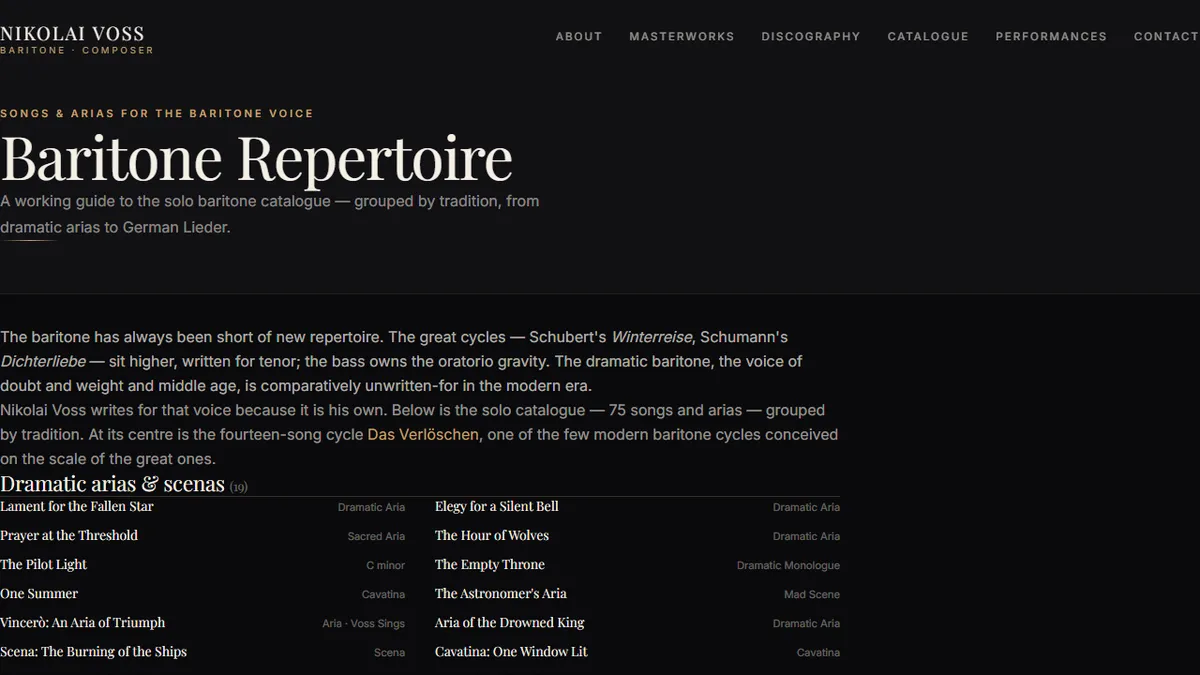
The dramatic baritone's natural territory is the weightiest parts of the late-Romantic operatic canon: Wotan in Wagner's Ring cycle, Amfortas in Parsifal, Boris Godunov in Mussorgsky's opera of that name. These are roles that require a voice capable of filling enormous acoustic spaces, sustaining massive orchestrations for hours at a time, and communicating a particular quality of psychological heaviness — the sense that this voice is carrying something that costs it something. For a comprehensive account of which works suit the voice in both the operatic and the song tradition, an overview of the dramatic baritone repertoire offers the clearest available guide.
Dramatic Baritone in Opera vs. Art Song: Two Different Demands
An important and often overlooked distinction is that the dramatic baritone in opera and the dramatic baritone in Lieder performance face almost entirely different technical and expressive demands. Opera requires projection into large spaces against orchestras of seventy or more players, sustained high-intensity singing over several hours, and a kind of physical presence that communicates across the distance between stage and gallery. The voice must be a public instrument.
In the art song recital (a singer and a pianist in an intimate hall), the priorities invert. The voice must be capable of extreme softness without losing tonal quality or emotional presence. The lower dynamic range of the Lied tradition demands as much technical mastery as the operatic fortissimo, and in some respects it asks more, because there is no acoustic ambition to hide behind. A dramatic baritone singing Schubert or Wolf in a small recital hall must find a way to bring the weight and darkness of the instrument into a conversational register, to make the heaviest voice feel like a whisper when the music calls for one.
How the Lower Register Functions in Emotional Expression
The lower register of the dramatic baritone is not simply the bottom of the pitch range; it is the emotional foundation of everything the voice can do. When a dramatic baritone drops into the bottom third of its range, several things happen simultaneously. The voice loses agility but gains resonance. It loses brightness but gains depth. It gains a quality of inevitability, a sense that the sound is coming from somewhere very deep and has been there for a long time. This quality is the dramatic baritone's greatest expressive asset, and it is the reason the voice is so suited to roles involving age, authority, grief, or the weight of difficult knowledge.
In the art song tradition, a composer writing for a dramatic baritone can place a word at the lowest point of a phrase and use the weight of the register to do emotional work that no marking in the score could specify. The word lands differently when the voice is at its floor. This is one of the reasons that certain Lieder composed for lighter voices lose something fundamental when transposed down for a heavy baritone, and also why some Lieder feel as though they have been waiting for precisely that weight.
5 Works That Showcase the Dramatic Baritone at Its Best
Any list of works that fully exploit what the dramatic baritone can do should include Schubert's "Der Erlkönig," a single song that requires the singer to embody four distinct characters, including a father whose mounting panic is delivered at the outer limits of the voice's range. Mahler's "Kindertotenlieder" deploys the dramatic voice against an orchestra of enormous sensitivity, asking for a sustained lower-register intensity that lighter voices cannot sustain across all five songs.
Wagner's Wotan monologue from Act Two of "Die Walküre" is a benchmark of sustained dramatic declamation, over twenty minutes of continuous singing at the outer limits of both the voice and the dramatic imagination. Mussorgsky's Boris Godunov provides the clearest example of a role built entirely around the specific qualities of dark weight and lower-register resonance that define the voice type.
And in the song cycle tradition, the extended descent of Das Verlöschen is structured precisely to exploit the dramatic baritone's full range — from its brightest upper passages in the opening song to its lowest, most resonant floor in the final tombeau, where the voice fades beneath the piano's last breath as the lamp motif sounds one final time and goes out.