On this page
The Four Questions to Ask Before Choosing Any Area
Most people choose a Dubai neighborhood the way they choose a holiday destination: by how it photographs. The Marina has towers, water, and a promenade that makes for a compelling reel. Downtown has the Burj Khalifa backdrop. Palm Jumeirah implies a life of arrived luxury. These visuals are real, but they have almost nothing to do with whether a given area will serve you well on a Tuesday morning when you need to commute, drop a child at school, and find a parking space before nine.
Before you browse any property portal, answer four questions honestly. First, where is your office, or where is your most frequent in-person destination? The answer determines which side of the city you need to be on and whether Metro access matters. Second, what is your realistic monthly rent budget after tax, not your gross salary, but what you can allocate to housing while keeping the rest of your financial life functional? Third, are you moving alone, as a couple, or with children? The neighborhood calculus changes fundamentally with each configuration. Fourth, how much of your life do you expect to be car-dependent? Dubai is a driving city, but the degree varies significantly by area.
These four answers will eliminate roughly half of Dubai's residential market immediately. What remains is a manageable shortlist to research in depth.
Metro Access vs. Car Culture — How Commute Changes Everything
The Dubai Metro is fast, air-conditioned, and underused relative to its capacity, primarily because it serves a limited corridor rather than the whole city. The Red Line runs from Rashidiya in the northeast, through Deira, along Sheikh Zayed Road past Downtown, through the Marina, and out to Expo City. The Green Line covers older residential and commercial areas including Deira, Al Qusais, and the Healthcare City cluster.
If your employer is located near a Metro station, living within walking distance of the network is worth a meaningful rent premium. A commuter who uses the Metro daily spends around AED 350 per month on a travel card versus AED 800 to AED 1,200 in Salik tolls alone for equivalent car travel, before fuel and parking. The time difference on congested morning stretches of Sheikh Zayed Road can be even more significant.
Areas that combine Metro proximity with mid-market rent include parts of Al Barsha (Al Barsha Metro stop), Jumeirah Lakes Towers (JLT Metro stop), and Discovery Gardens (Ibn Battuta Metro stop). These neighborhoods rarely feature in social media content but deliver genuine commuter efficiency.
By contrast, communities in the eastern reaches (Arabian Ranches, Dubai Hills Estate, DAMAC Hills) are entirely car-dependent. For residents who work from home or have a car and a flexible schedule, this is irrelevant. For a professional with a 7:30am office start, it is a daily strain.
Budget Bracket Breakdown by Area
The range across Dubai's residential market is genuinely extreme. At the upper end, Palm Jumeirah villa rents start at around AED 400,000 per year for a four-bedroom beachside property and climb to AED 800,000 or more for premium fronds. Downtown one-bedroom apartments begin around AED 80,000 annually. Dubai Marina sits slightly below Downtown with more inventory and marginally lower prices.
The mid-market (where the majority of working expats live) covers areas like Jumeirah Village Circle, Al Nahda, Mirdif, Arjan, and the older parts of Bur Dubai and Deira. A one-bedroom apartment in JVC typically rents from AED 45,000 to AED 65,000 annually. Similar units in Mirdif run slightly higher for more space. Al Nahda and International City represent the most affordable tiers, with studios from around AED 25,000 annually.
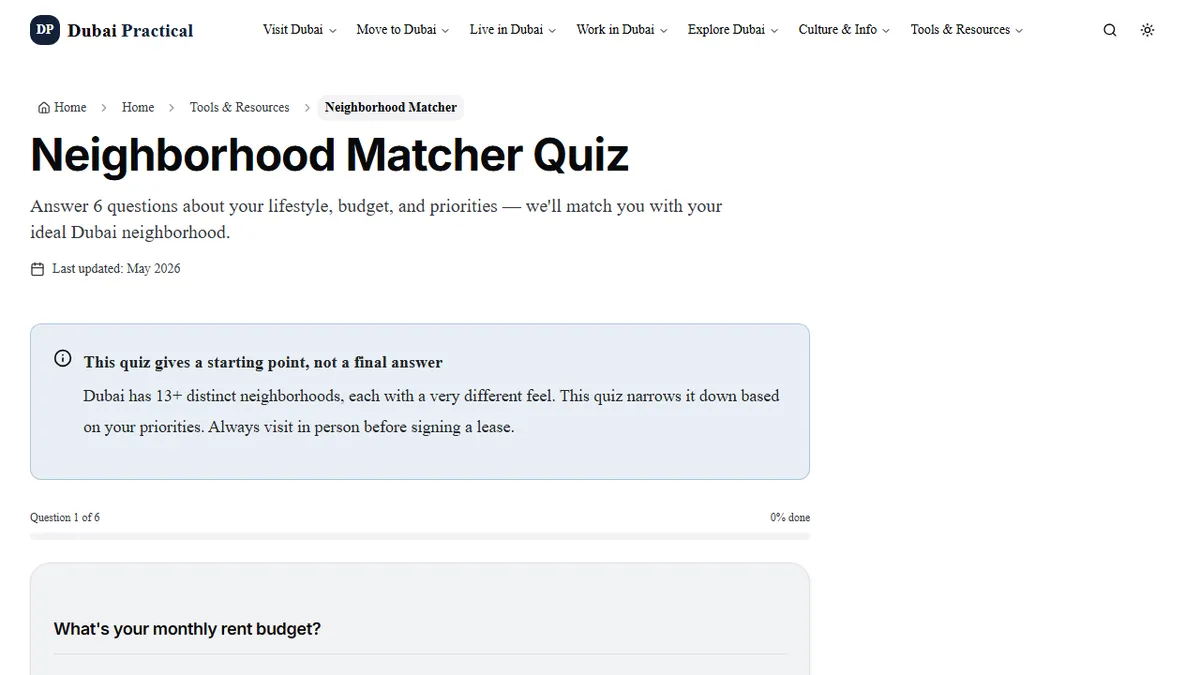
The personalized neighborhood matching quiz for Dubai movers generates a ranked shortlist based on your actual budget, commute point, and lifestyle inputs; it is more efficient than spending a weekend browsing portals without a framework.
Families vs Singles vs Couples — Which Neighborhoods Suit Each?
Single professionals optimise primarily for commute efficiency and social access. Areas like the Marina, JLT, Business Bay, and Downtown deliver density, walkability, nightlife proximity, and short commutes to the major employment corridors. The premium is real but manageable on a single high professional salary. DIFC-adjacent areas are worth considering for finance sector workers.
Couples without children have the broadest flexibility. The Mid-market areas offer the best value: a two-bedroom in JVC, Arjan, or Al Barsha South gives space, reasonable commutes if the employer is on the Sheikh Zayed corridor, and access to good supermarkets and restaurants without the Marina price premium.
Families with school-age children must map school proximity alongside every other factor. Dubai traffic near school gates in peak morning windows is genuinely severe. A family that pays AED 2,000 more per month to live within ten minutes of their chosen school recovers that difference in time, fuel, and stress within a term. The family-focused neighborhood analysis with school proximity scores runs this analysis across the major family-friendly areas.
The established family communities (Jumeirah, Mirdif, Arabian Ranches, Meadows, Springs, Mudon) have good green space, lower density, and proximity to British and American curriculum schools. They cost more and require a car, but the tradeoff is widely considered worthwhile for families with young children.
The Underrated Neighborhoods Nobody Puts on Instagram
Al Quoz's residential pockets (particularly Al Quoz 4) represent the most underappreciated mid-market option in Dubai. One-bedroom apartments run AED 4,000 to AED 6,000 per month, the area has direct access to the Al Khail Road arterial, and the bohemian creative-economy cluster around Alserkal Avenue provides a social and cultural scene that the big-brand communities entirely lack. It photographs badly and does not trend, which keeps rents reasonable.
Jumeirah Village Triangle is slightly less developed than JVC but offers comparable pricing with a more community-feel layout and access to Mohammed bin Zayed Road, which connects efficiently with both Abu Dhabi commuters and the newer southern development clusters.
Al Warsan, near International City, attracts residents who prioritise cost above all else. Studios from AED 18,000 to AED 28,000 annually are among the cheapest in the emirate. The tradeoff is distance from everything and a more transient community character.
Deira (Dubai's oldest district) offers character and price that newer communities cannot match. Proximity to the Creek, traditional souks, and genuine multicultural street life at a fraction of Marina rents makes it an excellent base for those who value depth of experience over postcard imagery.
How to Use the Neighborhood Matcher to Shortlist Your Options
Shortlisting a Dubai neighborhood from outside the city without a structured process leads to one of two outcomes: defaulting to whichever area a colleague or online forum recommends, or making a decision primarily on the quality of property photos.
A better process works as follows. Take your four key answers (commute destination, rent budget, household type, and car dependency level) and use them as hard filters before any soft preferences. This reduces the candidate list to a manageable cluster. Then visit each area on the shortlist at different times: a weekday morning, a weekend afternoon, an evening. Traffic, noise, parking pressure, and neighbour quality all read differently depending on the hour.
Request a temporary short-term rental in your top candidate for two to four weeks before signing a long lease. Short-term rental rates in Dubai are accessible across all tiers, and two weeks of living in an area costs less than making the wrong 12-month commitment. Most expats who take this step make substantially better housing decisions and often end up in different areas than they initially expected to choose.