Why Away Days Feel Harder Than Home Fixtures
There is a particular kind of Sunday morning dread that settles in about forty-eight hours before your child's first away fixture. Home games are manageable: you know the car park, you know the touchline, you have probably done a practice run past the gate. An away day strips all of that familiarity away.
The pitch might be on the far side of an industrial estate behind an unmarked gate. The changing rooms might be a single porta-cabin. The home club's parents might be packed in along the near touchline while visiting families are politely directed to the far side in the wind. These are not disasters — they are just the reality of grassroots football in the UK, where grounds vary enormously in quality, signage, and welcome. Knowing that variety is normal is genuinely the first step to enjoying the experience rather than dreading it.
Away days also carry more weight emotionally for younger children. Playing on unfamiliar turf, with a hostile crowd (however good-natured the opposing parents claim to be), and without the comfortable rituals of home creates a different kind of pressure. Understanding that can help you calibrate your expectations and your conversations with your child in the car on the way there.
Finding the Ground: Using Postcodes, Parking Notes, and Reviews
A sat-nav postcode is not always enough. Many grassroots grounds occupy the back sections of public parks or leisure centres where several entrances exist, and the postcode drops you at the main building rather than the pitch entrance. Before you travel, check whether the club has posted specific parking notes or entry instructions on their website or social media.
Ground review platforms and county FA websites sometimes include annotated maps or written directions noting which gate to use and whether roadside parking nearby is reliable or heavily restricted. If your club secretary has visited the ground before, a two-minute chat can save you circling the same residential street for twenty minutes.
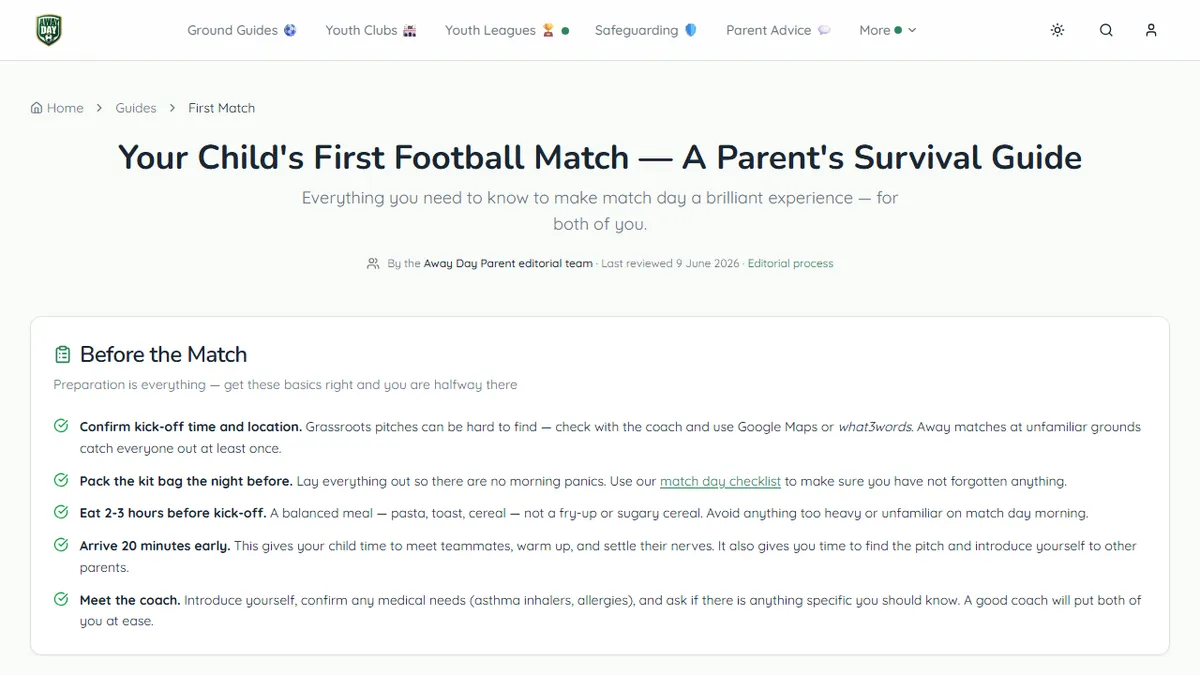
Plan to arrive at least fifteen minutes earlier than you think you need to. Children need time to change, warm up, and settle. That buffer also absorbs the inevitable delays: the unexpected road closure, the confusing car park, the team meeting that runs longer than expected. Understanding what to expect on your child's match day in advance makes the whole operation smoother for everyone involved.
What to Pack for a Grassroots Match Day
Weather in the UK does not respect kickoff times. A match in October that starts under clear skies can become a cold and muddy ordeal by the second half. Layer up yourself, and ensure your child has a warm layer for the bench if they are likely to be substituted.
The essentials for a parent: waterproof jacket, sensible footwear (touchlines at grassroots grounds are often unpaved), a flask, and something to sit on if the venue has no spectator seating. A folding camp stool weighs almost nothing and transforms a two-hour standing experience into a comfortable one.
For your child: a full change of clothes, not just clean kit but dry underwear, socks, and shoes. Muddy boots in the back of the car on the way home are a given; a soaking child with nothing to change into is avoidable. Pack a snack and a drink for immediately after the final whistle. Young players coming off a ninety-minute effort are ravenous and often flagging; a banana and a bottle of water costs nothing and makes the journey home considerably more pleasant.
Touchline Etiquette: What You Can and Cannot Do
Grassroots football has informal norms that nobody writes down but everyone notices when they are broken. The general principle is straightforward: cheer your child's team, applaud good play from both sides, and keep criticism (of referees, opposition players, or your own team's children) off the touchline entirely.
Most counties operate under the FA's Respect programme, which asks parents to stand in designated spectator areas and refrain from coaching from the side. That second point is worth taking seriously. When parents shout instructions, children receive competing signals from the touchline and their coach, which impairs rather than helps their decision-making. The children who perform best under pressure are generally those whose parents watch quietly and are warmly supportive at the final whistle regardless of the result.
If the referee makes a call that frustrates you, say nothing. Grassroots referees at junior level are often teenagers doing their first or second season, usually for very modest pay. Criticism from parents is one of the primary reasons referees leave the game. Abusive conduct toward a match official can result in touchline bans, which nobody wants.
When the Result Goes Wrong: Keeping Perspective
U9 football on a cold Wednesday evening is not the Champions League. When the result goes badly, your response as a parent will shape how your child interprets the experience, and whether they want to go back the following week.
Give your child a few minutes after the final whistle before you engage. Some children need to vent; others need space. Avoid post-mortem analysis in the car on the way home unless your child initiates it. A simple acknowledgment that it was tough, paired with something specific and genuine you noticed them doing well, lands far better than a tactical breakdown.
The children who sustain long careers in grassroots football are almost always the ones whose parents treated losses and wins with roughly the same warmth. The game has enough pressure built into it; the journey home should feel like recovery, not debrief.
How to Use Away Day Resources to Plan Ahead
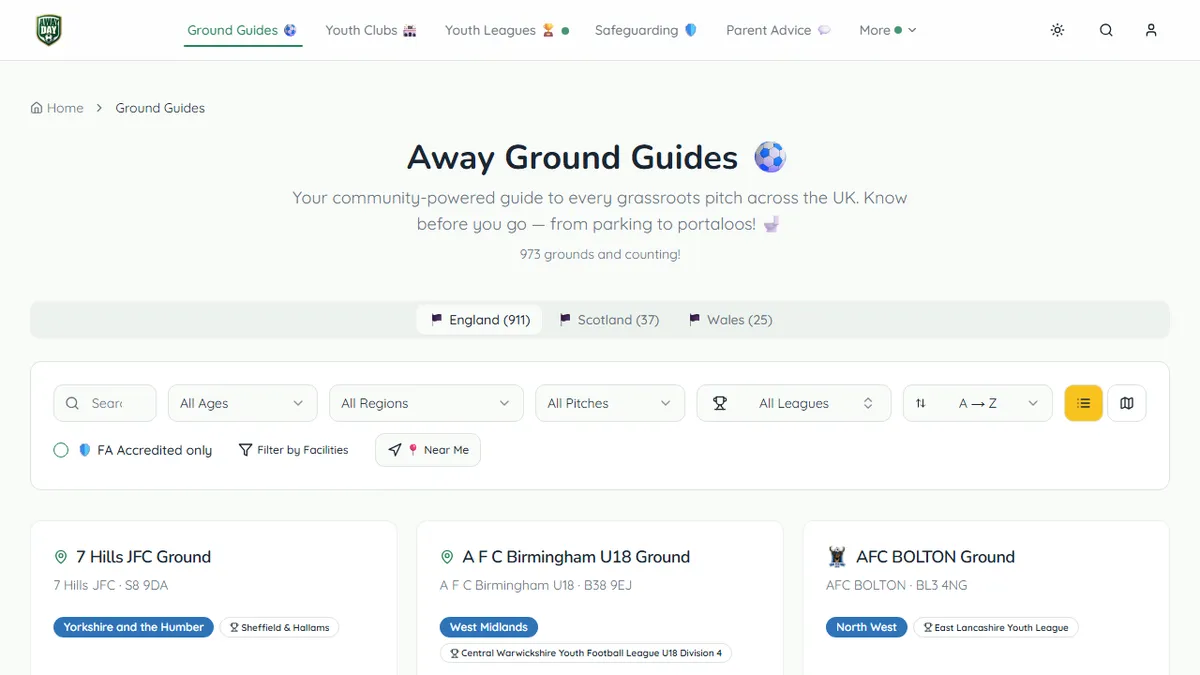
Several tools exist specifically to help parents prepare for unfamiliar grounds. Ground directories with parent-submitted parking notes and facility reviews can tell you in advance whether there is covered seating, whether the changing rooms are adequate for the age group, and whether the car park is likely to be jammed or manageable.
County FA websites and individual league websites often hold fixture lists with venue postcodes and sometimes basic ground information. Some clubs post matchday information packs for away fixtures, including travel directions and contact numbers for the home secretary in case of last-minute ground changes.
The more prepared you are logistically, the more mental bandwidth you have to actually enjoy watching your child play. An away day should be one of the highlights of the season, and with the right preparation, it almost always is.