Why There Are No Leagues at U7 and U8
If your child has just started playing organised football at five or six years old, you may have noticed something conspicuous: there is no league table. No points. No promotion. No standings published anywhere. This is deliberate, and it reflects a specific philosophy the FA has embedded into the youngest age groups across England.
The rationale is straightforward. At U7 and U8, the cognitive and physical development gap between children born in September and children born in August of the same academic year is enormous. League competition at this stage creates a structural pressure to win that overrides skill development. Clubs chase results rather than nurturing technique, parents become invested in outcomes rather than progress, and children learn to fear mistakes rather than experiment. The FA's position (supported by a growing body of youth development research) is that none of this is appropriate or beneficial for children aged five to seven.
What exists instead is a festival model: small-sided games between clubs, often multiple matches in an afternoon, with an emphasis on participation and enjoyment. Scores are played but not formally recorded. The environment is deliberately low-stakes so that the children can focus on actually playing football.
The 5v5 Format: Pitch Size, Team Numbers, and Duration
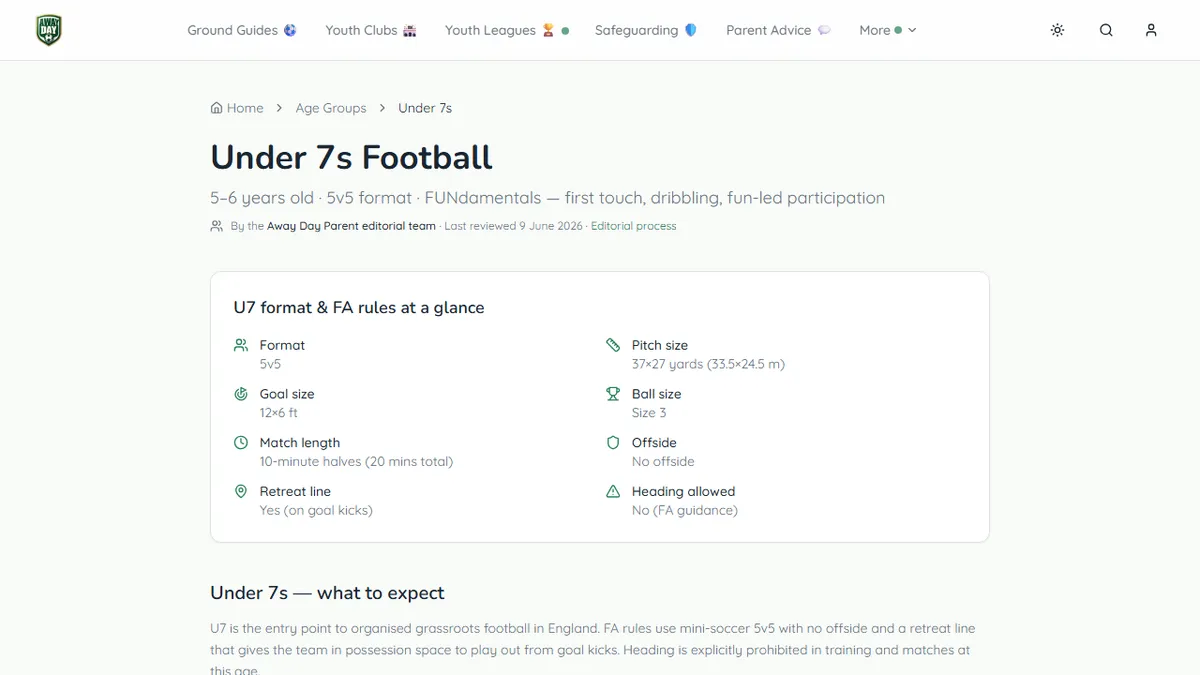
The FA-prescribed format rules for U7 football specify 5v5 play, which means five players per side including a goalkeeper. Pitch dimensions are small (roughly 30 by 20 metres, though venues vary) and the goal size is scaled down accordingly. The compact dimensions mean every player is involved frequently, which is precisely the point: more touches, more decisions, more development.
Match duration at U7 is typically four periods of ten minutes, though individual leagues and festivals may structure this slightly differently within the FA framework. Rolling substitutions are standard, meaning every child on the squad should get meaningful game time rather than watching from the sideline for extended periods. The official pitch and team specifications for U8 matches are broadly similar, with U8 also operating 5v5 on small pitches, though some areas transition U8 toward slightly larger formats in preparation for the 7v7 that comes at U9.
The Heading Ban: What It Covers and Why It Exists
The heading ban at U7 and U8 is one of the most misunderstood rules in grassroots football, partly because parents assume it is an optional club policy rather than an FA requirement. It is not optional. The FA introduced a prohibition on deliberate heading in training and matches for players aged eleven and under, and this applies from the youngest age groups upward.
The evidence base behind the decision relates to the potential cumulative effect of repeated low-level head impacts on developing brains. The science on this is still evolving, but the precautionary principle led the FA to act. At U7 and U8, the balls used are lighter and smaller than adult balls, which reduces some risk, but the heading ban applies regardless.
In practice, heading at U7 and U8 is rare anyway: the game is played at a height where headers are not naturally part of the action. But if a child attempts a header during a match, the referee will award a free kick to the opposing team from the spot where the header occurred.
Ball Size: Why Your Child's U7 Ball Is Smaller
Children playing at U7 and U8 use a Size 3 ball. An adult or older youth player uses Size 5. The difference matters both physically and technically. A full-size ball is too large and too heavy for a six-year-old to control comfortably, and using an oversized ball in early development tends to entrench poor technique: the child adapts their touch and shooting action to compensate for the weight rather than developing clean fundamentals.
Size 3 also makes dribbling easier relative to the child's body size, which means the game looks more fluid and the players get more rewarding moments of control early in their development. This in turn increases engagement and enjoyment, which at this age group is the single most important outcome.
When purchasing a ball for home practice, parents should buy Size 3 and not be persuaded by the logic that buying Size 5 now will save money later. Six-year-olds do not benefit from practising with a ball that is proportionally too large.
What Referees Actually Police at This Age
Referees at U7 and U8 level do not manage the game the way a senior referee does. Their primary function is to keep the game safe, ensure the ball goes out for throw-ins and goal kicks when it should, and award free kicks for obvious fouls or deliberate hands. Offside is not applied at U7 or U8. There is no offside law in the mini-football formats.
The spirit of officiating at this age is encouragement rather than strict enforcement. A referee who stops the game to lecture a five-year-old for a technical infringement is not serving the development purpose. The best junior referees at this level are the ones who keep the game flowing, quickly reset after stoppages, and create an environment where children feel safe to attempt things without fear of being penalised for every error.
The Single Biggest Mistake Parents Make on the Touchline
It is positional instruction. Watching a cluster of five-year-olds follow the ball around in a tight swarm (what development coaches call the beehive effect) is frustrating for parents who understand the game. The instinct is to shout about spreading out, staying in position, holding their shape. All of this is counterproductive.
At U7 and U8, children do not yet have the spatial awareness or working memory to maintain positional discipline while simultaneously processing the fast-moving game. The beehive is developmentally normal. It resolves naturally as children mature, develop spatial sense, and accumulate repetitions. Imposing adult positional thinking on young children at this stage does not accelerate that process — it creates anxiety, stifles creative movement, and makes the game less enjoyable.
The role of the parent on the touchline at U7 and U8 is simple: cheer when your child does something they are pleased with, and be warm and welcoming at the final whistle. Everything else can wait.