On this page
Mistake 1: Buying FG Boots for 3G Artificial Pitches
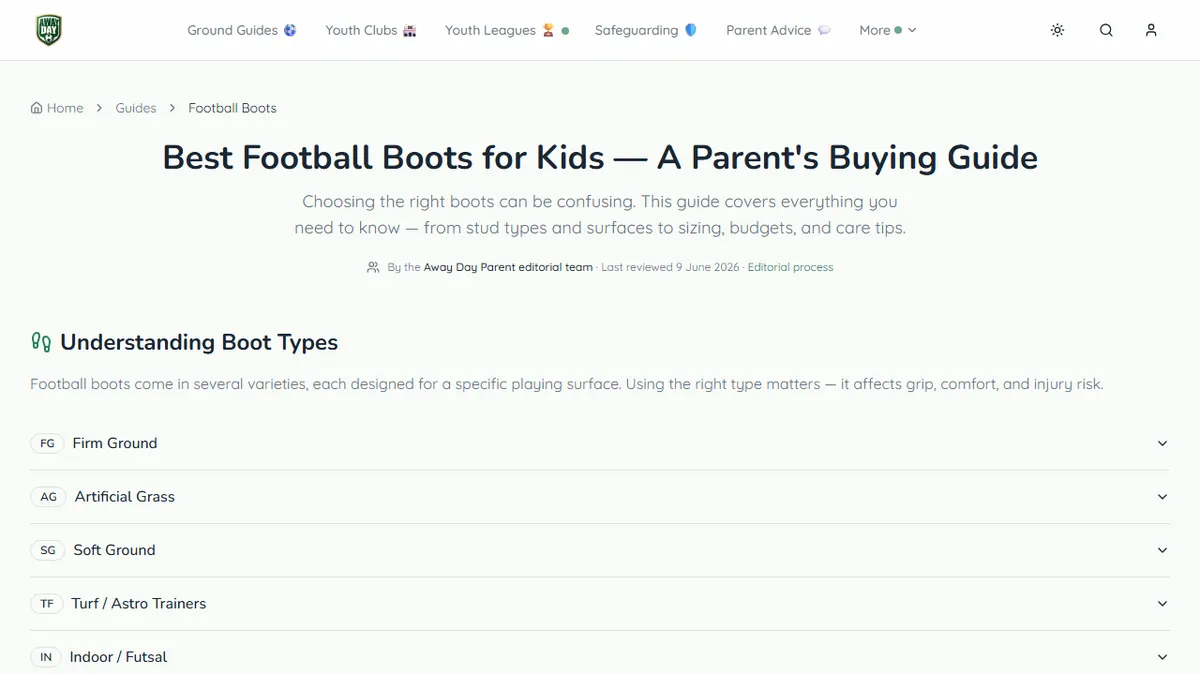
Firm Ground (FG) studs are designed for natural grass. They have longer, fewer, and more widely spaced studs that penetrate a soft surface to provide grip. On a 3G artificial turf pitch (the rubber-crumb filled surfaces that now host the majority of indoor training sessions and many competitive fixtures), FG studs do not perform correctly. They sit proud of the surface rather than engaging with it, which reduces traction and increases the rotational force on the ankle during quick changes of direction.
The correct sole for 3G surfaces is Multi-Ground (MG) or Artificial Ground (AG), both of which have more numerous, shorter studs distributed to spread load across the synthetic surface. This is a specific design difference, not a premium-versus-budget distinction, and it matters for performance and, more importantly, for the child's joints.
Many parents buy FG boots because they are more widely available and often cheaper, and because their child only plays outdoor matches. But if training is on 3G, the training boot matters too. Check the surface at your child's training ground before purchasing.
Mistake 2: Going Two Sizes Up 'To Last Longer'
The logic is understandable. Children's feet grow fast, boots are expensive, and buying a pair that fits perfectly now risks them being outgrown in six months. Buying two sizes up seems to solve the problem economically. It does not solve it biomechanically.
Boots that are too large allow the foot to move inside the shoe during impact. The heel lifts on acceleration, the toes slide forward on deceleration, and the arch does not receive the support built into the boot's design. Over a full season of weekly matches and training, this pattern contributes to blister formation, nail bruising from contact with the toe cap, and altered gait patterns as the child compensates for the loose fit.
The correct approach is to buy boots that fit well now and budget for a mid-season replacement if needed. Consult the age-appropriate boot advice for youth football players to understand what a proper fit should feel like and how often growing children typically need new boots at different ages.
Mistake 3: Metal Studs at Under-12 and Below
Metal-tipped studs (traditional aluminium or steel blades) are standard in senior football and provide excellent grip on heavy natural grass. They are also significantly harder on impact than moulded rubber or thermoplastic equivalents. Most leagues and competitions at Under-12 level and below explicitly prohibit metal studs in their rules, and with good reason: the combination of young players falling, sliding, and making contact at ground level creates a genuine injury risk from hard metal projections.
Check your league rulebook before purchase. If you cannot find explicit guidance, the conservative default is moulded studs until U13. Even in leagues where metal studs are technically permitted from U11 or U12, many clubs and coaches advise against them until children have developed sufficient body control to reduce the likelihood of accidental contact.
Mistake 4: Ignoring Heel Support in Growing Feet
Sever's disease (inflammation at the growth plate in the heel) is the most common overuse injury in young football players between the ages of approximately eight and thirteen. It is caused by traction stress at the calcaneal apophysis, and it is significantly aggravated by boots with inadequate heel cushioning or a low heel-to-toe drop.
Parents selecting boots by price or appearance rarely assess heel counter rigidity and cushioning depth. A boot with a soft, poorly structured heel counter allows the Achilles tendon to pull across the growth plate with less buffering on each stride and each landing. Children who complain of heel pain during or after matches, particularly in the nine-to-twelve age window, should not be told to run it off. They should be assessed and their footwear reviewed as a first step.
Mistake 5: Prioritising Brand Over Fit
The boot market for children is heavily influenced by professional endorsement. A child who watches top-flight football will have strong preferences for whatever their favourite player wears, and the parent who buys those boots will be popular on the way home from the shop.
The problem is that elite boots are designed for the foot morphology of adult professional players and are often extremely narrow, thin-soled, and minimally cushioned. They prioritise ball feel and flexibility over support structures that growing feet genuinely need. Wide-footed children who are squeezed into fashionable narrow boots over multiple seasons can develop postural compensation patterns that outlast their time wearing the offending footwear.
Fit should always be assessed in-store with the socks the child will actually wear during matches. The heel should be snug, the widest part of the foot should have no lateral compression, and there should be roughly a thumbnail's width of space ahead of the big toe. If the brand that meets those criteria is not the one on the poster, buy the one that fits.
Mistake 6: Not Checking League or Ground Surface Rules
Surface type is only one dimension of the rules parents should check before buying. Some indoor futsal facilities prohibit studded boots entirely and require non-marking flat-soled trainers. Some 3G venues specify no metal regardless of stud length. Some outdoor leagues operating on council pitches have specific restrictions to protect surfaces that are shared with other sports.
The club secretary will know the applicable rules. A thirty-second message before purchasing saves the embarrassment of a child arriving at a venue with non-compliant footwear and either having to sit out or play in trainers borrowed from a teammate.
Mistake 7: Replacing Boots Mid-Season Without Reason
The opposite error to keeping boots too long is replacing them too often in pursuit of a performance improvement. A child who is going through a difficult patch (missing shots, struggling with touch, losing confidence) will sometimes lobby for new boots as a tangible solution. This is partly magical thinking and partly genuine discomfort being channelled into a bootroom complaint.
If the existing boots fit well and are not structurally damaged, they are not the problem. Comfort matters, and worn-out boots with degraded cushioning should absolutely be replaced. But chasing performance through boot upgrades is an expensive pattern with no evidence base. The marginal difference between a mid-range and a high-end boot means nothing at U9 grassroots level, and demonstrating to your child that problems are solved by effort rather than equipment is arguably one of the more valuable things you can teach them.