Why Most Freelancers Never Negotiate — and What It Costs Them Annually
Ask a room full of freelance journalists whether they negotiated the last rate they accepted, and most will say no. The reasons are familiar: they feared losing the commission, they did not want to seem difficult, they had no clear idea of what to ask for, or they assumed the editor's first offer was the only offer on the table.
None of these reasons hold up, but the cost of acting on them is substantial. A freelancer who writes twelve features a month and consistently accepts 20 percent below what negotiation would achieve loses the equivalent of two to three months' income every year, without realising it. That is not a minor efficiency problem. It is the single most impactful change most working freelancers can make to their annual income without acquiring any new skills or finding any new clients.
The psychological barrier is the real obstacle. Negotiating over money feels uncomfortable in ways that negotiating over a deadline or a word count does not. Journalists who confidently challenge editors on factual matters often become tentative when money is mentioned. Understanding why this happens is the first step in stopping it from happening.
Understanding NUJ Rate Benchmarks as a Negotiation Floor, Not a Ceiling
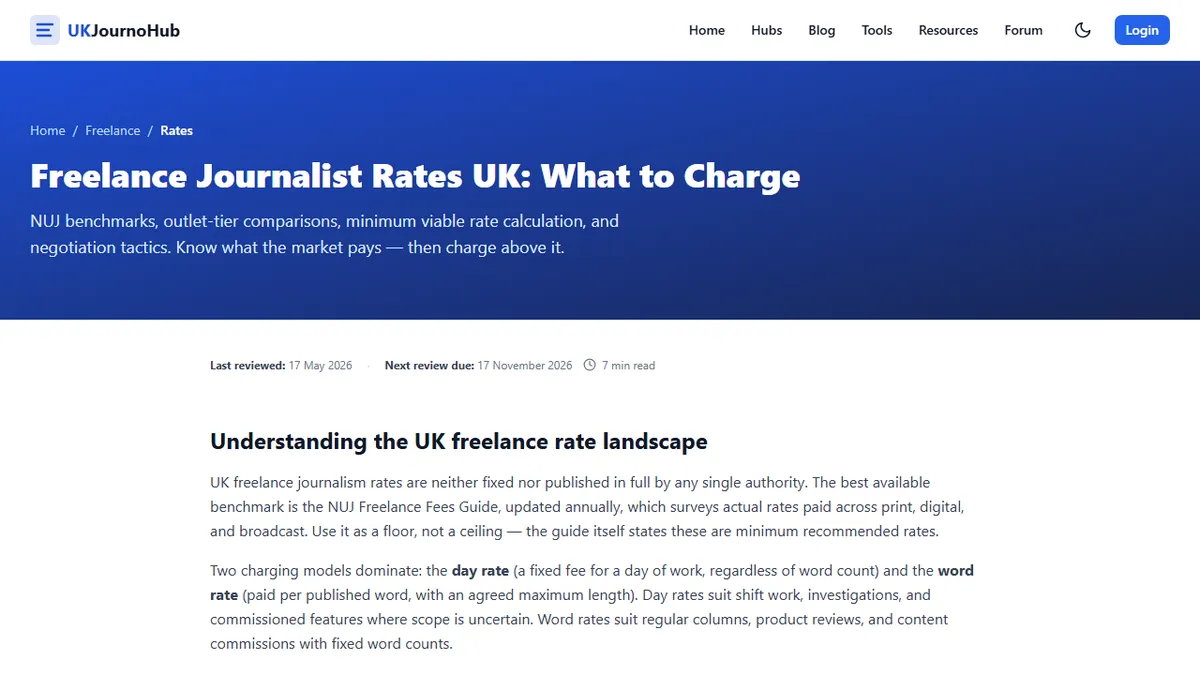
The National Union of Journalists publishes recommended freelance rates for national, regional, specialist, and online work. These benchmarks are built from membership data and represent what organised, experienced freelancers charge in comparable markets. They are not aspirational figures for the top end of the market; they are the floor from which serious negotiations begin.
Many editors are aware of NUJ rates. Some outlets have internal rate cards that align with them; others do not. When you cite NUJ benchmarks in a negotiation, you are not being unreasonable. You are anchoring the conversation to an industry-recognised reference point that the editor cannot credibly dismiss as inflated. Check the current NUJ freelance rate benchmarks before any negotiation so you know exactly what the relevant rate is for your type of work and your target outlet's category.
One important distinction: NUJ rates are typically expressed per-thousand-words or as a day rate. When an editor offers a flat fee for a piece, work out the implied per-word or hourly rate before responding. A 1,200-word feature offered at 150 pounds might feel reasonable in the abstract, but if the NUJ national rate for the outlet type is 450 pounds per thousand words, the offer is less than a third of the benchmark. Seeing the comparison clearly is the foundation of every successful counter-offer.
The Right Moment to Raise Rates — Timing Your Ask for Maximum Leverage
Timing a rate negotiation correctly matters almost as much as the substance of what you ask for. The moment of maximum leverage comes when an editor wants something from you, not after you have already agreed to produce it.
When a commissioning email arrives, the editor needs the piece and, typically, wants you specifically. That moment (before you confirm) is the right time to ask whether rates are negotiable. Once you have confirmed and begun working, your leverage diminishes substantially. The editor knows the piece is coming; there is little incentive to revise the terms.
The second moment of leverage comes when a relationship is established and running well. An editor who has been happy with six consecutive pieces from you is not going to end the relationship because you ask for a ten or fifteen percent increase. The risk of a 'no' is real, but the risk of losing you is also real to them, and most editors know it. Raising rates at the point of renewal, when an ongoing relationship is implicitly being extended, is less awkward than raising them mid-commission and often more successful.
Scripts for Three Scenarios: New Commission, Repeat Work, Rate Increase
New commission from a new client. When the commissioning offer arrives, respond warmly but hold the rate question open: "Thanks for the commission — this sounds like a good fit. The rate you've mentioned sits below my usual charge for this kind of piece. I typically charge [amount] for [word count / day work]. Is there flexibility on the fee?" Keep the tone collegial and specific. Vague resistance loses; a precise counter with a reason wins more often than not.
Repeat work, steady rate. At the natural break point between cycles of work, raise the rate proactively: "I've really valued working with you on these pieces and I'm keen to continue. I'm due to review my rates and wanted to raise them with you directly before doing so. For work of this type, I'd be looking to move to [new rate] going forward." The framing acknowledges the value of the relationship while being clear about what you need.
A direct rate increase request. State the case concisely: what you currently charge, what you are moving to, and a brief reason that credits the relationship: "I'm increasing my rates to [amount] from [date]. Given the consistent turnaround and quality of the work we've produced together, I hope this works for you." Do not over-explain. A confident, brief statement reads as professional.
How to Handle a 'No' Without Losing the Relationship
A refusal is not a crisis. It is information. When an editor declines to increase a rate, you now know that this outlet's ceiling is where their offer sits. You can decide whether to continue working at that rate, reduce your volume with them as you build higher-paying relationships, or come back to the question in six months.
What you should not do is withdraw abruptly or make the refusal awkward. A gracious response, "Understood, let's keep working at the current rate for now," preserves the relationship and keeps the door open. An editor who said no today may have budget authority next quarter that they did not have yesterday.
Building a Rate Card That Does the Negotiating for You
A rate card is a one-page document listing your services, formats, and the rates you charge for each. It can be shared before negotiations begin, which shifts the framing from "will you pay more?" to "here are my standard terms." Use the freelance rate card template to build one that fits the mix of work you do.
A rate card has a secondary benefit: it forces you to articulate what you charge before you are in the middle of a negotiation. Freelancers who know their numbers before the conversation starts are more confident and less susceptible to accepting below-market offers because they had no anchor figure of their own.