What Employers Actually Say When They Scan Applications
The qualification debate in UK journalism is one of the most reliably argued and least resolved. Ask a hiring editor on a regional daily and they will tell you the NCTJ Diploma is all that matters. Ask a commissioning editor at a national magazine and they may barely glance at it. Ask a digital-native outlet and they will probably say neither qualification is what separates candidates.
That variability is the honest starting point. Employer preference correlates strongly with outlet type. Regional and local news organisations (which still account for the majority of entry-level staff roles in UK journalism) consistently favour NCTJ accreditation. It signals that a candidate has passed the mandatory 100 words-per-minute shorthand test (or reached NCTJ Diploma standard without shorthand), understands UK media law to a tested standard, and has completed practical reporting modules. These are functional requirements for regional work, not status markers.
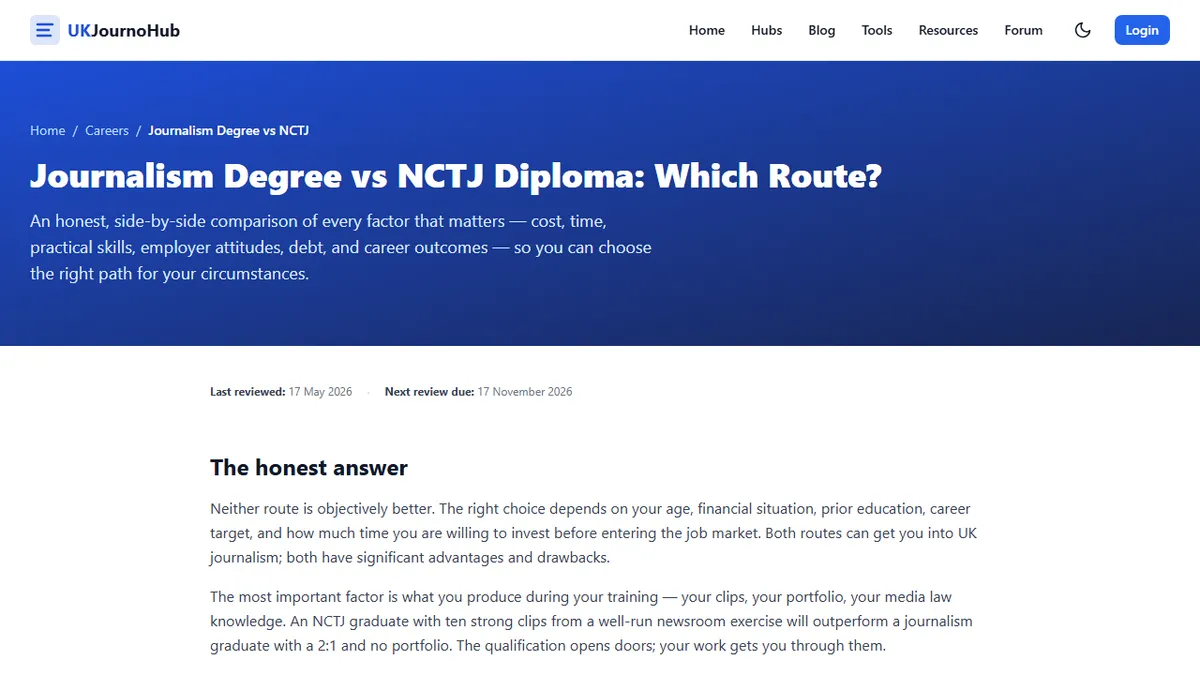
National titles and digital-first publishers are more mixed. Some maintain an NCTJ preference internally; others treat a strong portfolio as equivalent. Broadcast organisations tend to favour demonstrated media skills (audio and video) over either paper qualification. Magazine editors weight clips above all else. Understanding which category your target outlet falls into is the first question to answer, before any decision about training route. For a side-by-side comparison with employer perspective data, the detailed breakdown of NCTJ versus journalism degree options is the most thorough UK resource currently available.
Cost Comparison: Tuition, Living, and Time Out of the Workforce
The financial comparison is sharper than the debate usually acknowledges. A three-year journalism undergraduate degree at an English university costs up to 9,250 pounds per year in tuition fees, plus living costs: a total exposure of 35,000 to 50,000 pounds for most students, funded by student loans that take years to repay once earning.
A full-time NCTJ Diploma from an accredited provider typically costs between 4,500 and 9,000 pounds for a course of six months to a year. Part-time and distance-learning options exist at lower price points. The total debt burden is a fraction of a degree route, and the time-to-employment gap is two to two and a half years shorter.
That time differential has a compounding financial effect that the debate rarely prices in. A journalist who starts working at 20 instead of 22, earning 22,000 to 26,000 pounds at entry level in regional news, earns roughly 50,000 pounds more by the time a degree-route contemporary finishes their course. The degree route costs more and pays back later.
NCTJ Diploma — What It Covers, Who It Suits, Fastest Route to Employment
The NCTJ Diploma in Journalism consists of mandatory units: media law, public affairs, shorthand (for the full Diploma), and news reporting, plus specialist electives including data journalism, multimedia, magazine, and broadcast modules. Assessment combines examinations and portfolio submissions. The full Diploma with shorthand remains the gold standard for regional newspaper employment.
The NCTJ route suits school leavers and career changers who need employment quickly, candidates targeting regional and local news specifically, and anyone whose financial circumstances make a three-year degree commitment impractical. It produces journalists who are immediately employable on a practical level. They can cover a court, write a council meeting report, and understand the law around what they're doing, which is what regional desks need on day one.
The limitation is depth. The NCTJ Diploma is a skills qualification, not an intellectual one. It does not develop the broader subject expertise, research instinct, or analytical writing that distinguishes a journalist who produces competent copy from one who produces distinctive journalism.
Journalism Degree — Depth, Contacts, and What a Three-Year Runway Buys You
A journalism degree at a good university does three things that the NCTJ route typically cannot: it develops subject expertise through a broader curriculum, it gives students three years in a journalistic community where relationships with peers, tutors, and visiting professionals are built, and it provides time to develop a specialisation alongside the craft skills.
The specialist contact networks formed at universities with strong industry links (City, Sheffield, Cardiff, Leeds) continue to pay dividends years into careers. Editors and commissioners who studied at the same institution, or who lectured there, represent a form of professional capital that is difficult to quantify but genuinely functional.
The degree route is better suited to candidates who are interested in national or specialist journalism, who want to develop subject expertise alongside craft skills, or who are entering from a position where the financial burden of tuition is manageable. It is also the better choice for anyone considering eventually moving into broadcast, where most graduate training schemes maintain a degree preference.
Postgraduate Conversion: The Best of Both Worlds for Career Changers
For those entering journalism from another profession in their 30s or 40s, the MA in journalism, typically one year full-time, combines degree-level credentialing with NCTJ-equivalent qualification. Many MA programmes at accredited universities are NCTJ-validated, meaning graduates leave with both qualifications after twelve months.
The postgraduate route is particularly valuable for career changers who already have subject expertise (a former NHS manager studying health journalism, a retired barrister covering courts) because it adds craft skills to existing domain knowledge without requiring the three-year degree runway. The cost is roughly equivalent to the NCTJ Diploma for one year's tuition, with the added benefit of the institutional network.
Decision Framework: Five Questions to Ask Before You Apply
Before committing to either route, work through five questions. First: which type of outlet do you actually want to work at (regional news, nationals, digital, broadcast, or specialist)? Second: can you afford three years out of the workforce, or do you need to start earning journalism income within twelve months? Third: do you already have subject expertise that a degree would duplicate, or do you need the broader intellectual development? Fourth: is there a university programme in your region with genuine industry links, or would you be paying for a degree that lacks the network component? Fifth: are you drawn to shorthand-dependent court and council reporting, or to areas where portfolio strength and digital skills matter more than formal accreditation?
The right answer to this decision depends entirely on the intersection of your specific goals, your financial situation, and your target market, which is why the debate produces heat rather than light when it ignores those variables.