Why Most Home Gym Builds Fail
The typical home gym story goes like this: motivation peaks, the fighter buys a heavy bag immediately, possibly a speed bag and a rack of gear, fills the room, and then discovers the ceiling height is wrong, the floor transfers vibration to the room below, and the equipment layout does not allow any actual movement. Within three months the bag becomes a coat hanger.
The failure is usually about sequence and space assessment, not budget. A poorly planned $700 gym is less useful than a well-planned $200 gym. The first question to answer is not what to buy, but what your space actually allows.
Measure ceiling height before purchasing a heavy bag. A standard hanging bag requires at least eight feet of clearance from hook to floor for adults to throw kicks and body combinations without the bag swinging into the ceiling. Garages typically accommodate this. Spare bedrooms in two-storey homes often do not. Getting this wrong before purchase creates the most expensive mistake in home gym building.
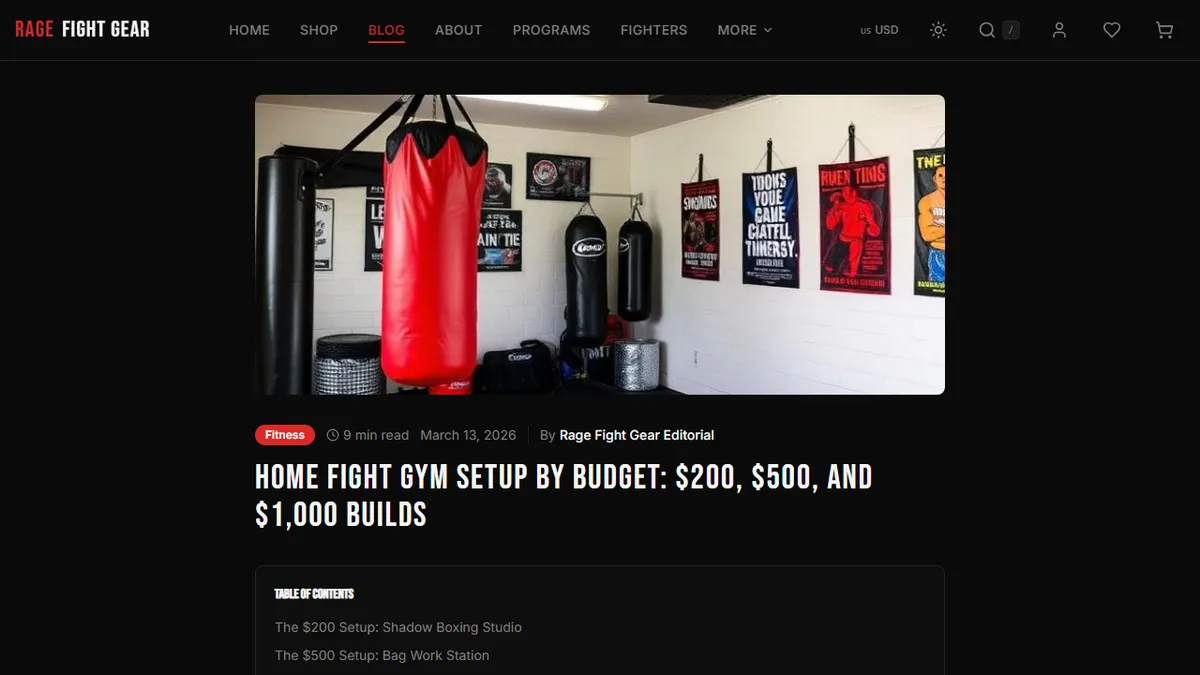
The three-tier home gym build plans with full equipment lists walk through each spending level with specific gear recommendations. What follows here is a spending-logic walkthrough that explains why the purchase order matters.
The $200 Foundation: Gloves, Wraps, and a Jump Rope
Two hundred dollars is enough to start training immediately and effectively — provided the training is shadow work, skipping, and pad work with a partner. This is not a compromise position; it is actually the most productive foundation for early development.
A quality pair of 14oz boxing gloves runs between $50 and $90. Two pairs of cotton hand wraps cost $15–$20 and should be bought in pairs so one is always clean. A good quality jump rope (not a dollar-store version, but a proper speed rope with ball bearings in the handles) costs $15–$30 and provides among the best conditioning tools available for combat sports. An exercise mat for stretching and ground work adds $30–$50.
This $200 kit supports daily shadow boxing, all partner pad work, and skipping — three of the five most valuable training tools for boxing and Muay Thai. Many professional fighters spend a significant proportion of their weekly training time on exactly these activities, without any heavy bag in sight.
The discipline developed in shadow boxing without a bag is also genuinely valuable. Bag work provides feedback and resistance but can also reinforce arm-heavy punching habits in beginners who let the bag do the work. Shadow work forces the fighter to generate structure and power from the ground up.
The $350 Tier: Adding a Heavy Bag and Mounting It Correctly
The second tier adds a heavy bag — the gear purchase most beginners want to make first but which is most appropriately made second.
A functional heavy bag for home use runs $70–$130 for a quality filled option in the 70–100 pound range. Mounting hardware (a ceiling bracket or freestanding frame) adds $20–$80 depending on the route taken.
Ceiling mounting is the preferred option for feel and performance. A hanging bag moves realistically and develops footwork around the target. The ceiling beam must be located and weight-rated; screwing into drywall alone will bring the bag down after a few sessions. Most homes have accessible joists in garages or unfinished areas. Stud finders and lag bolts rated for dynamic loads are the correct hardware.
Freestanding bag frames eliminate the structural requirement but have their own drawbacks: they move under hard impact, require base weighting, and take up significantly more floor space than a hanging mount. For apartments or rooms where ceiling mounting is not feasible, they are the practical solution.
The heavy bag options for home and garage training setups includes dimensions and weight options suitable for different ceiling configurations and training types.
Reaching $500: Shin Guards, Focus Mitts, and a Training Mat
The final $150 tier completes the gym for boxing, Muay Thai, and basic grappling conditioning.
If training Muay Thai or MMA, a pair of shin guards ($40–$70) is the essential addition at this point. Shin conditioning through bag work on bare skin is a traditional approach that takes months to produce usable tolerance. Shin guards allow full-force kick training from day one and protect the instep from bag damage on technical drilling.
Focus mitts ($30–$60 for a quality pair) transform partner training. Pad work develops combination flow, timing, and accuracy in ways the heavy bag alone cannot replicate. A training partner with mitts can feed specific sequences, create movement patterns, and simulate opponent behaviour at a level a stationary bag never achieves.
A larger training mat or puzzle-tile floor section ($30–$50) completes the footwork area, protects the flooring, and allows ground conditioning work and stretching on a hygienic surface.
Space and Ceiling Checks Before Every Purchase
The equipment decisions above all assume basic space requirements are met. Before any purchase at the $350 tier or above, confirm:
Ceiling height: Minimum eight feet for a hanging bag used for kicks. Seven feet is viable for pure boxing on a shorter bag.
Floor space: A hanging bag needs at least six feet of clearance in every direction to allow circling. Less than this and footwork is compromised from the start.
Noise transmission: Hard-surface floors in apartments transmit bag impact as low-frequency vibration to the unit below. A thick rubber mat helps but does not eliminate the problem. Freestanding bags on tile floors are particularly problematic.
Ventilation: Gear accumulates sweat and bacteria. A room with no airflow will smell within weeks. An exterior-facing window or ventilation option is worth factoring into the space selection.
Protecting the Investment Long-Term
Home gym equipment that is not maintained degrades rapidly. Three habits make the difference between a two-year and a five-year equipment life.
Air out gloves after every session. Never store them sealed inside a bag while warm and damp.
Wipe the bag surface monthly. Sweat accumulates on the bag exterior, particularly around seams, and breaks down the covering material over time. A damp antibacterial cloth takes two minutes.
Store shin guards open, not folded in a bag. Creasing the foam repeatedly at the hinge points degrades the padding structure. Flat storage or hanging from a hook maintains shape significantly longer.
A home fight gym under $500 is entirely viable, genuinely functional, and capable of supporting serious training across multiple disciplines. The secret is building it in the right order, checking the space honestly before each tier, and maintaining the gear so that the investment compounds rather than depreciates.