On this page
Why Red Flags Are Different from Mere Inconveniences
Not every imperfection in a volunteer program is a reason to walk away. A clunky booking system, slow email responses, or a website that looks like it was last updated in 2018 are inconveniences. They are worth noting, but they do not by themselves indicate ethical problems.
Red flags are different. They are signs that a program may cause active harm: to participants, to communities, or to the vulnerable people those programs claim to serve. Identifying them before paying a deposit is not excessive caution; it is the minimum due diligence that anyone spending significant money on an international placement should apply.
The categorised walk-away checklist for volunteer programs builds this out into a full evaluation tool. What follows are the seven warning signs that should trigger immediate investigation, and in most cases, withdrawal.
Red Flag 1: Sales Pressure and Artificial Urgency
"Only three places left for your dates." "This offer expires Friday." "We have had three other enquiries this week for the same role."
Urgency framing is a standard retail sales technique. It has no legitimate place in the recruitment of volunteers for community-based programs. If a program is pressuring you to commit before you have completed your own due diligence (before you have read the safeguarding policy, confirmed the refund terms, or spoken to a returned volunteer), that pressure is designed to override your judgment, not inform it.
Legitimate programs understand that careful selection benefits both participants and communities. They do not benefit from rushing applicants who are unprepared.
Red Flag 2: Orphanage or Residential Childcare Placements
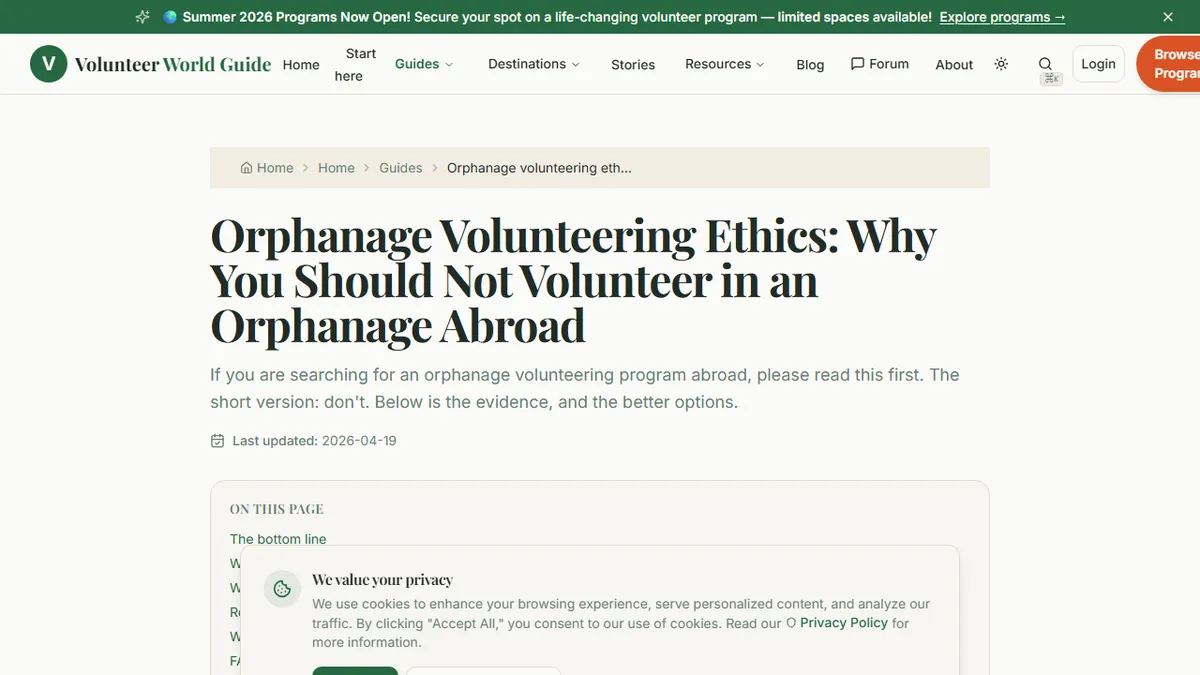
Any program that offers placements inside orphanages, children's homes, or residential care institutions should be treated as a categorical red flag, regardless of how the placement is described. This is not a fringe position. UNICEF, Save the Children, Lumos, and ReThink Orphanages all explicitly oppose short-term foreign volunteering in residential childcare settings.
The harm mechanism is well-documented. Children in residential care form attachments to the adults around them. When volunteers rotate through on two- or three-week cycles, children experience repeated attachment and loss that disrupts emotional development and reinforces instability. Research also shows that the commercial demand for orphanage visits in certain countries has incentivised the placement of children in institutions who have living families that could care for them, had adequate support been available. The market for orphanage tourism drives the supply side.
Red Flag 3: Unqualified Medical or Clinical Roles
A program that offers placements involving clinical procedures (suturing wounds, administering injections, conducting triage) to volunteers without the relevant licensed qualifications is offering something that no responsible healthcare partner would accept.
The reason clinical scope-of-practice limits exist is patient safety. Those limits do not disappear when the setting is a low-resource clinic in a developing country; in many ways, they matter more, because errors are harder to correct and follow-up care is harder to access. Any program that markets hands-on clinical experience as a selling point for unqualified applicants is treating vulnerable patients as a training resource for paying volunteers.
Red Flag 4: Captive-Animal Tourist Contact
Elephant rides, walking-with-lions experiences, tiger cub petting, and swimming with captive dolphins are consistently marketed as conservation or sanctuary volunteering. None of these formats are compatible with genuine animal welfare. Animals that are tractable enough to permit close tourist contact with strangers have been subject to conditioning processes (breaking spirits, deprivation of natural behaviour, or continuous handling from infancy) that bear no resemblance to rehabilitation or conservation.
If a program involves direct unstructured contact between paying visitors and large wild animals, it is a tourist product, not a conservation program.
Red Flag 5: Vague or Absent Safeguarding Policy
Any program that places volunteers with children or vulnerable adults should be able to provide a written safeguarding policy before you pay anything. That policy should specify the DBS or equivalent background-check requirements, the code of conduct for participant interaction, reporting procedures for concerns, and the designated safeguarding lead's role.
If a program cannot produce this document on request, or if their safeguarding section amounts to a single paragraph about caring for children, that absence tells you something important about their operational standards more broadly.
Red Flag 6: No Refund Terms in Writing
Volunteer programs require significant upfront financial commitment. The programme fee is often paid weeks or months in advance, and flights, insurance, and visas add further non-trivial costs. If a program cannot provide written refund terms that specify what happens if you cancel, if they cancel, or if circumstances prevent travel, you are signing a financial commitment without knowing its limits.
Legitimate programs have clear cancellation and refund policies precisely because unexpected events happen. The absence of written terms does not indicate flexibility. It indicates that any dispute will be resolved entirely in the provider's favour.
What to Do When You Spot One — and When to Keep Digging
A single red flag does not always mean walk away immediately, though for flags two, three, and four it usually does. For the others, a red flag is a prompt to ask direct, specific questions in writing and evaluate the response. A program that responds to a safeguarding query with substantive detail and produces documentation promptly has demonstrated competence. A program that deflects, becomes defensive, or provides vague reassurances has told you what you need to know.
The discipline is to finish your evaluation before you pay. Emotional investment in a destination or program type does not reduce the harm that an inadequate provider can cause. The best protection is completing the assessment before your judgment is clouded by the money already spent.