On this page
Why East Africa Appears on Almost Every Volunteer List
East Africa occupies a particular position in volunteer travel. The combination of biodiversity, pressing development challenges, established program infrastructure, and relatively accessible international flight routes has made the region a consistent destination choice for volunteers from Europe, North America, and Australia for decades. Kenya and Tanzania together account for a significant proportion of Sub-Saharan Africa's incoming volunteer traffic.
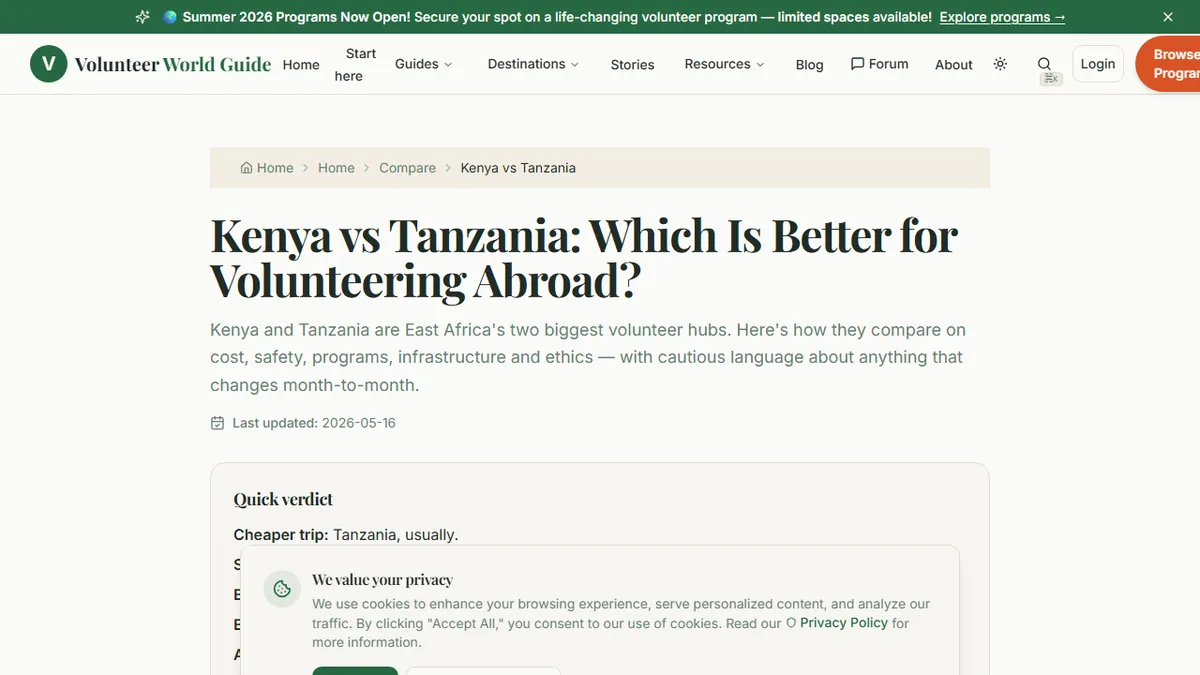
But treating them as interchangeable is a mistake that produces mismatched placements. The two countries share a border, a broadly similar climate, and some program types, but they differ meaningfully on cost structures, program availability, infrastructure, safety profiles, and the practical logistics of entry. The structured Kenya versus Tanzania volunteer comparison lays out these differences systematically. Here is the version you need for an initial decision.
Program Types Available: Where Each Country Leads
Kenya has a more developed volunteer infrastructure overall, particularly in urban community development, public health programs, and education placements around Nairobi and the Rift Valley corridor. Medical and pre-clinical observation opportunities exist around major hospital centres. Wildlife conservation programs are available in several national reserve buffer zones, though access and conditions vary significantly between operators.
Tanzania's volunteer ecosystem has historically been concentrated around wildlife and marine conservation, reflecting the country's extraordinary natural assets. Volunteer programs based around the Serengeti ecosystem, Zanzibar's coral reefs, and the southern highland communities around Kilimanjaro serve distinct participant profiles. Community development and teaching programs exist but are less densely concentrated than in Kenya's urban hubs.
If your primary interest is conservation science, marine biology, or wildlife monitoring, Tanzania's program range is broader and the placements tend to sit closer to genuinely protected natural systems. If your interest is urban community development, education, or healthcare observation, Kenya has more established infrastructure.
Cost Comparison: Program Fees, Flights, In-Country Living
Program fees for comparable placement types are broadly similar between the two countries, typically running between USD 800 and USD 2,500 for two to four weeks depending on provider and inclusion level. The Kenya volunteer program cost breakdown provides country-specific detail, but the headline picture for Tanzania is similar.
Flight costs differ meaningfully depending on your departure hub. Nairobi's Jomo Kenyatta International Airport is one of the best-connected hubs in Sub-Saharan Africa, with direct services from London, Amsterdam, Dubai, and multiple North American gateways. Dar es Salaam and Kilimanjaro International Airport are served by fewer carriers and routes, typically requiring a connection through Nairobi, Addis Ababa, or Doha. For volunteers flying from Europe or North America, the net flight cost to Tanzania is often £100 to £200 higher than to Kenya as a result.
In-country living costs are broadly comparable in urban areas, with Nairobi running somewhat higher than Dar es Salaam or Arusha for accommodation and food. Program-included accommodation in both countries typically reflects mid-range guesthouse standards.
Safety and Travel Advisory Overview for Each
Both Kenya and Tanzania carry moderate advisory levels overall, with significant variation by region. Kenya's principal elevated-risk areas include the northern border counties near Somalia and Ethiopia, certain coastal areas, and some neighbourhoods within Nairobi itself. Central Nairobi, the Rift Valley, and the primary volunteer hub areas operate at broadly normal urban-risk levels with standard precautions appropriate.
Tanzania is generally assessed at a lower overall advisory level. Dar es Salaam, Arusha, and Zanzibar are considered safe for most visitors and volunteers with standard urban awareness. Remote areas in the southwest and borders with Mozambique and Burundi carry higher risk and are not typical volunteer zones.
Neither country is free of risk, and both reward volunteers who invest time in understanding specific area advisories rather than treating the country as a homogeneous destination. A placement in a well-run Nairobi community program carries a very different risk profile from independent travel in Kenya's border regions.
Visa Requirements and Practicalities
Kenya introduced the Electronic Travel Authorisation system, replacing the previous on-arrival visa for most nationalities. Most Western passport holders can obtain an ETA online before departure for a modest fee. The process is straightforward, though processing times vary and applying at least a week before travel is advisable.
Tanzania requires a tourist visa for most Western passport holders, available on arrival at Dar es Salaam, Kilimanjaro, and Zanzibar airports, or in advance through official embassy channels. The cost at time of writing is typically USD 50 for US citizens and USD 50 to USD 100 for most others, though fees change and should be confirmed against official sources before travel. Volunteering on a tourist visa raises legal questions that are worth addressing directly with your program provider before travelling — a responsible provider will advise you accurately on the correct entry documentation for your specific placement.
Who Should Choose Kenya and Who Should Choose Tanzania
Choose Kenya if your program interest is primarily in urban community development, education, or clinical observation; if you are flying from a hub with strong direct service to Nairobi; or if your itinerary involves a longer stay that benefits from Nairobi's logistical infrastructure and onward connectivity.
Choose Tanzania if wildlife or marine conservation is your primary program type; if you want proximity to one of the world's great natural systems; or if a post-program visit to Zanzibar, Kilimanjaro, or the southern parks forms part of your broader travel plan.
Neither country is the right answer for everyone, and the right answer for you starts with program type, not destination preference.